New Cuba Ag Exports Act Opens Trade Options

John Davis

crawford1A new piece of legislation will open up trade possibilities for U.S. agricultural exports to Cuba. H.R. 3687, the Cuba Agricultural Exports Act, was introduced by House Agriculture Committee Chairman, Mike Conaway, along with Representatives Rick Crawford (R-AR) and Ted Poe (R-TX). It repeals financing restrictions, allowing U.S. banks to offer credit in Cuba in connection with exports of U.S. agricultural goods; eliminates restrictions on key federal funding used in agricultural export promotions for Cuba; and enables investment in Cuban agribusinesses not affiliated with the Cuban government. According to this news release from USA Rice, the measure could be of most benefit to American rice farmers.

This action follows closely on the heels of a trip to Cuba by Arkansas Governor Asa Hutchinson and a group of nearly 40 Arkansans including representatives of Riceland Foods. Governor Hutchinson returned to Arkansas motivated to ask for changes, saying, “Congress needs to equalize the field of operations for our businesses by allowing them to negotiate cash, credit, whatever they feel comfortable with and the level of risk they wish to take. Right now, we can’t even negotiate a credit sale, and that’s not customary in the market.”

“I’m excited to see my Congressman [Representative Crawford] introduce a bill that would positively affect so many parts of the U.S. rice industry,” said Arkansas rice farmer and USA Rice Chairman, Dow Brantley. “Our Congressional District alone grows nearly half of the U.S.’s rice – so we would certainly stand to benefit from open trade with the Cubans – as would rice producers throughout the mid-South.”

Brantley continued, “USA Rice has been working to remove the trade barriers for a long time, and after 55 years that the trade embargo has been in place, it’s time for things to change. It’s my hope that the rest of Congress will join the sponsors in supporting this legislation, which has the potential to seriously strengthen the agricultural economy.”

Keith Gray, a Texas-based rice miller with Riviana Foods, said, “We have been looking for opportunities to sell rice to Cuba for some time and it’s always been held up because of the financing issue. This bill would be a game-changer and I think it’s the best option put forward so far to open up the Cuban market for our rice.”

USA Rice endorsed the legislation and continues to seek congressional support for all legislation that works towards normalized trade relations with Cuba.

Ag Groups, Rice

Zimfo Bytes

Talia Goes

Zimfo Bytes

  • The “Upper Midwest Organic Agriculture Tour” planned at the Synergy in Science ASA, CSSA, SSSA International Annual Meeting in Minneapolis, MN, on Nov. 14th will highlight the Twin Cities’ organic food system.
  • Swanson Russell announces the promotion of Megan Bollish and Jeremie Memming in its Lincoln office.
  • broadhead has made eleven across the board hires and promoted seven current agency staffers, bringing the total of new hires this year to nearly 30.
  • Swanson Russell announces the promotion of Katie Sands and Tony Sattler to vice president in its Lincoln office.
Zimfo Bytes

USDA Gives $3 Mil in Critical Ag Production Research Grants

John Davis

usda-logoThe U.S. Department of Agriculture (USDA) is giving $3 million in grants to address critical issues affecting agriculturally-important plants and animals. This news release from the agency’s National Institute of Food and Agriculture (NIFA) says the science developed from these grants will provide timely assistance and have an immediate impact for the agriculture community. The awards were made under the Agriculture and Food Research Initiative’s (AFRI) Critical Agricultural Research and Extension (CARE) program.

“It is essential to promote partnerships between researchers, extension experts, and producers to ensure the success of American agriculture,” said Sonny Ramaswamy, NIFA director. “The CARE program is centered on the swift identification of problems, creation of solutions, and prevention of interruptions or issues that impact farmers’ ability to provide a safe and abundant food supply for our nation.”

Fiscal year 2014 is the first year NIFA has made awards under the CARE program. Examples of what these grants will focus on include a project from the University of Georgia that is researching disease management practices for blueberries, particularly addressing the currently unknown life cycle time of the damaging Exobasidium leaf and fruit spot disease. An Extension project from Montana State University will be working directly with cattle producers to adopt sagebrush grazing techniques for their cattle that create a sustainable environment for the greater sage-grouse.

The AFRI Foundational Program addresses six priority areas to continue building a foundation of knowledge in fundamental and applied food and agricultural sciences critical for solving current and future societal challenges.

The list of schools and grant amounts is available here.

Research, University, USDA

Fly-In Tells Congress of Need for National Food Labeling

Jamie Johansen

safe affordable foodThe Coalition for Safe Affordable Food, organized a fly-in bringing representatives of our country’s agriculture and food sectors to Capitol Hill urging passage by Congress of a uniform, national labeling standard for foods made with genetically modified organisms (GMOs).

Vermont is set to implement its own labeling standard next July and other states passing or considering their own labeling mandates, participants in the fly-in expressed the urgency to get a federal bill passed this fall in order to stave off the negative effects of a patchwork of differing state labeling laws.

A uniform, national food labeling standard will ensure that consumers in all 50 states have access to the same labeling information, bringing consistency and transparency to the marketplace. Additionally, a GMO-free certification program will provide consumers who choose to purchase non-GMO items a reliable means of doing so.

The group came from 22 states who represent the entirety of the nation’s food supply chain: farming groups, co-ops, seed producers and food companies. In total, the group had more than 140 meetings on Capitol Hill Wednesday.

Participants in the fly-in expressed the urgent need for action by the Senate soon on the critical issue.

“Soybeans are a two-billion-dollar industry in Missouri and different state GMO labeling mandates would hurt hardworking farmers across that state,” said the executive director of the Missouri Soybean Association, Gary Wheeler. “As I explained to members of the U.S. Senate on Wednesday, inconsistent state labels would wreak havoc on Missouri farms. We need Congress to pass a reasonable solution that provides transparency and consistency for farmers and consumers.”

The U.S. House of Representatives passed the Safe and Accurate Food Labeling Act in July by a significant 275-150 bipartisan vote, with 45 Democrats voting yes. That legislation would ensure that consumers have access to the same science-based information regardless of which state they shop in instead of different state mandates. It would also create a national GMO-free certification program that would provide consumers who prefer GMO-free foods a consistent means of identifying those products.

Ag Groups, Food, GMO

Seeking Common Ground

Chuck Zimmerman

ZimmCast 488Kim Bremmer has spent her lifetime working in agriculture and lending her voice to share the special message about the food we eat with consumers across the country. One way is through CommonGround, a group of farmers having conversations about the food we grow and how we produce it. Jamie spoke with Kim during the 2015 World Dairy Expo to learn more about how CommonGround teaches how to eat fearlessly.

CommonGround shares personal experiences, as well as science and research, to help consumers sort through the myths and misinformation surrounding food and farming. The information tool was developed by farmers through the United Soybean Board (USB) and the National Corn Growers Association (NCGA).

common ground“CommonGround is all women in agriculture volunteering at consumer events, talking about farming and the food we raise. We are not at agriculture events. We are at things like women’s expos, dietitians conferences or farm to table dinners. Any time we can help facilitate the conversation between consumers and farmers is really where CommonGround fits in.”

Kim said we have more bus drivers in our country than farmers. Farmers are out numbered 99-1 and most people are four generations removed from the family farm.

Through CommonGround you can learn more about farm ownership, GMO’s, animal welfare, food safety, antibiotics, hormones, organic & local foods, the price of food and sustainability. Kim encourages us all to ask questions and get engaged.

Kim has also ventured out on her own to continue sharing the real story of american agriculture through Ag Inspirations.

Listen to this week’s program here: Common Ground

Subscribe to the ZimmCast podcast here.

View and download photos from the event here: 2015 World Dairy Expo Photo Album

Coverage of World Dairy Expo is sponsored by
Coverage of World Dairy Expo is sponsored by New Holland
ZimmCast

Qualls Named Executive Director of ResponsibleAg

Kelly Marshall

QuallsBill Qualls has been selected by the Board of Directors as the new Executive Director of ResponsibleAg. His new responsibilities include recruiting for retailer and auditor, monitoring the quality assurance program as well as advising the board.

Most recently Qualls has been the Lead Auditor for Global Environmental, Health and Safety at the Eastman Chemical Company. He also serves as president of the Board of Directors of the Auditing Roundtable and on the Board of Governors of the Institute of Internal Auditors. His background includes a bachelors in chemistry and biology from Lyon College, a masters in environmental engineering from Oklahoma State University, and he is a Certified Professional Environmental Auditor. Qualls grew up on a small family farm in Arkansas.

“We are thrilled to welcome someone with Bill’s experience and skills as Executive Director,” said J. Billy Pirkle, Chairman of the Board of Directors. “His leadership and results-driven focus will help build on existing support and generate stakeholder recognition of ResponsibleAg.”

Qualls also expressed his excitement to be joining the team at ResponsibleAg.

“My goal is to encourage involvement in this worthwhile effort,” he said. “And to better equip fertilizer retailers with the tools to continuously improve their environmental, health and safety efforts so they are widely recognized as a model of compliance and trusted neighbors.”

Agribusiness, Fertilizer

Will There Be a New Heavyweight Pumpkin Champ?

Kelly Marshall

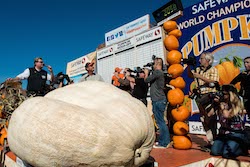
2014WinnerJohnHawkley-2-300dpiContestants have gathered for the 42nd Annual Safeway World Championship Pumpkin Weigh-Off in the world pumpkin capital of Half Moon Bay, CA.  The search for a heavyweight champ to break the world record kicks-off the Art & Pumpkin Festival October 17-18.  The prize for such a pumpkin is $30,000.

To receive the $30,000 world record prize, the grower must break and hold the world record at the conclusion of the Half Moon Bay weigh-off. If two or more growers happen to break the world record at Half Moon Bay, the prize money would go to the grower of the heaviest pumpkin. The current world record pumpkin is 2,323-pounds grown by Swiss grower Beni Meier and set at at weigh-off in Germany in 2014.

Pictured here is last year’s superstar, John Hawkley and his 2,058 pound champion.  This gourd set a new North American record at the 2014 Safeway World Champion Pumpkin Weigh-Off and Hawkley is expected to return to defend his title.

California’s drought is expected to play a role in the competition, since water plays a big role in growing these giants.

Events

Appeals Court Suspends WOTUS Implementation

Cindy Zimmerman

gavelA new ruling issued today by a federal appeals court places a nationwide stay on the Environmental Protection Agency’s Clean Water Rule, better known as Waters of the U.S. (WOTUS).

The court agreed with petitioners that the treatment in the rule of tributaries, “adjacent waters,” and waters having a “significant nexus” to navigable waters is at odds with a previous Supreme Court ruling and that “it is far from clear that the new Rule’s distance limitations are harmonious with the instruction.”

In addition, the ruling called EPA’s rulemaking process “facially suspect” because it did not include any proposed distance limitations in its use of terms like “adjacent waters” and significant nexus.”

Agricultural organizations are supporting the ruling. “The American Farm Bureau Federation is pleased the Sixth Circuit recognizes that this rule has serious flaws and cannot go forward until the courts have had an opportunity to understand its effect on farmers, ranchers and landowners of all kinds,” said AFBF president Bob Stallman in a statement. “The judges expressed deep concerns over the basic legality of this rule. We’re not in the least surprised: This is the worst EPA order we have seen since the agency was established more than 40 years ago. The court clearly understood our arguments.”

Senate Agriculture Committee Chairman Pat Roberts (R-KS), a long-time critic of WOTUS, also applauded the court ruling. “Due to the widespread confusion and frustration with the new regulations and pending litigation, this ruling should send a clear signal to the EPA that the rule should be scrapped altogether,” Roberts said. “The process was flawed from the beginning and I commend the court for this finding in particular: ‘Moreover, the rulemaking process by which the distance limitations were adopted is facially suspect.’”

A three judge panel for the U.S. Court of Appeals for the Sixth Judicial Circuit voted 2-1 to stay implementation over concern that burden to state and federal government, as well as private parties and the public in general, from the implementation of the WOTUS rule outweighed any harm to the agencies in keeping the status quo.

AFBF, EPA

Borlaug 101 Focus on Global Food Security

Joanna Schroeder

borlaug-101To celebrate the 101st anniversary of the birth Dr. Norman Borlaug, the 2015 Borlaug Dialogue has gathered an outstanding “faculty” of international leaders, experts and scientists for Borlaug 101 a 3-day “course” on The Fundamentals of Global Food Security. The Borlaug Dialogue is being held October 14-16 as part of the World Food Prize events next week at the Des Moines Marriott Downtown Hotel.

Referred to as the “premier conference in the world on global agriculture”, the 2015 Borlaug Dialogue will include the perspective of government leaders and policymakers, farmers and agribusiness executives, and scientific, academic and development experts from around the world. Kicking off the Dialogue this year is Chelsea Clinton, Vice Chair of the Clinton Foundation.

Another big event is the release of the Global Harvest Initiative’s (GHI) 2015 Global Agricultural Productivity Report (GAP Report): Building Sustainable Breadbaskets. The launch event will include a panel of global food experts from industry, agriculture and government. This year’s report provides a focus on how the right policies, investments and partnerships can improve lives and build more sustainable and inclusive breadbaskets. One such way is precision agriculture and innovative technologies and practices that can help conserve resources and mitigate agriculture’s climate impact.

Each year, the GAP report is updated to highlight the process made toward sustainably doubling agricultural output through 2050. The 2015 report also analyzes productivity and water and soil conservation opportunities throughout the world.

We will be bringing you coverage of the Borlaug Dialogues thanks to our generous supporter John Deere.

Food, World Food Prize

First Chairwoman of CropLife America

Chuck Zimmerman

CropLife AmericaAt the recent annual meeting of Croplife America some newly elected board leaders were announced. One of those is the first ever chairwoman, Diane Allemang, director of North America business development and global portfolio at FMC Corporation. Diane was elected to a two-year term and is the 46th chair of the board.

I spoke to Diane this morning to get to know her and learn about the priorities for the organization. As you might suspect environmental regulations are at the top list with concerns about EPA not only for existing products but ones in development.

Listen to my interview with Diane here: Diane Allemang - FMC

Other officers elected include the following. Susanne Wasson, commercial leader – U.S. crop protection of Dow AgroSciences, LLC, was elected to serve as the board’s treasurer and vice chair. Dave Tretter, vice president of procurement at Crop Production Services, Inc, will continue to serve as vice chair and will be joined by James Blome, president and CEO of Bayer CropScience. Vern Hawkins, president and North America regional director of Syngenta Crop Protection, will serve as immediate past chairman. Eric Wintemute, CEO of American Vanguard, will also continue as a board officer, elected in the capacity of vice chair emeritus.

Ag Groups, Audio, Crop Protection, FMC