RFS Uncertainty Hurting Farm Income

Joanna Schroeder

The uncertainties around the Renewable Fuel Standard (RFS) are threatening farm income and hurting the economic stability of rural economies. A new white paper from the National Farmers Union (NFU) and the National Corn Growers Association (NCGA), using recent USDA data on net cash income for American farmers and ranchers, states that income is expected to decline by 26 percent in 2015 from peak 2013 levels. This, the paper argues, is proof that the Environmental Protection Agency’s (EPA) current RFS proposal is negatively impacting the farm economy.

ncga-smaller “That devastating forecast is worse than originally projected, and it represents the lowest farm income levels in nearly a decade, and it could get worse,” says the paper.

During a press conference to launch the paper, NCGA President Chip Bowling of Maryland said, “There are factors other than the RFS. (But) it has changed the basis, the price received for our corn, it has changed the way we’re buying equipment … most of that is due to the uncertainty in the Renewable Fuel Standard.”

nfu_logo2EPA is expected to release the final rule at the end of November and NFU president Roger Johnson says they have heard nothing to indicate they will change that time line. “They agreed to that in the court order,” said Johnson. “It’s hard to say what to expect from them.”

Johnson stressed that the so-called blend wall should not be included in any determination for volume requirements under the RFS. “When the RFS was put in place it was never intended that it would stop at ten percent,” he said. “It was always the intent that it would go way beyond ten percent.”

Bowling says corn growers have responded to the demand for more corn to produce ethanol and another record crop is expected this year. “We’re still expecting yields of 162 bushels per acre at minimum,” said Bowling. “We have carry over that’s growing and without a strong Renewable Fuel Standard demand for corn is going to decrease.”

Listen to the announcement from NCGA and NFU here: Press call on RFS/farm income white paper

Agribusiness, Audio, Biofuels, Corn, Ethanol, NCGA

Is TPP good for US agriculture?

Jamie Johansen

New Holland ZimmPollOur latest ZimmPoll asked the question, “Where or how do you hunt?”

I won’t lie. I was a bit surprised we had so many non-hunters out there. I personally don’t hunt, but have many friends and family that do. I don’t hunt simply because I don’t think I could actually sit still and quiet long enough to not scare away my target. But those that do hunt seem to focus their efforts on their own property. You may not know this, but Chuck is an avid hunter. If you have time to kill just ask him about Crystal Pig Hunt Club.

Here are the poll results:

  • Own property – 33%
  • Private property – 14%
  • Public property – 0%
  • Organized hunt – 0%
  • Don’t hunt – 53%

Our new ZimmPoll is now live and asks the question, Is TPP good for US agriculture?

Trade talks in Atlanta are a wrap, but we will continue to talk about the Trans-Pacific Partnership (TPP) and it’s impact on agriculture. And it seems like everyone has something to say about the agreement. What do you have to say? Is it good for all of agriculture, parts or bad news for everyone?

ZimmPoll

John Deere and DN2K to Further Develop Software

Kelly Marshall

john_deere_logo_3623Deere & Company and DN2K are working together to form SageInsights, a joint venture to further develop DN2K’s existing cloud software.  The goal is to enhance the software, called MyAgCentral, to provide consulting services to growers.      and others who provide consulting services to growers.

“Through this initiative, John Deere expands its products and services for precision agriculture,” said John May, President, Agricultural Solutions and Chief Information Officer at Deere. “DN2K is uniquely positioned to help advisers and consultants use information from multiple sources to better serve growers.”

DN2K, Greenwood Village, Colorado, developed the MyAgCentral platform to help agriculture advisers collect, organize, and analyze machine-to -machine information and use it along with insights from other resources to help improve decision-making. Deere & Company is the world’s largest manufacturer of agricultural equipment and a leader in precision agriculture.

“The agriculture industry has significant opportunities to increase productivity by understanding and leveraging the operational intelligence that is already available,” said Susan Lambert, President and CEO of DN2K. “Creating SageInsights allows us to serve a broader range of the agricultural community.”

The partnership will involve integrating MyAgCentral with John Deere Operations Center and using the Deere API.  This This development will allowed the data management systems of both platforms to be available to producers and their advisors to enhance decision making.

“John Deere customers are faced with the challenge of feeding an increasing world population,” said May. “This joint venture aligns with our efforts to connect people, equipment, technology and insights to help farmers meet that challenge.” The creation of SageInsights, he added, allows for a nimble response to market needs and a continuation of DN2K’s innovative spirit in developing customer solutions.

The future could include applications for the construction industry and possibly other industries like energy, oil, gas and healthcare.

Agribusiness, data, John Deere

MachineryLink Becomes MachineryLink Solutions

Kelly Marshall

MachineryLink SolutionsMachineryLink continues to better serve growers with new products and services.  Now they are announcing the addition of MachineryLink Sharing to that list.  The site is agriculture’s first peer-2-peer online sharing community.  Growers, retailers, and professionals can list their equipment for use during its idle-time and see what others are sharing when they need assistance.

“People helping people is what MachineryLink Sharing is all about,” they tell us.

Leading industry and non-industry news agencies, such as Farm Futures and Bloomberg Business News, recognize the enormous value the peer-2-peer sharing economy brings to the agricultural industry. The MachineryLink Sharing community goes live soon!

MachineryLink Combine Leasing will continue to operate has it has for the past 16 years.  Farmers can utilize a combine from the fleet of high-quality, meticulously maintained machines rather than handle the headaches of ownership.

FarmLink is committed to helping farmers and retailers be more profitable and productive by making data technology a reality in their businesses.  MachineryLink Solutions is an exciting new way to do that.

Agribusiness, Equipment

USDA Gives $17 Mil for Beginning Farmers and Ranchers

John Davis

usda-krystaMore than $17 million in grants to help America’s beginning farmers and ranchers is being given by the U.S. Department of Agriculture (USDA). This news release from the agency says the awards are through the Beginning Farmer and Rancher Development Program, administered by USDA’s National Institute of Food and Agriculture (NIFA).

“When new farmers and ranchers start their operations, the Beginning Farmer and Rancher Development Program can help them implement tested strategies and new ideas that in turn benefit all of us by reducing food insecurity, growing economic opportunities, and building communities,” said Deputy Secretary Krysta Harden. “Today, we are partnering with organizations who recognize that an investment in our beginning farmers and ranchers is also an investment in our future.”

The Beginning Farmer and Rancher Development Program was first established by the 2008 Farm Bill and was continued in the 2014 Farm Bill. The program provides support to those who have farmed or ranched for less than 10 years. NIFA awards grants to organizations throughout the United States that implement programs to train beginning farmers and ranchers, which may take place through workshops, educational teams, training, or technical assistance.

The 2014 Farm Bill mandated that at least five percent of BFRDP funding must support veterans and socially disadvantaged farmers. This year, 10 percent of the funding supports veterans and farming, while about 50 percent of the funding will serve socially disadvantaged farmers and ranchers.

You can read the entire list of grant recipients here.

USDA

Farm Bureau: Take Advantage of Fall Beauty for Photo Contest!

John Davis

farmbureauThis is truly the most beautiful time of the year, and the American Farm Bureau Federation is reminding you not to let it go by without snapping some great pictures. And while you’ve got those great pics, you might as well enter them in the Farm Bureau Photo Contest, open to all state and county Farm Bureau members and staff above 18 years of age at the time of entry, including professional photographers.

“Fall is a great time to take photos of farmers and ranchers working safely during harvest, birthing calves, or even working at agri-tourism events such as pumpkin patches and corn mazes” said Kim Baker, AFBF’s assistant director, creative services. “The changing leaves in the fall offer a beautiful backdrop for agriculture-related pictures.”

Photo submissions will be used to accurately portray today’s agriculture and the safe practices of farmers and ranchers. Additionally, submissions will also be used for future publications, promotions and social media by AFBF and related companies. All photos submitted must exemplify safe practices on the farm or ranch.

The contest is open for submissions until March 31, 2016. Photos may be entered in four categories: Farm Families, Farm Labor, Technology and Consumer Outreach. Monetary prizes will be awarded to the top three placing photos from each category. First place winners will be awarded $150, second place $100 and third place $75.

Contest winners will be announced April 15, 2016, on Farm Bureau’s social media platforms and website.

Uncategorized

USDA Breaks Down Benefits of TPP for Each State

John Davis

USDAThe U.S. Department of Agriculture (USDA) is making its case on how the newly reached Trans-Pacific Partnership (TPP) agreement will benefit ag operations across the country. This news release says the USDA is releasing a series of fact sheets put together by the agency’s Foreign Agricultural Service that show how TPP will boost the U.S. agriculture industry, supporting more American jobs and driving the nation’s rural economy, state-by-state and commodity-by-commodity.

Trade ministers from Australia, Brunei, Canada, Chile, Japan, Malaysia, Mexico, New Zealand, Peru, Singapore, the United States and Vietnam concluded TPP negotiations on Oct. 5 in Atlanta, Ga. Trade with these countries accounted for 42 percent of U.S. agricultural exports in 2014, contributing $63 billion to the U.S. economy.

“Increased demand for American agricultural products and expanded agricultural exports as a result of the Trans-Pacific Partnership agreement will support stronger commodity prices and increase farm income. Increased exports will support more good paying export-related jobs, further strengthening the rural economy,” Agriculture Secretary Tom Vilsack said. “All of this activity benefits rural communities and keeps American agriculture on the cutting edge of global commerce. The TPP agreement will contribute to the future strength of American agriculture and helps to ensure that the historic agricultural trade gains achieved under President Obama since 2009 will continue.”

The United States runs an agricultural trade surplus which benefits farmers, ranchers, and all those who live, work and raise families in rural America. Agricultural trade supports more than one million American jobs. TPP will remove unfair trade barriers and help further the global expansion of American agricultural exports, particularly exports of meat, poultry, dairy, fruits, vegetables, grains, oilseeds, cotton and processed products.

More information on TPP benefits is available here.

Trade, USDA

Kings and Queens of the Butterflies

Melissa Sandfort

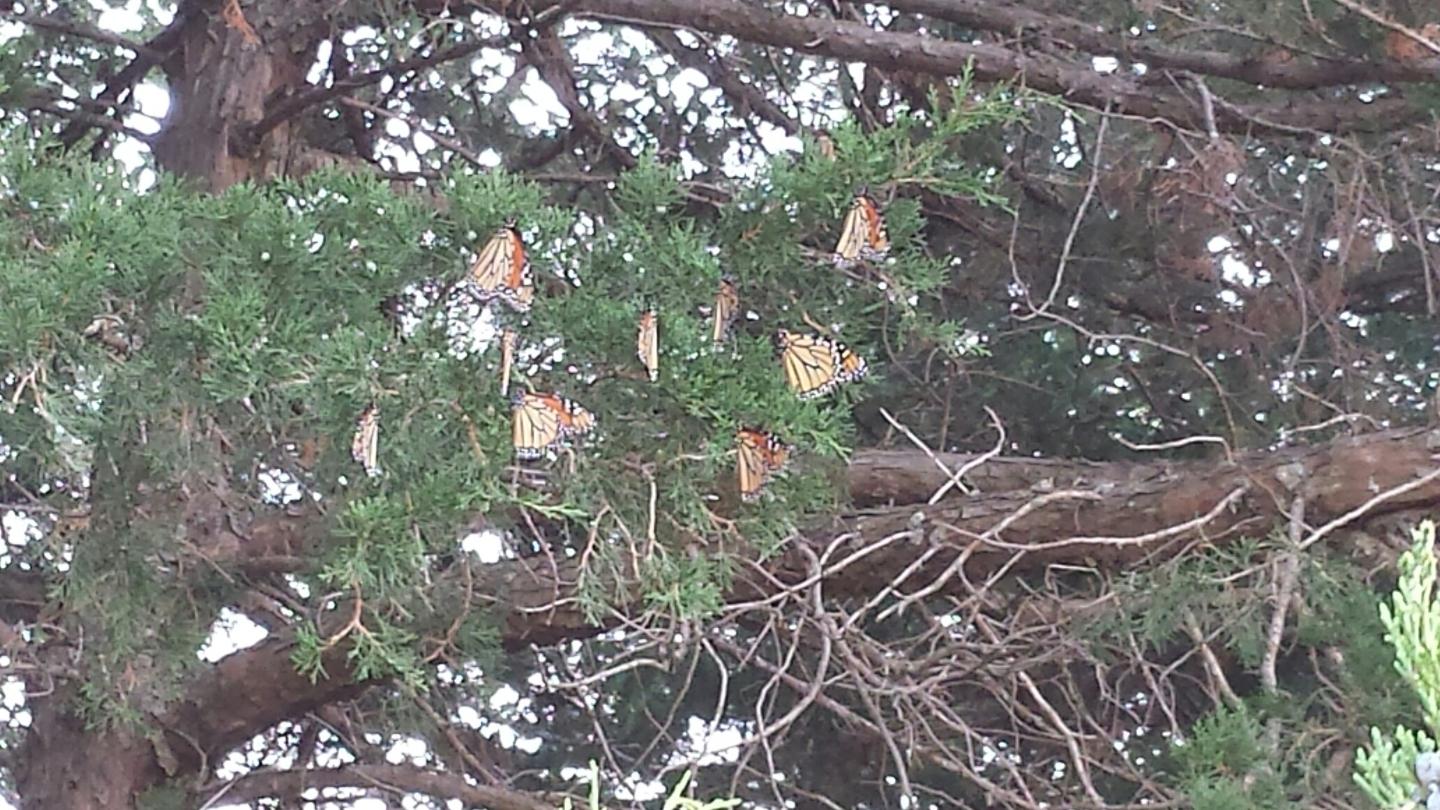
20150927_185525Today Aunt Jeanette writes:

“This looks like a 5-star place to spend the night.”
“It is quiet, our sleep won’t be disrupted, and we can get a good night’s rest.”
“There will be a continental breakfast buffet on the deck (and the roadside ditch) in the morning.”
“The pond across the road has an abundance of drinking water.”
“I will give our traveling companions a heads-up.”

As I was putting grass clippings in the north windbreak yesterday I was surprised, and rather startled, by a sudden flurry of wings fluttering from the trees. Looking more closely, I saw that I had disturbed hundreds of monarch butterflies. They quickly and quietly settled back into the trees while I stood and watched, fascinated by this phenomenon. As I reluctantly walked back to my house, not wanting to leave this wonder of nature, I imagined the above conversation among these butterflies that had chosen our windbreak as a rest stop before resuming their migratory flight to their winter home in Mexico.

When I was teaching, a favorite fall science project (and reading, writing, and art – not in the textbook!) was finding a monarch caterpillar (or if you are very lucky like our youngest son, Jeff, finding some eggs on a milkweed leaf), feeding it milkweed, watching it grow at an amazingly fast rate, seeing the beautiful green and gold chrysalis, and waiting patiently until the monarch butterfly finally hatched. For an eight-year-old it seemed like an eternity – waiting those two long weeks until the monarch finally emerged from its chrysalis, its wings visible through the transparent, gold-flecked case. It was always a rather sad day when we released the butterfly and let nature take its course. But, oh, the stories we wrote and the pictures we drew!

I love seeing cornfields being picked, trees showing the first tell-tale signs of changing color, bean fields being harvested, the clear, bright blue fall skies, goldenrod blooming by the roads, and yes, the gathering of monarch butterflies. Take time from your busy schedules to go for a walk and enjoy autumn. I guarantee you will see something unexpected and awesome!

Until we walk again …

Uncategorized

American Agri-Women Celebrate 40 Years

Kelly Marshall

American Agri-WomenThe American Agri-Women (AAW) have been celebrating their 40th anniversary this year and the festivities will culminate with the national convention in Portland, Maine November 5-7.

The convention’s theme will be “Harvesting for the Future.”  The Maine Agri-Women are hosting the convention and the state is also the home of AAW President Sue McCrum, who is finishing her final year in the position.  In addition to speakers, attendees will also have the opportunity to tour  a 5,000 working farm and educational center, a potato,corn, and grass farm, a farm specializing in fresh-cut vegetables, an original Belgian-style brewery, and an animal healthcare company.

“It’s such an honor to celebrate all that we’ve achieved in our first 40 years in my home state and to plan for a future where we’ll continue being a force for truth for American agriculture,” says President Sue McCrum.

Speakers include:

· Walter Whitcomb, Commissioner of Agriculture, Forestry and Conservation
· Ann LePage, First Lady of Maine
· Karen Worester of Worcester Wreaths and executive director of Wreaths Across America
· Marge Kilkelly, senior policy advisor for U.S. Senator Angus King
· John Rebar, executive director of the Maine Extension Service
· Kathy Day, a nurse and patient safety activist and advocate

Ag Groups, Events

Ag Co-ops Set New Income Records

Cindy Zimmerman

coop-month-2015October is National Cooperative Month and USDA traditionally releases its annual report on cooperatives to coincide with the observance.

Agriculture Secretary Tom Vilsack has announced that the nation’s farmer, rancher and fishery cooperatives posted record income and revenue in 2014, previewing a USDA report to be released later this month that shows cooperatives earned $6.5 billion in net income and generated $246.7 billion in total revenue last year. Net income increased 16.5 percent while revenue rose 0.4 percent from 2013. Co-ops set records for income and revenue in 2014 for the fourth year in a row.

“The nation’s co-ops are essential to the U.S. economy and to rural America,” Vilsack said. “The income they generate is reinvested or returned to members who spend it in their local communities. USDA is proud to continue its support of the cooperative movement.”

USDA also released the latest top 100 ag cooperative rankings in terms of business and assets. According to the rankings, Minnesota-based CHS Inc. remains the nation’s largest cooperative posting $43 billion in revenue in 2014. Kansas City-based Dairy Farmers of America, with $18 billion in total revenue, moved up from number three to number two this year while Land O’Lakes in St. Paul dropped to third place with $15 billion in revenue.

Illinois-based GROWMARK retained its fourth place ranking for 2014 with $10.4 billion in revenue and Ag Processing Inc. of Omaha rounded out the top five with $5.2 billion.

Agribusiness, Cooperatives, USDA