
New Holland Roll-Belt Facebook App

Chuck Zimmerman

New Holland Roll-BeltJust last year New Holland introduced the new Roll-Belt 560 Round Baler as they continue to develop this product line. The company decided to get their customers involved with the online conversation about baling with an interactive Facebook App – the New Holland Roll-Belt App. To learn more about the campaign, which we’ve helped promote, I spoke with Curt Hoffman, Crop Packaging Marketing Manager. The FB app was created to allow customers to share their baling tips like the one you see in this card. They responded and on the app you’ll find a map showing where the tips have come from so you can click on that location and see the tip.

You can listen to my interview with Curt here: Interview with Curt Hoffman

Here’s some background on New Holland in the round baler business.
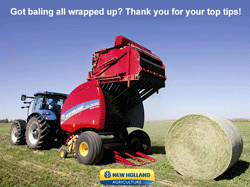
New Holland Roll-Belt ThanksNew Holland launched the very first round baler back in 1974. The Model 850 was the first in a long line of balers which has featured state-of-the- art technology to improve baling performance. The Model 630 introduced belt technology in 1989 and set the industry standard for variable chamber baling. Over a decade later, New Holland introduced the CropCutterTM models, which set the benchmark in ultra-fine chopping performance, perfect for silage operations. In 2006 the 200,000th round baler rolled off the production line, testament to the range’s enduring popularity.

Agribusiness, Audio, Forage, Hay, New Holland

Wearable Technology for Agriculture – Google Glass

Chuck Zimmerman

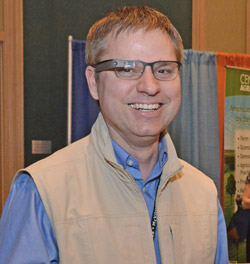
ZimmCast 443It’s time to get a ZimmGlass update. Actually, this is more of a wearable technology update that includes Google Glass. My guest this week is Bruce Rasa, TekWear, LLC. You might have met Bruce at our booth during the Agri-Marketing Conference or on a program somewhere demonstrating Google Glass.

Bruce RasaBruce has been using Glass longer than I have and in more places. He’s demonstrated it to people from 22 countries and has had his personal device in the hands of over 1,000 people! We both agree that we’re getting less of a visible reaction from people in the public but find that there is still a high level of interest from people who are fascinated by the technology. Concerns for privacy seem to be more general consuming public focused than with industries like agriculture that are looking at Glass as a potential new tool.

The areas of highest interest for agricultural applications for Glass are in field related activities like crop scouting, agronomist/consultants use, remote equipment maintenance, animal handling and identification. Many companies are considering building applications for Glass specifically or adapting existing applications to work on Glass. One of the biggest advantages Glass has is its hands free capability. This brings up options for increased safety for lots of tasks that might include checking grain bins where it would be essential to use your hands for climbing but also being able to have a device you can communicate with at the same time.

If you’re an agnerd like Bruce and myself or just plain interested in why anyone would want to wear a computer on their face then I think you’ll enjoy this week’s program.

Listen in to our conversation to learn more about what’s going on with wearable technology for agriculture: Wearable Technology for Agriculture

Thanks to our ZimmCast sponsor, GROWMARK, locally owned, globally strong, for their support.

Subscribe to the ZimmCast podcast here.

Agribusiness, Audio, Precision Agriculture, Technology, ZimmCast

Advocates at World Conservation Congress for Ag

Jamie Johansen

Screen Shot 2014-06-24 at 12.04.43 AMDuring the upcoming World Conservation Congress for Agriculture you will hear from outspoken advocates for conservation agriculture from around the globe. The event will take place June 22-25 in Winnipeg, Manitoba and it’s the first time being held in North America.

DAY 1 – David Montgomery, author of Dirt, sees no-till farming as “the hope for a new agricultural revolution that might help us avoid the fate of previous civilizations.

DAY 2 – Howard G. Buffett, Central Illinois farmer, philanthropist and author, operates a 1,500-acre family farm and oversees three foundation-operated research farms. Buffett travels the world documenting the challenges of preserving biodiversity and providing resources for the growing population.

DAY 3 – Dwayne Beck manages the Dakota Lakes Research Farm, a unique cooperative arrangement between South Dakota State University and farmers demonstrating how producers can profitably adopt conservation practices.

The World Congress on Conservation Agriculture is offering a one-day rate for growers during the conference week. Farmers can take in all the advantages of the conference in one day for only $225. Click here to register and select the date. WCCA will take place June 22-25 in Winnipeg, Manitoba. During this conference, farmers, researchers and other experts from around the globe will share ideas and knowledge of sustainable agriculture. You’ll take home new ideas for increasing efficiency.

The event is sponsored by platinum sponsors Dow AgroSciences, Monsanto, Mosaic, The Howard G. Buffett Foundation and Seed Hawk. Gold sponsors include Agrium, Syngenta, the Food and Agricultural Organization of the United Nations and Manitoba Agriculture, Food and Rural Development.

Ag Groups, Conservation

ASTA Supports International Plant Treaty

Cindy Zimmerman

treatyYou may have never heard about the International Treaty on Plant Genetic Resources for Food and Agriculture but the multi-lateral agreement is considered crucial in the fight against global hunger and poverty.

“The treaty is an international regime where countries decided that we needed to do something about conserving and sustainably using plant genetic resources for food and agriculture,” said Tom Nickson of Monsanto, who provided an update on the treaty to members of the American Seed Trade Association (ASTA) Intellectual Property Rights Committee during the recent annual meeting.

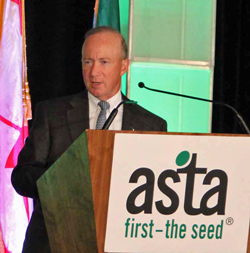
asta-14-nicksonOver 130 countries are currently “contracting parties” to the treaty, including Australia, Brazil, Canada and the European Union nations. A number of others, such as the United States, are only “signatories” to the agreement. The treaty has been awaiting ratification by Congress since 2002. “It came very close about four years ago,” said Nickson. “But we’re hoping we can resurrect the conversation and get this over the goal line.”

ASTA supports ratification of the treaty and Nickson says they are urging Congress to make it a priority. “We don’t have to change any of our laws, it’s philosophically aligned with what we’re trying to do in our national plant germplasm system to protect and conserve genetic resources, so we’re really, really very close,” he said.

Find out more in this interview. Interview with Tom Nickson, Monsanto

ASTA Annual Meeting Photo Album

ASTA, Audio, International, Seed

Purdue President Proud to be Pro-GMO

Cindy Zimmerman

asta14-danielsFormer Indiana governor and current president of Purdue University Mitch Daniels had some strong words for opponents of biotechnology when he addressed the American Seed Trade Association annual meeting in Indianapolis recently.

“It’s bogus for people to try and alarm consumers about fictional difficulties with biotechnology,” said Daniels in an interview with Brownfield Ag News following his address. “The fight against biotechnology is anti-poor. We have arguments for labeling products. Well I have one for GMOs. Being anti-GMO should be labeled as heartless, cruel, and frankly immoral.”

Daniels hopes that those who are opposed to the use of biotechnology will eventually change their minds. “I hope they will rethink their opposition and support thoughtful, careful use of these technologies,” he says. “It is our only hope in feeding a world of 9 billion people.”

Listen to Meghan Grebner’s interview with Daniels here: Interview with Purdue President Mitch Daniels

ASTA Annual Meeting Photo Album

ASTA, Audio, Biotech, Seed

GROWMARK Report Studies Stocks-to-Use

Cindy Zimmerman

growmarklogoA new report from GROWMARK Research challenges the commonly accepted notion that ending stocks are a primary determinant of agricultural commodity prices.

In the report, GROWMARK economic and market research manager Kel Kelly shows that stocks are inversely correlated with prices, but that the correlation occurs within a limited price range, meaning that stocks do not dictate the extent of the price moves. “Stocks do not influence overall price levels,” says Kelly, adding that the correlation is often reversed – changes in prices cause changes in stocks.

growmark-kelThe report titled “Stocks and the Stocks-to-Use Ratio: Are they meaningful for price determination?” indicates that fear of running out of stocks is likely based more on perceptions than on reality, as there is not much evidence that the marketplace takes strong action to compensate for missing supply in years of low production.

Listen to Kelly explain his findings in this interview: Interview with Kel Kelly, GROWMARK

Audio, Grains, GROWMARK, Markets

Got Camel Milk?

Chuck Zimmerman

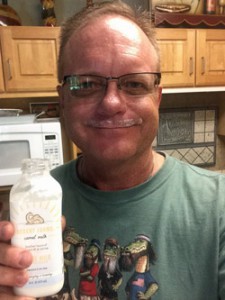
Desert FarmsMake every day a hump day with camel milk from Desert Farms. I requested a sample and tried it this morning on my cereal. I won’t deny being a little skeptical and cautious. However, this milk tastes great! Very smooth, rich and creamy. Kind of what I miss with all this watered down milk we have now. Desert Farms milk comes from small farms here in the U.S. with 6 or less camels on them.

Camel Milk MustacheMention the words “camel milk” to most American consumers and the look you’ll get will likely fall somewhere between incredulity, bemusement and outright dismissiveness. It’s a look entrepreneur Walid Abdul-Wahab has seen a thousand times. But it’s the look of surprise, joy and satisfaction he invariably sees from these very same skeptics after a single glass of camel milk that has changed his life and may very well soon change the lives of milk lovers and health-conscious consumers in the United States forever.

Introducing Desert Farms Camel Milk, America’s first retail camel milk brand and perhaps the most unusual and long overdue addition to the fast-growing trend toward Middle Eastern cuisine in this country.

Available in select Lassen’s Market and by the end of June in 40 Whole Food Markets in Northern California, as well as direct via the company’s www.desertfarms.com website, Desert Farms camel milk is 100% wholesome, raw and natural; packed with special proteins, calcium and a full 70% of our suggested daily value of Vitamin B1; a good source of potassium and phosphorus; and only 110 calories per serving.

Perhaps best of all, Desert Farms camel milk (which is also free of GMOs, additives, preservatives and hormones) is truly delicious – smooth, refreshing, sweet and far more natural than the overly-processed milk we’ve settled for all our lives.

Containing only milk from U.S.-based camels and bottled entirely in America, Desert Farms Camel Milk is available in several distinct varieties: Raw Camel Milk; Raw Camel Milk (Frozen); Raw Camel Milk Kefir; Pasteurized Camel Milk; Raw Camel Milk Colostrum (1st); and Raw Camel Milk Colostrum (Regular).

Dairy, Farming

USDA’s Big Biobased Picture

Cindy Zimmerman

usb-bio-usdaThe U.S. Department of Agriculture takes a wide angle view of the biobased product picture which encompasses several different segments within the agency.

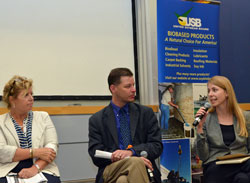
At the USB Biobased Stakeholders Dialogue last week in Washington D.C. we heard from a number of USDA officials about what they are doing to expand biobased opportunities. One panel featured Rural Business Cooperative Service administrator Lilian Salerno, Dr. Daniel Cassidy with the National Institute of Food and Agriculture (NIFA), and Special Assistant to the Secretary Tara Rice.

Salerno discussed how her department offers grants and loan guarantees to help fund companies with new product ideas. “We’re devoted to the agricultural sector and to those rural communities that offer so much,” she said. “This mission area is devoted to making sure there’s capitol out there for those businesses trying to create jobs and create value.” The farm bill provided funds for the Value Added Producer Grants, as well as small loan and grant programs. Interview with Lilian Salerno, USDA Rural Business Cooperative Service

Tara Rice talked about the brand new Made in Rural America initiative. “Which is a White House Rural Council partnership of folks across the federal government working together to support rural businesses that have potential to engage in international exports,” said Rice, who adds that there’s big opportunities for value added businesses in the export market. Interview with Tara Rice, Special Assistant to Secretary Vilsack


2014 USB Soy Biobased Dialogue Photo Album

Audio, Biodiesel, Soybean, USB, USDA

Tomato Growers get Expert Help from Doctor App

Jamie Johansen

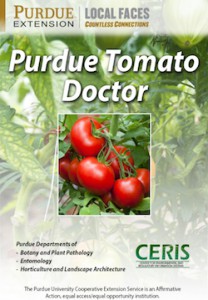
tomatodoc-coverHome gardeners needing some quick, expert advice about their tomato plants will find it right in their pockets with Purdue Extension’s Tomato Doctor mobile app.

The app will help gardeners diagnose problems and offer solutions to get their plants back to a healthy condition, said Janna Beckerman, a Purdue Extension plant disease specialist and content specialist for the app.

“Even people who don’t consider themselves gardeners grow tomatoes,” Beckerman noted. “And every year, all of us tomato growers confront different problems. This app is designed to help home tomato growers identify problems and find a useful solution so they can thoroughly enjoy more tomatoes.”

The Tomato Doctor covers more than 80 common – and not so common – insect, disease and environmental problems that occur throughout the United States and around the world. It includes nearly 500 high-quality images to help users identify problems involving their plants.

Correctly identifying problems will help gardeners avoid using pesticides on their plants unnecessarily, Beckerman said.

“Not every problem needs a pesticide to manage it,” she said. “But when they are needed, we always start with the least toxic approach, and we try to recommend common varieties that are more resistant to certain problems. Sometimes, switching varieties is all that is needed. But for some people, they have to grow Brandywine or Speckled Roman, which may require a bit more protection. We included some common beneficial insects so growers don’t mistake a helpful insect for a harmful one,” she said.

Find the app on iTunes and Google Play.

Ag Groups, Apps, Vegetables

AgriLife Extension’s Recipes, Videos & Cooking Schools

Jamie Johansen

TAMAgEXT8The idea of a family sitting down together for a meal may seem passé in today’s fast-paced, drive-through society, but a statewide initiative by the Texas A&M AgriLife Extension Service is helping families eat healthier — and together –at mealtime.

“The percentage of the food budget spent on away-from-home food has increased steadily since the 1970s and so has the number of calories,” said Dr. Susan Ballabina, AgriLife Extension associate director for program development, College Station. “There are so many families where both parents work and the kids are on their computers or watching TV and don’t want to stop what they’re doing to have family mealtime.”

“The Dinner Tonight! program was developed by AgriLife Extension agents statewide with the knowledge and expertise to provide resources and recipes to help encourage at-home family mealtime,” Ballabina said. “It provides quick, nutritious, cost-effective recipes to consumers through weekly video cooking webcasts and other web-based methods, including blogs and Facebook, and through healthy cooking schools.”

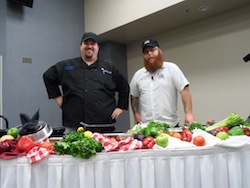
ChefsDallas-DTProgramEvery Monday, a new video demonstration is released by a member of the agency’s statewide Dinner Tonight! team, she said. There are now more than 250 free video webcasts of easy-to-prepare, nutritious recipes available under the Dinner Tonight! tab. The videos have been televised in Dallas and Austin media markets.

“We ask program participants to fill out a survey so we can see if we are meeting our goals, and a large majority of respondents have stated they intend to incorporate new, healthy foods in their diet, as well as eat more fruits and vegetables and plan healthy meals in advance,” she said. “And all participants who responded said what they learned would benefit their families.”

The initiative added healthy cooking schools to its programming in 2012, Ballabina said. Last year, 25 Healthy Cooking Schools were conducted throughout the state, reaching over 1,960 people, and many more have already been conducted this year.

She said Dinner Tonight! will continue to evolve and expand through the development of more community partnerships, broadening Dinner Tonight! programs, including offering more healthy cooking schools, and additional educational outreach.

Ag Groups, Food