Welcome to the 2014 BASF Ag Media Summit

Cindy Zimmerman

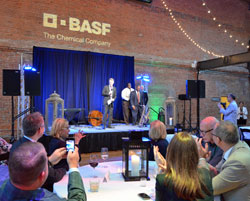
basf-media14-openThe semi-annual BASF Ag Media Summit is being held this year in the home state of the crop protection division, North Carolina.

We are in the beautiful Raleigh-Durham metro area near the campus of Duke University and the opening reception and dinner was held at a venue celebrating the Tar Heel State’s farming heritage in the tobacco industry. Bay 7 at American Tobacco is part of a cluster of former tobacco warehouses that has been redeveloped for commercial, residential and office use. While tobacco is no longer as popular as it once was, it is nice to see that they do appreciate the fact that the crop literally made Raleigh-Durham what it is today.

Welcoming us to the media summit was Nevin McDougall, BASF Senior Vice President for the North America Crop Protection business, who invited us to raise our glasses as he offered the official North Carolina State Toast.

Here’s to the land of the long leaf pine,
The summer land where the sun doth shine,
Where the weak grow strong and the strong grow great,
Here’s to “Down Home,” the Old North State!

Looking forward to hearing the latest on what BASF is doing to help farmers get the most out of every acre. Cheers!

2014 BASF Ag Media Summit Photo Album

BASF, Crop Protection

Elizabeth Leamy Moderates Food Dialogues

Chuck Zimmerman

Elizabeth LeamyThe moderator for today’s Food Dialogues in Chicago is Elizabeth Leamy, a journalist currently working as a correspondent for the Dr. Oz Show. At the conclusion of this morning’s live webcast panel discussion I got to talk with her about the experience.

The topic of the discussion was Integrity in Food Marketing and my first question was what that means to her personally. Elizabeth says, “I think that integrity in food marketing is evolving. It used to just mean telling people how many calories there are and that being accurate. Selling it for a fair price. Now there is this demand for information about where the food comes from and how it came to be. And so increasingly I think integrity in food marketing is going to mean you have to tell people more about where food comes from.”

Elizabeth kept this morning’s program on a rapid pace while also being very informative and entertaining. We clearly had some divergent viewpoints expressed but all in a cordial fashion. I have several more panelist interviews to share but it’s time to get back on the agriblogging highway to Missouri. See you from there.

Interview with Elizabeth Leamy

You can now watch a recording of today’s Food Dialogues here.

USFRA Food Dialogues Chicago Photo Album

Ag Groups, Audio, Food, USFRA

National Festival Highlights Wheat

Jamie Johansen

Screen Shot 2014-06-10 at 1.48.03 PMWheat weavers, farmers, bakers, millers and educators will greet visitors to the United States Botanic Garden (USBG) on Saturday, June 14 as part of the Amber Waves of Grain Family Festival.

The Festival runs from 10:00 a.m. to 2:00 p.m. and highlights the USBG’s summer exhibit on the history and beauty of wheat. The festival includes hands-on activities for children, live wheat weaving, baking demonstrations – including samples, hand-crank flour mills and a tabletop threshing machine as well as a mixing activity illustrating the function of different wheat classes and flours.

In addition to USBG staff and volunteers, participating groups include farmers from Maryland and Kansas as well as representatives from the American Bakers Association, Home Baking Association, Kansas Association of Straw Artists, Kansas Foundation for Agriculture in the Classroom, Kansas Wheat Commission, Maryland Grain Producers Utilization Board, National Association of Wheat Growers, Nebraska Wheat Board, North American Millers’ Association, Wheat Foods Council and U.S. Wheat Associates.

The Amber Waves of Grain exhibit will continue to feature wheat on the outdoor terrace until Oct. 13.

The exhibit also honors the addition of Dr. Norman Borlaug to the National Statuary Hall Collection in the United States Capitol on March 25, the 100th anniversary of his birth. In addition to the outdoor exhibit, a panel exhibit highlights Dr. Borlaug’s research in the USBG’s West Gallery.

Ag Groups, Wheat

Dr. Dane Goede’s PRRS Swine Health Update

Joanna Schroeder

wpx14-bivi-goedeDuring a media dinner hosted by Boehringer Ingelheim (BIVI), during the 2014 World Pork Expo, attendees had the opportunity to learn a lot about what the industry is coining the 20th anniversary of PRRS (Porcine Reproductive & Respiratory Syndrome). The dinner kicked off with Reid Phillips, DVM PRRS technical brand manager for BIVI who gave the group a quick 20 year history of PRRS innovation. Some of these innovations were a result of the work of the Swine Health Monitoring Project.

Dane Goede is a PhD student at the University of Minnesota and during grad school, he began working on the then, fairly new, Swine Health Monitoring Project. Today, he has the opportunity to continue working on the project and gave an update on the 5 Years PRRS Incident Report.

The goal of the program, said Goede, is to monitor all the sticky diseases they are seeing in the swine industry right now including PRRS and PEDv. They take data from collaborative partners and try to get as much information as they can from sow production operations, and then they see if they can characterize what is happening with these viruses throughout the U.S.

For the past five years the team has been monitoring 14 production systems with a large amount of sows (372 herds and 1.2 million sows). Goede said they can now see a striking consistency in how the PRRS virus behaved. The virus seems to begin to increase during late fall and early winter and then kind of recovers in early spring.

“What is really interesting in the PRRS Incident Study is that this last year we’ve seen a really significant difference in both the timing of the incidences beginning to take off as well as the duration of the incidents we’ve seen,” said Goede. “This last year 2013/2014 something’s changed but we’re not really sure what that is. ”

Goede said there are a lot of factors including the introduction of PEDv, which could be taking the focus off of testing for PRRS. Aside from this, he said, we could just be getting better at what we are doing, and we’re all hoping that’s the case.

Producers who are interested in joining the Swine Health Monitoring Project can contact Dane Goede at the University of Minnesota to learn more.

Get the full 5-year PRRS Swine Health Monitoring Project Update in my interview with Dane: PRRS Incident Report

2014 World Pork Expo photo album

wpx-bivi-tag

Animal Health, Audio, Boehringer Ingelheim, Pork, Swine, World Pork Expo

NCGA Thanks President for Signing WRRDA

Jamie Johansen

NCGA-LogoThe National Corn Growers Association thanked President Obama for signing the Water Resources Reform and Development Act of 2014. This final reauthorization bill, which will improve the reliability and efficiency of the U.S. inland waterways system, was passed by the House on May 20 and the Senate on May 22.

“This legislation provides an important step toward the infrastructure improvements vital to our nation’s inland waterway system, and we thank the President for signing this bipartisan bill into law,” said NCGA President Martin Barbre. “Our locks and dams transport our cargoes today, but were built in the 1920s and 1930s to accommodate far smaller loads and far less river traffic. For farmers in particular, this is crucial, as more than 60 percent of the nation’s grain exports are transported by barge. The need is urgent; U.S. farmers and businesses rely upon this transportation channel to create economic opportunities at home and supply markets abroad.”

WRRDA will bring a greater degree of accountability to the Army Corps of Engineers project delivery system by prioritizing authorized improvements based upon risk of failure and economic return to the nation. The report includes four recommendations originally issued in the Capital Development Plan which was developed in concert with the U.S. Army Corps of Engineers and unanimously endorsed by the Congressionally-chartered Inland Water Users Board in 2010.

– Federalize the project at the Olmsted Locks and Dams. This would create a permanent cost-sharing arrangement for the remaining cost of the project, with 85 percent of funding taken from the general fund and 15 percent taken from the Inland Waterways Trust Fund. This would make approximately $105 million per year available for funding other Trust Fund priority projects.
– Redefine major rehabilitation projects eligible for funding through the Inland Waterways Trust Fund, increasing the current level defined in law from $14 million to $20 million. The level would also be adjusted annually to account for inflation.
– Prioritize projects solely upon the basis of risk of failure and economic benefit to the United States.
– Reform project delivery to achieve on-time and on-budget performance.

With this final reauthorization bill signed into law, NCGA urges Congress to quickly move to address the proposed increase to the diesel fuel user fee which would provide additional revenue to the Inland Waterways Trust Fund. By increasing this tax between six and nine cents per gallon of fuel, the industries using the waterways would be able to provide needed funds for the improvement and maintenance of the infrastructure on which they rely.

Ag Groups, Corn, NCGA, transportation, Water

AFBF Not Happy With Clean Power Plan

Joanna Schroeder

Last week the Environmental Protection Agency made history when it released its Clean Power Plan proposal – an attempt to reduce carbon dioxide emissions from utility plants by 30 percent from 2005 levels by 2030. The EPA already has other pollution regulations (greenhouse gas emissions) on the utility sector. According to the EPA, utility plants are the single largest source of carbon pollution in the U.S.- even more than what is emitted in the transportation sector.

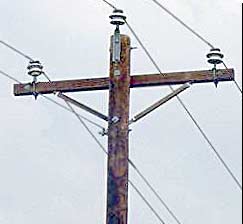
While many groups were thrilled with the proposal, many in the agricultural sector are not happy with the proposed Clean Power Plan. According to the American Farm Bureau Federation (AFBF), the proposal will harm the nation’s economy, rural communities and America’s farm and ranch families if implemented. (In a Utility polerecent post I discussed the fact that agriculture is one of the largest electricity sectors in the U.S.).

AFBF said the EPA’s attempt to impose a 30-percent reduction in carbon dioxide on the nation’s power plants will lead to higher energy prices. Farmers would face not just higher prices for electricity, but any energy-related input such as fertilizer. Rural electric cooperatives that rely on old coal plants for cheap electricity would be especially hard hit.

“U.S. agriculture will pay more for energy and fertilizer under this plan, but the harm won’t stop there,” American Farm Bureau Federation President Bob Stallman said. “Effects will especially hit home in rural America.”

Stallman noted that this announcement came on the heels of EPA’s Waters of the United States” proposal that would unlawfully increase the agency’s role in regulating America’s farms under the Clean Water Act. AFBF responded with a formal campaign to “Ditch the Rule,” and other ag organizations are supporting this campaign.

“The greenhouse gas proposal is yet another expensive and expansive overreach by EPA into the daily lives of America’s farmers and ranchers,” Stallman added. “Our farmers and ranchers need a climate that fosters innovation, not unilateral regulations that cap our future.”

AFBF, Agribusiness, Energy, Environment

Integrity in Food Marketing

Chuck Zimmerman

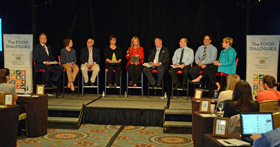
USFRA Food DialoguesThe U.S. Farmers & Ranchers Alliance Food Dialogues is taking place live as of this post in Chicago. The topic is “Integrity in Food Marketing 2014.” I’ve already interviewed several of our panelists and will do more when today’s discussion concludes.

The program is live now and will be archived on the Food Dialogues website. We’ve got some very interesting questions being addressed about things like trust, truth, transparency and more.

You can follow the discussion with the Twitter hashtag, #FoodD.

I’ve got a photo album you are quite welcome to view and share if you’d like: USFRA Food Dialogues Chicago Photo Album

Ag Groups, Food, USFRA

It’s Iowa Corn Cy-Hawk Day!

Cindy Zimmerman

Any Mizzou, Jay Hawk or Husker fans are welcome to skip this post because today is Iowa Corn Cy-Hawk Day!

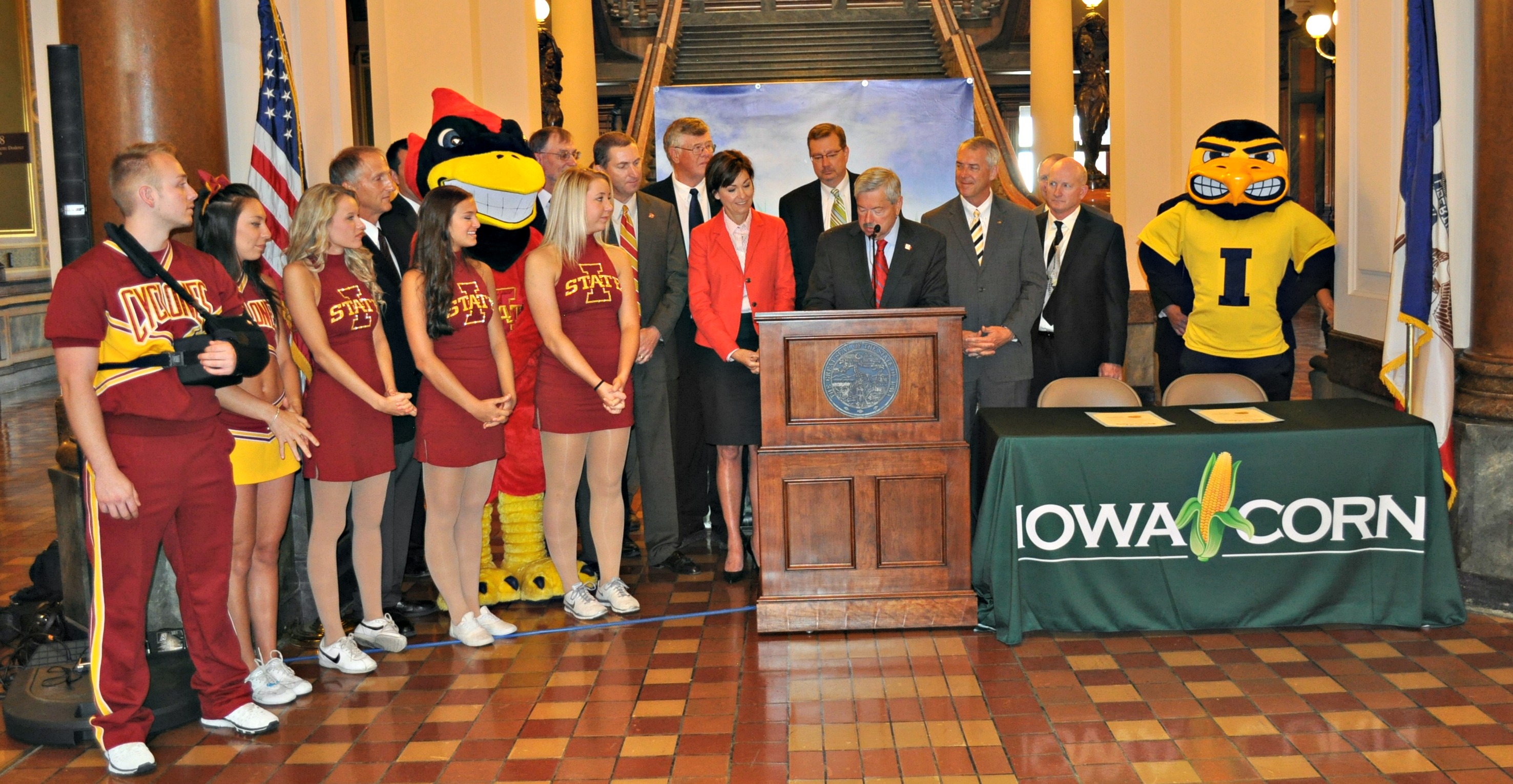
ia-corn-cy-hawkIowa Governor Terry Branstad made that official by signing a proclamation today declaring June 9, 2014 as Iowa Corn Cy-Hawk Day, with members of the Iowa Corn Promotion Board in attendance. Iowa Corn is a proud sponsor of the University of Iowa and Iowa State sports teams to educate fans about the importance of corn in their everyday lives.

“Today marks a special day, because we aren’t just celebrating the Iowa Corn Cy-Hawk Series, but we are celebrating both Universities, the coaches, athletes and the farmers who make the partnership work,” said Chris Edgington, a farmer from St. Ansgar and the current Vice President of Iowa Corn Promotion Board. “Not unlike building on the traditions that this interstate rivalry represents, we hope that whether or not you are a Cyclone or a Hawkeye, whether you like football, basketball, wrestling, volleyball, track or swimming, men’s or women’s athletics, it is about being Iowan.”

The official proclamation states, “Whereas, the series salutes the tradition and significant role that agriculture has in the history and the future of our great state; and the series is about celebrating the games, academics, the people of Iowa, and awarding points to the winner in various head to head match ups.”

The Iowa–Iowa State football game on September 13th will launch the 4th year for the Iowa Corn Cy-Hawk Series.

Corn

BCAP Funding Application Period Opens

Joanna Schroeder

One energy and ag program that was saved by the 2014 Farm Bill was the Biomass Crop Assistance Program or BCAP, designed to provide financial assistance to mainly farmers and ranchers who establish and maintain new crops of energy biomass or harvest and deliver forest or ag residues to a qualifying energy facility. Farmers who harvest ag residues such as corn cobs and stalks that can be converted to cellulosic ethanol may also qualify as an energy-producing feedstock.

USDA will begin accepting applications June 16 through July 14, 2014.

Of the total $25 million per year authorized for BCAP, the 2014 Farm Bill provides up to 50 percent ($12.5 million) each year for matching payments for the harvest and transportation of biomass residues. BCAP matching payments will resume this summer, bcap_logo_368while crop incentives will begin in 2015. Some matching payments will support the removal of dead or diseased trees from National Forests and Bureau of Land Management public lands. This will be turned into renewable energy while reducing the risk of forest fire.

“Removing dead or diseased trees from forests to use for biomass production creates clean energy while reducing the threat of forest fires and the spread of harmful insects and disease,” said USDA Ag Secretary Tom Vilsack. “Increasing our country’s production of biomass energy also helps grow our economy. Food is made in rural America, but fuel is made in rural America, too. This program is yet another USDA investment in expanding markets for agricultural products made in rural places across the country.”

With the 2014 Farm Bill requiring several regulatory updates to BCAP, the resumption of payments for starting and maintaining new sources of biomass (Project Areas) has been deferred until a later date when the regulatory updates occur.

Agribusiness, Biofuels, Corn, Forestry, USDA

Zimfo Bytes

Talia Goes

Zimfo Bytes

  • CropLife magazine, the nation’s leader in ag retail communication, announces the launch of its completely redesigned website, CropLife.com.
  • Monsanto Company has selected Locus Technologies to provide a comprehensive, integrated software platform for sustainability management and environmental stewardship throughout the corporation’s facilities.
  • Iowa men and women with a commitment to the future of Iowa agriculture and an interest in developing their leadership potential are invited to apply for Class 7 of the Iowa Corn Leadership Enhancement and Development Program , sponsored by the Iowa Corn Growers Association and the Iowa Corn Promotion Board.
  • At the 2014 World Pork Expo last week, the National Pork Board announced a new common industry-audit program for pork producers, packers and processors.
Zimfo Bytes