How ARC Programs Control Swine Disease

Joanna Schroeder

Dr. Erin Johnson, DVM, technical manager, PRRS Solutions Team explained that the goal of the ARC program, is to voluntarily get a group of producers in an area to work together to better understand and control the spread of disease in their neighborhoods, townships and counties. To make the ARC effective, continued Johnson, the producers must develop processes to provide open and transparent communication, cooperation in outbreak investigations, and coordination of their individual disease control efforts to create a positive effect.

Boehringer Ingelheim Vetmedica (BIVI) has been utilizing area regional control (ARC) programs with swine producers for more than six years. During their PEDV is Speaking: Are We Listening ? seminar at 2014 World Pork Expo when BIVI first began working with producers who wanted to create ARC programs, PRRS (Porcine Reproductive & Respiratory Syndrome) was the main issue at hand. Today these groups are using the same strategies and tactics to address PEDV (Porcine Epidemic Diarrhea Virus). People on the ARC Dr Erin Johnson BIVIteam, including Johnson, have been providing a wide range of support to meet their producers’ needs as their programs evolve – especially into new disease areas. Johnson also noted that one of the most important lessons producers have learned through these programs are ways to improve biosecurity, a means to reduce viruses spreading and creating breakouts among herds.
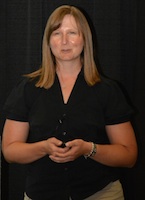
Johnson has a saying about the ARC programs, “Transmit unto your neighbors as your neighbors would transmit unto you”. Very applicable especially in that many viruses that affect swine are airborne. In this example, one production facility can inadvertently transmit PRRS to their neighbor a few miles down the road.

The direct value, stresses Johnson, of an ARC program is improvements in health, productivity and ROI. In addition, there are indirect benefits including: reduction of infection risk; reduction of genetic diversity; generation of critical knowledge; improvement in on-farm morale; and improvement of the image of the swine industry.

Speaking of critical knowledge, Johnson said that when you combine the leanings from ARC programs with other research sources such as the Swine Health Incident Program and the Disease Bioportal website managed by University of California Davis, the industry is better able to track disease outbreaks.

Learn more about Area Regional Control in my interview with Dr. Erin Johnson: Interview with Dr. Erin Johnson

As Johnson mentioned, many ARC programs are know quickly advancing their collaborative efforts to fight PED. Once such ARC is the Northeast Illinois PRRS ARC (located in De Kalb county Illinois). The program is located in the number 2 hog producing county in Illinois and the county borders Chicago. Dr. Noel Garbes, DVM with Bethany Animal Hospital gave a testimony to their program. What began in literally a coffee shop, has grown into nearly 95 percent producer participation in their area.
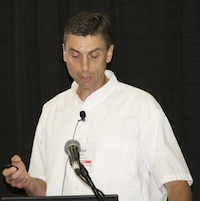
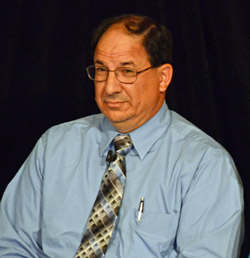
Dr Noel Garbes Bethany Animal HospitalHe explained that producers sign a consent form so that their information can be shared during other meetings, such as this seminar where I heard him speak. During meeting producers share successes or areas in where they are struggling to get ideas and strategies from other producers. Now moving into PEDV, the ARC began issuing alerts and notifications (the first confirmation was December 26, 2013) of PED positive farms with positive results using the tools they already had in place.

In his area they have had success in keeping PED outbreaks fairly low and this is one reason why producers from his group are sharing their experiences with others. When I asked him what piece of advice he had for other producers, he cited something several other speakers noted: While is great to have 30 ARC, we need 300 ARC. Garbes said it only takes a few people to get an ARC started and he believes everyone should be involved because until everyone gets involved, we will always have a chance for new virus’ to emerge.

Learn more about the DeKalb Area Regional Control in my interview with Noel Garbes: Interview with Dr. Noel Garbes

2014 World Pork Expo photo album

wpx-bivi-tag

Animal Health, Audio, Boehringer Ingelheim, Pork, Swine, World Pork Expo

NCGA CEO Addresses Fuel Ethanol Workshop

Leah Guffey

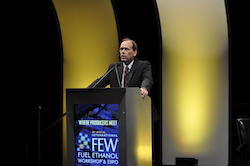
_DSC0020National Corn Growers Association CEO, Rick Tolman took the podium on his farewell tour to address the general session at the Fuel Ethanol Workshop in Indianapolis this week. It’s the 30th year for the workshop and during his remarks he commented on how things have changed in the last 30 years from the acres of corn planted and bushels harvested to the gallons of ethanol produced and where things are headed in the future of the industry.

So far this year proves to be better than last year. Emergence of the 2014 corn crop pushed past the five-year average last week, according to a U.S. Department of Agriculture report released Tuesday. Despite strong storms with high winds and hail over the past week, the 2014 corn crop condition held nearly steady with 75 percent of all acres rated good or excellent as of June 8. This represents only a one-point decline from the prior week and remains 12 points ahead of the number of acres with the same rating last year at this point.

Tolman says we have planted a few less acres this year, and we continue to push through the 10-million bushel barrier that was so difficult to reach in his tenure as NCGA CEO.

You can listen to my interview with Rick Tolman here Rick Tolman, NCGA

2014 Fuel Ethanol Workshop Photo Album

Audio, Corn, Ethanol, NCGA

Understanding Farmer Attitudes

Meghan Grebner

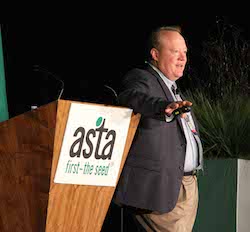
asta-14-26-editedThe Seed Leadership Program was held just before the start of the 131st Annual American Seed Trade Association Annual Meeting in Indianapolis.  During today’s Green Flag Session, Brent Gloy, Purdue University professor discussed the key themes from the 2013 Large Commercial Producer survey.  He says they survey helps both farmers and agribusinesses better understand where the commercial farm segment is going.

Since 1998, Purdue University has conducted the Large Commercial Producer survey every five years.  The survey’s objective is to examine the fundamental attitudes of commercial producers and how they impact buying decisions. The attitudes of farm and ranch operators and their underlying behaviors have implications for the way agribusinesses market and sell to commercial producers.

One area Gloy highlighted today was how farmers demands and needs were changing over time.  “As farms have grown, their needs for services and information has evolved,” he says.  “When you look at farms from 1,500 acres in size to over 5,000 acres – the common theme is that product performance is most important to their operations.”

Interview with Brent Gloy, Purdue University

You can purchase the complete 2013 Large Commercial Producer survey results HERE.

ASTA Annual Meeting Photo Album

Agribusiness, ASTA, data, Farming, Technology

ASTA Annual Meeting Kicks Off

Meghan Grebner

asta-14-28-editedIndustry leaders and seed experts are in Indianapolis this week for the 131st American Seed Trade Association’s Annual Meeting. ASTA CEO Andy Lavigne says much of the discussion this week will focus on innovation and technology in the seed industry.

The meeting kicks off Thursday morning with Purdue University president Mitch Daniels.  Lavigne says Daniels will focus on innovation and that will set the meeting’s tone.

Lavigne anticipates breeding technology will be one of the hot topics this week.  Breeding techniques can impact development of new varieties for farmers depending on how they want to produce seed.  But, because concern has been expressed that some regulatory bodies may treat breeding techniques similar to biotechnology, it now could become an issue for the seed industry. “If that regulatory process goes down that route,” Lavigne says. “Then it becomes a burden for companies to use those techniques to develop varieties to give farmers the choice they want.”

Andy Lavigne, American Seed Trade Association

Also on-deck for the first day, the World Food Prize Laureate Panel that includes World Food Prize Laureates Gebisa Ejeta and Philip Nelson.  Both will share their insights and experience with the seed industry to help shape the seed business for the future.

ASTA Annual Meeting Photo Album

Agribusiness, ASTA, Biotech, Seed, Technology

Farmers Dialoguing About Food

Chuck Zimmerman

ZimmCast 441Two farmers got to discuss food on the panel for the USFRA Food Dialogues in Chicago this week. I visited with them and am sharing my conversations in this week’s ZimmCast.

Chuck Wirtz USFRAFirst up is Chuck Wirtz, a pork producer from Iowa. With the topic being “Integrity in Food Marketing” I wondered what that meant to the panelists so I asked him.

He says, “To me integrity is an adherence to moral and ethical principals and as production systems differ and as marketing products differ we have to make sure that everybody is being truthful in what it is that they’re telling.”

Dawn Caldwell USFRAThe other farmer participating in the Food Dialogues is Dawn Caldwell, a family farmer from Nebraska, seen here being interviewed after the program. I also asked her to describe what the topic of the discussion means to her.

She says “To me it’s something very factual, very black and white and concise.” She noticed that a couple of the panelists brought emotion into the discussion but enjoyed hearing other opinions.

Listen to this week’s program and hear more about what these farmers had to say about their experience on the Food Dialogues panel here: Farmers Dialogue About Food

Thanks to our ZimmCast sponsor, GROWMARK, locally owned, globally strong, for their support.

Subscribe to the ZimmCast podcast here.

Ag Groups, Audio, Food, USFRA

BASF Ag Solutions Through Innovation

Cindy Zimmerman

basf-media14-kreimeyerBASF – The Chemical Company – will be celebrating a pretty significant milestone next year. The company was established in 1865, which means it will be 150 years old in 2015.

Andreas Kreimeyer, member of the board and Research Executive Director for BASF, says innovation is the reason they have survived so long. “Innovation is our life blood,” he said at the BASF Ag Media Summit today. “We create chemistry for a sustainable future.”

Listen to Kreimeyer’s brief presentation here on how the company’s mission relates to innovations that yield results for farmers. Andreas Kreimeyer, BASF

Right now I am on the bus heading out to the BASF Holly Springs research farm where we will see some of these new products in action.

2014 BASF Ag Media Summit Photo Album

Agribusiness, Audio, BASF

BASF Highlights North American Investment

Cindy Zimmerman

basf-media14-nevinAt the BASF Ag Media Summit today, BASF North America Crop Protection Senior VP Nevin McDougall outlined the continued R&D investment his company is making to bring new agricultural products to market.

“Our global investment is upwards of $2 million a day in agricultural research,” said McDougall. “Many of those research projects have direct application to North America.”

That translates into a multitude of new products scheduled for launch in the next 1-2 years. “Such as Sultan and Nealta (miticides) which will be launched in 2015 and 2016, the launch of Engenia herbicide for dicamba-tolerant crops, the newest formula of dicamba which will be available in the next 12-18 months,” McDougall said. In addition, there’s functional crop care products in the immediate future such as Limus urea inhibitor, which we’ll tell you more about later.

Besides products, McDougall says BASF is very proud of the investment they are making in people to help support farmers in the field.

Find out more in this interview: Interview with Nevin McDougall, BASF

Right now I am on the bus heading out to the BASF Holly Springs research farm where we will see some of these new products in action.

2014 BASF Ag Media Summit Photo Album

Agribusiness, Audio, BASF, Crop Protection

PEDV 101 From ISU’s Dr. Phillip Gauger

Joanna Schroeder

The talk of the 2014 World Pork Expo town:  PEDV and the emergence that took the U.S. by storm.

According to Dr Phillip Gauger, with Iowa State University, Veterinary Diagnostic Laboratory, between April 28 – May 4, 2013 they had four separate ISU-VDL submissions – one from Indiana and three from Iowa – from farms with no relationship. He and his team realized after running diagnostic tests that more tests were needed. Then in partnership with the National Veterinary Services Laboratory (NVSL) they conducted additional tests and discDr Phillip Gauger ISU-VDLovered the virus was PEDV (Porcine Epidemic Diarrhea Virus). On May 17, 2013 NVSL announced that PEDV was in the U.S. and with that the PEDV epidemic began.

I asked Dr. Gauger, who participated in Boehringer Ingelheim’s (BIVI) seminar, “PEDV is Speaking: Are We Listening,” at the 2014 World Pork Expo, to explain exactly how the PEDV virus works. He explained that PEDV is a viral infection that infects the pig through fecal-oral transmission, it can infect an animal orally, then sets up replication or propagation of the virus within the intestinal tract destroying the mucous. And as the virus replicates, and more virus gets shed into the environment naturally, that intestinal lining becomes destroyed. Depending on the age of the pig some could be severely affected with profuse diarrhea followed by death. In older pigs they can become clinical but less affected and mortality isn’t as severe.

There are two known strains of the virus in the U.S. and Dr. Gauger said there are several challenges with regards to the virus: prevention and control; vaccination; virus transmission (they still don’t know exactly how the virus is transmitted); and diagnostic tests.

In addition, he said there are some future PEDV perspectives that need to be considered. For example, there are still some unanswered questions: How did PEDv enter the U.S.? What are the pathogenic differences between the original and variant PEDV? What new biosecurity needs and methods of control of PEDV are needed?

Today, Dr. Gauger said there are 13 labs voluntarily reporting PEDV and it has been confirmed in 26 states. It has also been found in Canada and Mexico. In the U.S. there has been a loss of 10 percent of the pig population or 7 million pigs, since May of 2013.

Dr. Gauger stressed the need for more voluntary samples to be submitted to labs for testing. In addition, he stressed the need for voluntary collaboration within the swine industry to expand PEDV research and knowledge. When I asked him about the talk around mandatory reporting, he said, “The industry is much better off taking a proactive stance to lead the efforts and do some voluntary reporting including voluntarily offering information and voluntarily offering samples unique to their particular system. In the long-run this will become more productive than waiting for something to become mandatory and that’s required and that can cause some consternation or concern on the part of the producer when they don’t understand what potential ramifications could come out of that.”

*Note: The day following my interview with Dr. Gauger, USDA Ag Secretary Tom Vilsack announced mandatory reporting of PEDV.

Learn all things PEDV in my interview with Dr. Phiilip Gauger: All Things PEDV

2014 World Pork Expo photo album
wpx-bivi-tag

Animal Health, Audio, Boehringer Ingelheim, Pork, Swine, World Pork Expo

Welcome to the 2014 BASF Ag Media Summit

Cindy Zimmerman

basf-media14-openThe semi-annual BASF Ag Media Summit is being held this year in the home state of the crop protection division, North Carolina.

We are in the beautiful Raleigh-Durham metro area near the campus of Duke University and the opening reception and dinner was held at a venue celebrating the Tar Heel State’s farming heritage in the tobacco industry. Bay 7 at American Tobacco is part of a cluster of former tobacco warehouses that has been redeveloped for commercial, residential and office use. While tobacco is no longer as popular as it once was, it is nice to see that they do appreciate the fact that the crop literally made Raleigh-Durham what it is today.

Welcoming us to the media summit was Nevin McDougall, BASF Senior Vice President for the North America Crop Protection business, who invited us to raise our glasses as he offered the official North Carolina State Toast.

Here’s to the land of the long leaf pine,
The summer land where the sun doth shine,
Where the weak grow strong and the strong grow great,
Here’s to “Down Home,” the Old North State!

Looking forward to hearing the latest on what BASF is doing to help farmers get the most out of every acre. Cheers!

2014 BASF Ag Media Summit Photo Album

BASF, Crop Protection

Elizabeth Leamy Moderates Food Dialogues

Chuck Zimmerman

Elizabeth LeamyThe moderator for today’s Food Dialogues in Chicago is Elizabeth Leamy, a journalist currently working as a correspondent for the Dr. Oz Show. At the conclusion of this morning’s live webcast panel discussion I got to talk with her about the experience.

The topic of the discussion was Integrity in Food Marketing and my first question was what that means to her personally. Elizabeth says, “I think that integrity in food marketing is evolving. It used to just mean telling people how many calories there are and that being accurate. Selling it for a fair price. Now there is this demand for information about where the food comes from and how it came to be. And so increasingly I think integrity in food marketing is going to mean you have to tell people more about where food comes from.”

Elizabeth kept this morning’s program on a rapid pace while also being very informative and entertaining. We clearly had some divergent viewpoints expressed but all in a cordial fashion. I have several more panelist interviews to share but it’s time to get back on the agriblogging highway to Missouri. See you from there.

Interview with Elizabeth Leamy

You can now watch a recording of today’s Food Dialogues here.

USFRA Food Dialogues Chicago Photo Album

Ag Groups, Audio, Food, USFRA