UF/IFAS Photo Contest Needs Your Pictures

Kelly Marshall

PIE ContestThe University of Florida Center for Public Issues Eudcation in Agriculture and Natural Resources (PIE Center) is inviting you to submit your favorite photographs in their 4th annual photo contest.  The Center is looking for pictures that capture a moment, landscape, product or service that represents and celebrates the agriculture industry.

All photographs must be submitted by Friday, March 18 at 11 a.m.  Voting will begin at noon.  Voting will be done on Facebook and winners will be announced in six categories: crops, livestock, wildlife, scenery, leadership and people of agriculture.

Professional photographers are being asked to chose an overall winner and a best of Florida award.  The best overall photo will earn a $100 Amazon gift card, sponsored by UF/IFAS Wedgworth Leadership Institute) and the Best of Florida winner will receive a $50 Amazon gift card compliments of Farm Credit of Florida.

For more information, please contact Phillip Stokes (p.stokes@ufl.edu) or Laura Bernheim (bernheim@ufl.edu)

Photography

GMO Answers Stands Up For Science

Lizzy Schultz

classic-16-cbi-hall The use of genetically modified organisms (GMOs) and the controversial legislation surrounding GMO labeling were hot discussion topics at the 2016 Commodity Classic, with U.S. Secretary of Agriculture Tom Vilsack addressing the issue during the event, as well as several commodity groups.

In the trade show, the Council for Biotechnology Information (CBI) had a booth dedicated to GMO Answers, an initiative that works to make credible, accurate information on GMOs easier for consumers to find, addresses consumer concerns and misconceptions about the technology, and provides resources to help farmers feel more comfortable talking about GMOs with consumers.

“Farmers are the most trusted voices, and the most important spokesperson on this issue,” said Kate Hall, Managing Director for CBI, at an interview during the 2016 Commodity Classic. “We want to make sure they have what they need to communicate clearly, whether it’s through social media or one-on-one conversations, because the farmers voice is the most important in this conversation.”

Consumers are invited to visit the GMO Answers website to ask questions and voice their concerns about GMO technology. GMO Answers has pledged to answer every question they receive, and has enlisted volunteer farmers, nutritionists, doctors, and academics to help answer consumer questions and concerns. The site also provides studies, articles, and other educational materials on the use of biotechnology in agriculture, and addresses frequently voiced concerns about the health and safety of GMOs.

The organization will continue bringing the experts to consumers through a nationwide farmers market tour this summer, where they will work with local farmers at multiple farmers markets across the country to talk with consumers about GMOs. They are also working with Scientific American to host an event on the way science is portrayed in the media on March 31st in Washington, DC.

“This event won’t just cover GMOs, but also vaccines and climate change, all of the issues where we’re seeing a juxtaposition between what the science says and science denialism, and how that’s affecting people’s perception about these issues,” said Hall.

Listen to my full interview with Kate here:
Interview with Kate Hall, GMO Answers

2016 Commodity Classic Photo Album

Coverage of Commodity Classic sponsored by

Coverage of Commodity Classic sponsored by BASF Coverage of Commodity Classic sponsored by New Holland


Ag Groups, Audio, Biotech, Commodity Classic, Education, GMO

I AM USFRA Series

Cindy Zimmerman

i-am-usfra-webWe’re starting a new series here on AgWired and we’re calling it “I AM USFRA.”

Most of you have probably heard about the U.S. Farmers and Ranchers Alliance, which was started in 2010 with the goal of engaging in dialogue with consumers who have questions about how today’s food is grown and raised. USFRA consists of nearly 100 agricultural organizations and agribusiness partners and the goal of I AM USFRA is to learn about those partners and why they support this coalition.

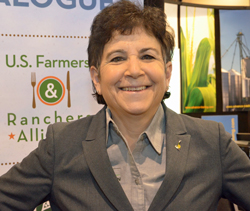
usfra-nancyTo learn who USFRA is, we start at the top with chairwoman Nancy Kavazanjian who represents the United Soybean Board (USB) on the board of the USFRA. Nancy has been farming in Wisconsin with her husband for 35 years, but you might detect a New York accent when you hear her speak. “I grew up on Long Island, so I was a suburban girl who always wanted to live on a farm – finally living my dream!” she said during an interview at Commodity Classic. Nancy is the second chair of USFRA – the first was former American Farm Bureau president Bob Stallman.

Nancy says USB was one of the six founding members of USFRA back in 2010. “The major checkoff boards all found themselves at a meeting one time and realized they were all doing consumer outreach,” she said. “They realized that if they all got together and pooled their resources and spoke in a common voice they could have a lot more impact on that consumer.” She says that USB has been actively involved in USFRA on many levels, particularly with the launch of the movie “FARMLAND” which has become a great educational tool for USFRA.

Learn more about Nancy, USB, and USFRA in this interview: Interview with Kavazanjian

Audio, USB, USFRA

InfoAg Conference is Gearing Up for 2016

Kelly Marshall

classic16-infoag-reetzIt might be their off-season, but the people behind the InfoAg Conference aren’t taking it easy.  Harold Reetz, the original founder of the event, recently traveled to the 2016 Commodity Classic.  His goal in attending the event was to share more about the opportunities available at InfoAg with the great group of farmers who come to Commodity Classic.

Since 1995 InfoAg has been a leading event in precision agriculture, and Reetz is working hard to ensure this year’s event will give participants the experience they are looking for.  For most in the precision field that includes learning about all the newest technology; sensors, drones and all.  But the biggest challenge for growers is what to do with all the data those sensors and drones collect.

“We’ve got farmer that have collected data for years,” Reetz said.  “They have the capability of collecting more now, and faster and getting it in a position to use faster, so how do we do that?  As a farmer who can help us get the data to work in such a way and ready to use so we can use it to make better informed decisions on the farm.”

Attendees can look forward to hearing new ways to answer that question at this year’s event.  New solutions keep presenting themselves and Reetz reports a number of new developments in that area within the last six months.

The conference is being held at Union Station in St. Louis from August 2-4, 2016.  It is held in conjunction with the 13th International Conference on Precision Agriculture, with the concurrent programs offering the opportunity to learn from each other about how best to help the grower.  Register now to InfoAg or ICPA.

Listen Jamie Johansen’s full interview here:
Harold Reetz, InfoAg Conference

2016 Commodity Classic Photo Album

Events, Precision Agriculture

Bayer Partnerships Invest in New Tech

Cindy Zimmerman

Searching for the latest in agricultural innovation, Bayer has formed strategic innovation partnerships with two leading venture capital firms in the past year.

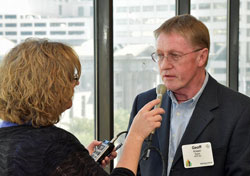
bayer-agvocate-kneen“Bayer is 150 years old and has a long and rich history of product development for agricultural uses,” said Geoff Kneen, Bayer R&D Licensing and New Ventures Manager for North America. “But we recognize there are technology developments outside the company which have the potential to revolutionize the way agriculture is conducted.”

To seek out those new developments, Bayer entered into partnerships with Finistere Ventures of San Diego and Flagship Ventures of Boston. “What we’re doing is investing in their funds and using their network of technology access to make investments in the technologies we believe that will be the future of the ag business,” Kneen said. “As the interest in agriculture rapidly expands to include different areas of innovation, such as genomics, IT/data management, and remote sensing, we want a window into that new innovation.”

Learn more in this interview with Geoff from the Bayer AgVocacy Forum: Interview with Geoff Kneen, Bayer

Bayer AgVocacy Forum Photos

Audio, Bayer, Technology

AFBF Asks Courts to Stop Sage Grouse Overreach

Kelly Marshall

AFBFThe American Farm Bureau Federation together with the Idaho Farm Bureau Federation, the Public Lands Council and the National Cattlemen’s Beef Association have petitioned the court to stop the federal use of land management to exclude millions of acres from grazing.  Currently these lands are being used for only one purpose, to provided habitats for the greater sage grouse, despite laws mandating a land management plan involve multiple uses.

According to the Farm Bureau, BLM and the Forest Service violated key laws directing how the federal government must manage federal lands and the process by which land management plans are promulgated.

“Sage grouse numbers are up 63 percent over the last two years largely due to local conservation efforts, yet the BLM and the Forest Service are refusing to promote multiple uses of these lands as the law requires,” AFBF General Counsel Ellen Steen said. “Ranchers depend on access to federal lands and the revised land use plans will have a devastating impact on these rural communities.”

Farm Bureau and their allies filed a brief with the U.S. District Court for the District of Columbia on March 8.  The brief supports a current lawsuit filed by Idaho Governor Butch Otter which challenges the management plans issued in November of 2015.  Other states have filed similar lawsuits where they apply within their boarders.

The Fish & Wildlife Service has decided that the sage grouse is no longer in need of protection as an endangered species because of the protection provided under this land management plan.  While the groups agree that the sage grouse does not require that level of protection, the new land management requirements are actually more onerous than the Endangered Specials Act.

AFBF, Ag Groups

#RealYield Game Was a Winner

Cindy Zimmerman

ZimmCast 504There were lots of winners in the Bayer LibertyLink® Real Yield Game that you might recall us promoting at the end of last year.

classic16-liberty-winnersAmong them were five farmers who were instant winners, receiving 500 acres of LibertyLink soybean seed and Liberty herbicide, and one grand prize winner who gets a year’s lease on a John Deere 8320R tractor. Even better, 28 state FFA organizations got a share in $50,000 from Bayer for their help in promoting the game.

All of those winners were recognized during the 2016 Commodity Classic in New Orleans, where we had the opportunity to talk with them and learn how they found out about the game and what winning means for them. And that is the topic of our ZimmCast this week.

Listen to it here: LibertyLink Real Yield Game Winners

2016 Commodity Classic Photo Album

The ZimmCast

sponsored by
The ZimmCast podcast is sponsored by GROWMARK
Locally owned, globally strong.
Audio, Bayer, Commodity Classic, FFA, Soybean, ZimmCast

Farm Credit Celebrates Centennial at #Classic16

Cindy Zimmerman

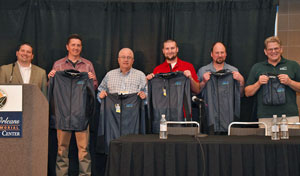
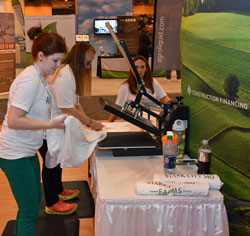
classic16-farm-creditFarm Credit was celebrating 100 years of serving farmers and ranchers across the nation at Commodity Classic last week by serving up personalized tee shirts.

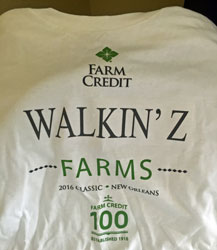
“We wanted to celebrate the resiliency of the farm family,” said Sarah Cortese, Director of Communications at Capital Farm Credit in Lubbock, Texas. She added that the t-shirt idea was very popular and they were printing up shirts “like hot cakes, literally.” We even had one printed up for Chuck’s brother in Georgia, who has his own small acreage estate that he calls Walkin’ Z Farms.

classic16-farmcredit-shirtWhile farm income may be down right now, Cortese says it’s nothing new for the agriculture industry. “We’ve all been there before,” she said. “We’ve been trying to meet with borrowers early and we have a lot of risk management programs that we offer free of charge.”

She encourages people to visit the Farm Credit 100 website to learn more about their centennial anniversary and the history of the system.

Listen to Chuck’s interview with Sarah here: Interview with Sarah Cortese, Capital Farm Credit

2016 Commodity Classic Photo Album

Coverage of Commodity Classic sponsored by

Coverage of Commodity Classic sponsored by BASF Coverage of Commodity Classic sponsored by New Holland
Audio, Commodity Classic, Farm Credit

Soil Health Partnership Participation Explodes

Lizzy Schultz

classic-16-shp-mcfarland Twenty-five more farms have joined in on the groundbreaking research effort from Soil Health Partnership (SHP) that could change the way farmers take care of their land.

SHP works to test and measure farm management practices that improve soil health, such as growing cover crops, practicing conservation tillage like no-till or strip-till, and using sophisticated nutrient management techniques.

The program’s goal is to quantify the benefits of these practices from an economic standpoint, showing farmers how healthy soil benefits their bottom line. In just two years of operation, the organization has quickly grown strong. They have hosted two highly attended Soil Health Summits, and farmer support for the program continues to increase.

Once enrolled, field managers from the partnership work with farmers to determine what practices might work best on their farms. They help the farmer gather soil, planting and tillage data from test plots. The program started with 20 demonstration farms in 2014, and with the recent addition of 25 new demonstration farms, the latest number of project participants is 65. The goal is to eventually see that number increase to 100. Once a grower enrolls, the test site is included in research for five years. The new farm sites are located in eight Midwestern states, mainly focused throughout the corn belt.

SHP announced the addition of the new test sites during the 2016 Commodity Classic, where they also hosted a learning session that allowed industry professionals an opportunity to learn more about the farmer-led conservation initiative of the National Corn Growers Association (NCGA). SHP also hosted a panel of farmers who have worked with the organization, allowing them to highlight how the organization has impacted their individual operations.

“We’ve got a great network of demonstration farmers that have been enrolled in the project, and we’ve been taking soil samples and collecting yield data and economic data on all of those farmers,” said Elyssa McFarland, Iowa Field Manager, during an interview at Commodity Classic. “We’ve done a great job of getting out there and having events and talking to different people to get the word out their about soil health and how it is affected by management.”

Listen to my full interview with Elyssa here:
Interview with Elyssa McFarland, Soil Health Partnership

2016 Commodity Classic Photo Album

Coverage of Commodity Classic sponsored by
Coverage of Commodity Classic sponsored by BASF Coverage of Commodity Classic sponsored by New Holland
Ag Groups, Audio, Commodity Classic, Conservation, Environment, Soil, Soil Health Partnership

The Great Grain Marketing Debate

Lizzy Schultz

classic-16-channel-bennett Grain marketing was at the center of many educational sessions during the 2016 Commodity Classic, as the stressful state of the economy has made it imperative for farmers to have a clear understanding of grain marketing. One session at this year’s event, the Great Grain Marketing Debate, offered attendees a valuable panel discussion on grain marketing strategies for 2016.

One panelist, Matt Bennett, is an Illinois farmer and grain marketing consultant for Channel seed. He also runs Bennett Consulting, a full service agricultural marketing and commodities brokerage firm. He sat down with AgWired after the panel to discuss what he considered to be the most important aspect of the conversation: the painful drop in profitability, and how to overcome the challenges it presents growers.

“Several years ago we had historic profitability, so the transition from that era to this era has been really painful for a lot of producers, especially the younger ones that haven’t seen tough times in agriculture before,” said Bennett.

Bennett’s biggest takeaway for growers was the absolute necessity of knowing their breakeven prices for corn.

“Part of the problem with marketing is how emotional it is, its very tough to pull the trigger on marketing, because every time the market goes up, we start thinking its going to go up more,” he said. “So I always tell producers that if they know going in what your breakeven price for corn is, you can make a decision based on business and numbers. It’s a frustrating thing to try to market, but I want to base it on dollars and cents.”

Listen to my full interview with Matt here:
Interview with Matt Bennett, Channel

2016 Commodity Classic Photo Album

Coverage of Commodity Classic sponsored by
Coverage of Commodity Classic sponsored by BASF Coverage of Commodity Classic sponsored by New Holland
Ag Groups, Audio, Commodity Classic, Corn, Grains, Marketing