The widespread drought is now garnering national attention, with Secretary of Agriculture Tom Vilsack today meeting with President Obama on the situation and giving a press briefing at the White House.
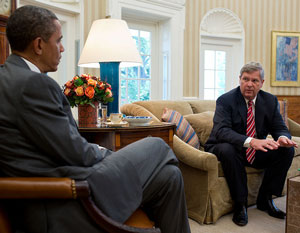 Calling it the “most serious situation we’ve had in 25 years,” Secretary Vilsack said the president is fully informed about the damage being inflicted by the weather on crops and farmers. “61% of the land mass of the United States is currently characterized as being impacted by this drought,” said Vilsack. “Our hearts go out to the producers, the farm families who are struggling with something they have no control over.” As of today, about one third of the counties in the United States are designated as secretarial disaster areas.
Vilsack said the drought will likely have an impact on food prices down the road, but warned that it may lead to price-gouging. “If people are beginning to see food price increases now, it is not in any way, shape or form related to the drought,” he said.
Best comment from Vilsack that is getting lots of airplay – “I get on my knees every day, and I’m saying an extra prayer now. If I had a rain prayer, or rain dance, I could do, I would do it. But right now the focus needs to be on working with Congress.” That comment was in response to a Christian media reporter’s question about whether Vilsack thought it was a good idea to have a national day of prayer and fasting for relief from the drought.
Great to listen to the questions from the mainstream media relating to agriculture that reflect how far removed they are indeed from the farm.
Listen to or download Vilsack’s press briefing here. Vilsack Drought Briefing
Thanks to USDA Radio’s Gary Crawford for sending me the briefing audio and @usdapress for tweeting the photo of the secretary and the president.
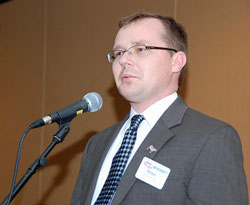

 Hello young agrimarkeing professionals. Want to get a leg up on your career and network with some of the best and brightest? Check out
  NCBA testified at an EPA hearing in Philadelphia Tuesday in opposition to any attempt to lower the coarse particulate matter (PM) standard as part of the National Ambient Air Quality Standards (NAAQS). Every five years, the EPA is required to review scientific studies associated with “criteria pollutants” regulated under the NAAQS of the Clean Air Act to determine if the pollutant is regulated appropriately. One of the criteria pollutants is PM, which includes dust. PM in arid western regions is made up primarily of mechanically generated crustal material, including fugitive dust. The coarse PM emitted from cattle operations is fugitive particulate matter or fugitive dust, which is the result of windblown dust and cattle movements. Because rural coarse PM is largely a natural phenomenon, it is extremely difficult to ensure compliance with the standard in dry, arid regions where coarse PM predominates despite use of best management practices.