Soil Health Summit Starts Today

Chuck Zimmerman

Soil Health PartnershipMy current home is the Alexander in Indianapolis where the Soil Health Partnership is about to kick off the 2016 Soil Health Summit. Cindy attended the first one last year. It’s my turn this year.

I’ll be sharing interviews with staff, supporters and farmer who are participating in the organization’s work. Here’s what the SHP 5 year initiative says:

Over the next five years, we plan to identify, test and measure management practices that improve soil health and benefit farmers’ operations. Right now, many farmers across the country are implementing innovative management practices that result in economic and environmental benefits. We plan to build upon the work of these farmers to provide connections between on-farm practices and improving soil health.

We believe the results of this farmer-led project will provide a platform for sharing information from farmers to farmers, with the support and resources to benefit farmers’ bottom lines and agricultural sustainability. We want to help provide the spark for greater understanding and more broadly implementing agricultural practices that work best.

Photos from the event can be found here: 2016 Soil Health Summit Photo Album

The Soil Health Partnership is a National Corn Growers Association Initiative, with Initial Support From Monsanto and The Walton Family Foundation and With Technical Support From The Nature Conservancy


Ag Groups, Conservation, Environment, NCGA, Soil, Soil Health Partnership

New Sustainability Initiative by @GROWMARK

Cindy Zimmerman

growmark-worldOne of the definitions of sustainable is “able to endure or continue for a long time” and that is the main characteristic that GROWMARK has chosen to focus on with a new system sustainability initiative.

GROWMARK Executive Director of Agronomy Marketing Ron Milby says the initiative fits in with the cooperative’s overall goals. “Our mission statement is ‘To improve the long-term profitability of our member-owners’ and I think with sustainability we can actually get there,” said Milby. “That’s why we’ve created a program called ‘ENDURE’ – what are the enduring management practices that keep our farmers profitable long term.”

growmark-milbyOne aspect of the new initiative is ENDURE Advocates for GROWMARK FS crop specialists. “What we’re trying to do with this advocate program is recognize and award those crop specialists that are doing a good job promoting sustainable business practices,” Milby explained.

Promoting pollinator health is also part of the ENDURE initiative, which has already been very successful, and they are working on other ways the concept of enduring sustainability will be promoted within the GROWMARK FS system and beyond. Sustainability is even the theme for GROWMARK’s 2016 Essay Contest for high school FFA members in Illinois, Iowa, Missouri and Wisconsin.

Learn more about GROWMARK’s sustainability initiative in this interview: Interview with Ron Milby, GROWMARK Agronomy

Agronomy, Audio, GROWMARK, Sustainability

#SpudNation Food Truck Chefs

Chuck Zimmerman

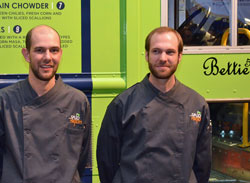
spud-nation-chefsBettie the Spud Nation Food Truck was unveiled in dramatic fashion last week at the 2016 Potato Expo, but while Bettie is pretty and shiny, what makes her really special is the unique potato recipes that she will be offering for spud lovers. That’s where United States Potato Board (USPB) Executive Chef Travis Howard and Chef Derek Johnson come in.

“Spud Nation is the first vehicle of its kind,” said Howard. “We’re owned by 2500 farming families, bringing you a field-to-fork potato adventure!”

Spud Nation food trucks are part of the new marketing and education programs launched by the USPB to carry the potato message to the expanding food truck market, estimated to be a be a $2.7 billion industry by 2017. The first adventure for Bettie and her chefs will be in the Denver market.

Learn more about Bettie in this video tour with Travis:


Potato Expo 2016 Photo Album

Coverage of the Potato Expo is sponsored by Coverage of Potato Expo is sponsored by Nufarm
Food, Potato, Video

Bipartisan Child Nutrition Reauthorization Passes Senate

John Davis

uscapitolThere’s not a lot that Republicans and Democrats can agree upon, especially in this election year, but a bipartisan bill that reauthorizes vital child nutrition programs brought them together. Senate Agriculture Committee officials say the “Improving Child Nutrition Integrity and Access Act of 2016,” reforms and reauthorizes child nutrition programs under the Richard B. Russell National School Lunch Act and the Child Nutrition Act of 1966 and brought praise from Farm Bureau.

“Folks said we couldn’t come to an agreement on child nutrition reauthorization – let alone a bipartisan agreement – but we did. This bipartisan legislation is a true compromise. Not everyone got everything they wanted, but a lot of folks have a lot to be happy about,” said Chairman Pat Roberts (R-KS). “This legislation ensures programs use taxpayer dollars more efficiently, gives local schools more flexibility in meeting standards, and focuses on fraud and error prevention.”

“This bipartisan bill puts the health of America’s children first,” added Ranking Member Debbie Stabenow (D-MI). “We are making sure our children get nutritious meals based on smart, science-based policies to give every child a fair shot at success. The investments made in this bill will give important new resources to fight hunger, from WIC to the summer meals program.”

The American Farm Bureau Federation sent a letter to the committee leadership supporting the measure and recognizing that it “improves flexibility for school lunch programs and reinforces dietary guidelines which include dairy, meat, fruits and vegetables, and grains.”

The letter stated that Farm Bureau is pleased that the proposed legislation includes provisions to boost milk and dairy product consumption through the National School Lunch Program.

“The Dietary Guidelines for Americans recommends three dairy servings per day and offering milk with each school meal helps to meet that goal,” Farm Bureau said. “School meal offerings should include milk or dairy products for the essential nutrients they provide to growing children, such as protein, potassium, vitamin D and calcium.”

AFBF, Ag Groups, Food, politics

What Now for WOTUS?

Cindy Zimmerman

vetoAs expected, President Obama yesterday vetoed a disapproval resolution passed by Congress that would have nullified the controversial clean water rule by EPA, better known as Waters of the U.S. or WOTUS.

“Because this resolution seeks to block the progress represented by this rule and deny businesses and communities the regulatory certainty and clarity needed to invest in projects that rely on clean water, I cannot support it,” the president said in his veto message.

The resolution was introduced by Senator Joni Ernst (R-IA), who criticized Obama’s action in a statement.

“(T)he President chose to side with an unchecked federal agency and empower un-elected Washington bureaucrats to expand their authority to control what’s done on private land,” she said. “It is clear President Obama did not take into account the comments, perspectives and legitimate concerns raised by those whom this expanded WOTUS rule directly impacts.” Ernst added that she remains “committed to identifying new ways to push back against this complex, burdensome and overreaching rule.”

National Corn Growers Association (NCGA) president Chip Bowling says the veto harms farmers. “We are disappointed in the President’s veto, especially in light of the recent GAO report that stated EPA engaged in ‘covert propaganda’ in an effort to sell the American public on this rule,” said Bowling. “This administration continues to ignore the will of Congress and the significant impact this will have on our country’s farmers at a time when they cannot afford more regulatory confusion and red tape.”

Several lawsuits over the rule are pending and a temporary nationwide stay on implementation of the WOTUS rule remains in effect.

Environment, EPA, NCGA, Water

Bio-Oil Produced Right on the Farm

Joanna Schroeder

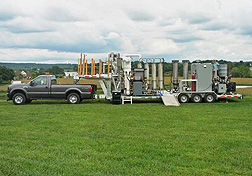
Soon farmers will be able to produce bio-oil right on their farm. The renewable fuel can be produced from agricultural and food waste using a new mobile unit. The goal of USDA project is to be able to distill this bio-oil in existing petroleum refineries.

TGRP mobile Unit

ARS scientists are testing this mobile pyrolysis system for on-farm production of bio-oil from agricultural waste.

The research team, headed by Agricultural Research Services (ARS) chemical engineer Akwasi Boateng with the Sustainable Biofuels and Coproducts Unit at the Eastern Regional Research Center in Wyndmoor, Pennsylvania, is working on a modified pyrolysis technique called “tail-gas reactive pyrolysis” (TGRP). Traditionally, pyrolysis uses very high heat and the resulting product is not compatible with current distillation equipment at petroleum biofineries due to its highly acidic and high oxygen content. The fuel also requires the addition of an expensive catalyst.

Now, however, using waste materials, bio-oils are being produced at an accelerated rate using a new high-output mobile processing unit funded by a Biomass Research and Development Initiative Grant from USDA’s National Institute of Food and Agriculture. Instead of shipping large amounts of agricultural waste to a refinery plant at high cost, the mobile reactor allows conversion of the biomass into energy-dense bio-oil right on the farm. In addition, this bio-oil is a higher quality bio-oil that is more marketable to biofuel producers than bio-oil made from traditional pyrolysis methods.

“Ideally, the biofuels added to gasoline would be identical to fuels produced at petroleum refineries,” Eklasabi told AgResearch Magazine. “The quality of TGRP deoxygenated liquids is equal to or better than the bio-oil produced by catalyst pyrolysis.” And, added Eklasabi, bringing the bio-oil one step closer to being able to be distilled at existing petroleum refineries.

Agribusiness, Biofuels, USDA

Straight from the Nufarm Zebra’s Mouth

Chuck Zimmerman

nufarm-zebra-hatWe’ve been telling you about Chip, the Nufarm zebra, who was at the 2016 Potato Expo last week – and if you check out the Potato Expo photo album you’ll see quite a few of Chip – but we wanted to get the story straight from the zebra’s mouth. So, I had a little chat with the striped star to find out just why he agreed to join Nufarm at the expo.

Chip’s main mission was to let people know about Nufarm’s research into bactericides that have the potential of controlling zebra chip. “Zebra chip is a disease that causes potato growers a lot of problems and as a zebra named Chip, I took a personal interest in this threat because frankly I thought it was damaging the zebra’s reputation,” said Chip, who actually is a little shy so he spoke through Nufarm marketing director Brian Rund. “I’m considered quite photogenic … so we invited people to take selfies – or “zelfies” as I call them – and we tweeted them out and it went great!”

The zelfie participants were all entered into a drawing to provide Chip with a new home and the winner was Lucy Zhu from Edmonton, AB. She is very happy to welcome Chip into his new home.

Besides getting a new home, some of Chip’s highlights at the Potato Expo were visiting the Simplot igloo and working in the Spud Nation food truck. Listen to the interview with Chip here: Interview with Chip the Nufarm Zebra

Potato Expo 2016 Photo Album

Coverage of the Potato Expo is sponsored by Coverage of Potato Expo is sponsored by Nufarm
Audio, Crop Protection, Nufarm, Potato

Chile & Peru Slated for Stops on USDA Trade Mission

John Davis

USDATwo South American countries have been slated for a U.S. Department of Agriculture (USDA) trade mission. This news release from the agency says Agriculture Secretary Tom Vilsack will lead a trade mission March 14-18 to expand export opportunities for U.S. agriculture in Chile and Peru.

“Thanks to existing free trade agreements, the United States enjoys strong trading relationships with both Chile and Peru,” said Vilsack. “In addition, both nations are part of the Trans-Pacific Partnership, which if implemented will boost the Chilean and Peruvian economies and tighten integration with the U.S. economy, helping further expand demand for U.S. agricultural products.”.

The United States entered into a trade agreement with Peru in 2009 that slashed agricultural tariffs and improved market access for many U.S. products. As a result, U.S. farm and food exports to Peru have nearly tripled, reaching a record $1.25 billion in fiscal year 2015. In the Chilean market, all U.S. products enjoy duty-free access as of 2015, thanks to the free trade agreement enacted in 2004. Since 2004, U.S. exports to Chile have grown more than 500 percent, totaling $803 million in fiscal year 2015.

“In both Chile and Peru, steady economic growth and an expanding middle-class population are fueling demand for high-quality, made-in-America food and agricultural products. Now that the United States enjoys open access to these markets, it’s a great time for U.S. companies – especially small- and medium-sized enterprises – to start or expand their exports there,” Vilsack said.

International, Trade, USDA

NCGA Gains Insight During Priority and Policy Conference

John Davis

NCGA-LogoMembers of the National Corn Growers Association were able to gain some great insights during their recent annual Priority and Policy Conference held in St. Louis. This news release from NCGA says the meeting brought together a wide array of stakeholders for discussions on the direction and the future of the organization.

“This meeting consistently provides a chance for NCGA leadership to gain valuable insight from our state affiliates while fostering deep discussions that help all of us examine the issues more fully,” said NCGA President Chip Bowling, a grower from Newburg, Md. “This year, NCGA focused on finding new and innovative ways to foster discussion and deepen our exploration of the issues. The insight and ideas our attendees brought to discussions will provide us with sound guidance upon which to base effective, impactful plans for the upcoming years.”

The meeting includes chairs, presidents and executive directors of NCGA’s state organizations, as well as chairs and vice chairs of the organization’s action teams and committees. For two days, these leaders discussed organizational policy and their perspective on the relative importance of each issue facing the industry. As each party provided their own unique perspective, a clearer picture of the overall views held by corn farmers across the United States came into focus.

Again this year, as part of a collaborative initiative with the U.S. Grains Council, the Priority and Policy Conference also included leadership from that organization for a discussion of USGC priorities and trade issues.

Ag Groups, NCGA

Real Interviews with Real Growers about LibertyLink

Chuck Zimmerman

Bayer Liberty LinkIf you listen to farm radio you probably have heard spots for Bayer’s LibertyLink system. Last fall they included promotion for the RealYield game which ended December 31, 2015. Those commercials, moderated by Cindy, came from real interviews with real growers like Reid Atha from northwest Missouri. I thought you might want to hear one of the full interviews instead of just a sixty second spot.

I asked Reid what the biggest challenges are to farming in his area. Last year it was the weather but on a year to year basis it is weed control. He says that he’s going into his third season using the LibertyLink system. During the 2015 season he saw excellent weed control even with the weather challenges. As he puts it after treating with Liberty, “It smoked everything.” He didn’t plant a single bean until June 14th last year but says his yields were excellent.

Listen to my interview with Reid for his full story: Reid Atha, Missouri

Sponsored Post

Agribusiness, Audio, Bayer, Soybean