GMO Infographic Shows Impact on Water Conservation

Jamie Johansen

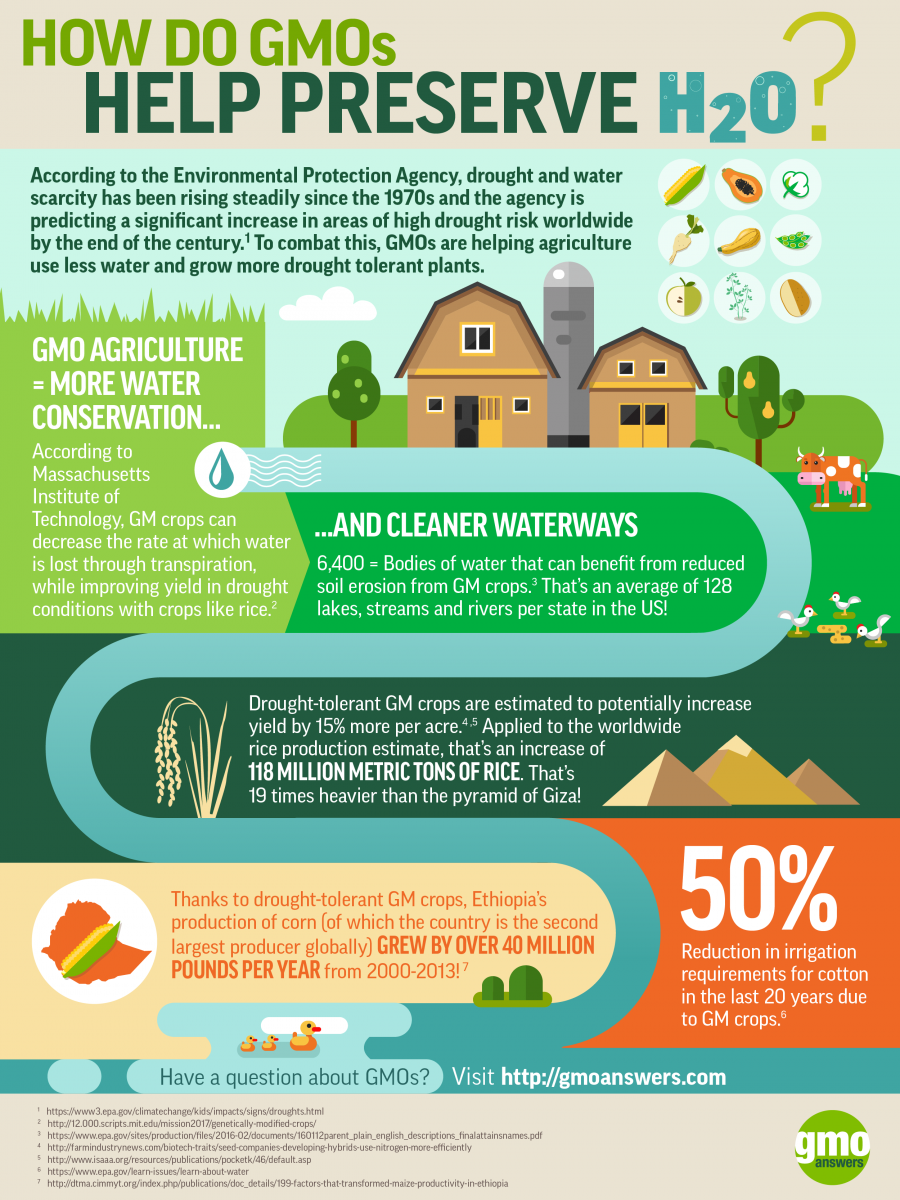
GMO_Answers_DataCard_2016-08-15_GMO AnswersGMO Answers released a new infographic to educate consumers about how GMOs help conserve water usage in agriculture in honor of World Water Week.

Water is one of the most important factors in producing food, fuel and fiber, and preserving water is critical to agriculture’s sustainability. With changing weather patterns and an increased number of widespread droughts – water conservation continues to be a challenge and priority for communities around the world. Advancements in biotechnology such as drought-tolerant, genetically modified (GM) crops are one solution to helping farmers use less water and reduce irrigation needs.

“Water is precious, which is why choosing sustainable practices to help resolve ongoing environmental challenges is so important,” said Kate Hall, managing director of the Council for Biotechnology Information and GMO Answers spokesperson. “We’re pleased to share our new infographic in celebration of World Water Week and to continue our education efforts to show the public how GMOs help protect and preserve our limited, natural resources.”

According to the United Nations, by 2025 1.8 billion people will be living in countries or regions with absolute water scarcity, and two-thirds of the world population could be under stress conditions.2 GMO Answers’ “Water Preservation” infographic illustrates how GMOs allow farmers to do more with less to conserve water and grow more drought tolerant plants:

– GM crops have helped reduce the irrigation needs of U.S. grown cotton by 50 percent over the last 20 years.
– GM crops can decrease the rate at which water is lost through transpiration, while improving yield in drought conditions with crops like rice.
– Nearly 6,400 bodies of water can benefit from reduced soil erosion through the usage of GM crops. That’s an average of 128 lakes, streams and rivers per state in the U.S.

Ag Groups, Food, GMO, Precision Agriculture, Water

Report Projects Increased Challenges For Ag Retailers

Lizzy Schultz

cobank logo A new report from CoBank has revealed that accounts receivable at farm supply co-ops and other ag retailers are growing, and so are the challenges they face.

The report shows that retailers are adjusting to a tougher economic environment accompanying the down-phase of the current ag commodity cycle, as current headwinds are directly related to the sharp decline in commodity prices that have reduced farm income and tightened farm cash flows. The downturn in fertilizer prices, along with a spate of mergers and acquisitions in the seed and fertilizer industry, have also aligned to further create adversity for ag retailers going forward.

“The drop in farm income over the past three years is the steepest decrease since the Depression,” says Tanner Ehmke, CoBank senior economist covering the grains, oilseeds and ethanol, and farm supply sectors. “Producer incomes have fallen more than 50 percent from 2013 to today and their debt-to-income ratio is on the rise. Not surprisingly, total accounts receivable for ag retailers posted an 11 percent gain for 2015, and that’s expected to grow in the year ahead due to ongoing farmer cash flow challenges.”

Retailers have become unsure about demand opportunties as farmers are continuing to stretch existing credit lines, cut costs and reduce pre-pay practices, creating a more price sensitive market that has formed additional competitive pressures on ag retailers.

Falling fertilizer prices have also made it difficult for retailers to maintain positive margins, and forecasts are calling for this slide to continue through 2017 as commodity values remain under significant pressure from abundant supplies in the United States and throughout the world.

“The biggest challenge for ag retailers going forward will be to manage inventory to sync with demand,” notes Ehmke.

The new wave of consolidation occurring throughout many major seed and crop protection companies is also creating increased ambiguity and insecurity about product offerings, prices, and competition in the industry, making retailers concerned about the potential consequences that reduced competition could bring to the surface. The consolidation wave could also leave ag retailers with less bargaining power, potentially reducing their ability to negotiate prices or rebates on volume sales.

Ehmke did mention that, on a positive note, USDA’s projections for 2016 call for only a 2 percent reduction in net farm income year-over-year, compared to 2015 when net farm income dropped 38 percent year-over-year and 2014 when it dropped 27 percent.


Ag Groups, Agribusiness, Farm Credit

Culver’s Grows 19 “Thank You Farmers” Mazes

Jamie Johansen

inside-culvers-thank-you-farmersFrom food to fuel, there are more than 4,000 uses for corn across the world. This year Culver’s restaurants added one more use to the list: thanking farmers.

The restaurant chain wouldn’t be what it is today without the hardworking farmers who grow the food that’s proudly served in its restaurants. That’s why Culver’s worked with farmers across the country to grow 19 larger-than-life “Thank You Farmers” mazes—including a sunflower maze in Florida—planting more than 5,360,000 seeds of gratitude for American farm families.

“Culver’s is passionate about creating ways to say thank you to farmers, letting them know that their hard work is appreciated,” said Jessie Corning, senior marketing manager. “We’re excited that our guests across the nation can join us in showing gratitude by visiting these mazes.”

These mazes are part of Culver’s Thank You Farmers program, which recognizes the hard work and commitment of the farmers who produce wholesome food to feed our nation. To date, the Thank You Farmers initiative has raised nearly one million dollars in support of the National FFA Organization and Foundation, local FFA chapters and a variety of local agricultural organizations.

Agribusiness, Corn, Farming, Food

#IFAJ2016 Tour – Part 9 – Bayer ForwardFarming

Chuck Zimmerman

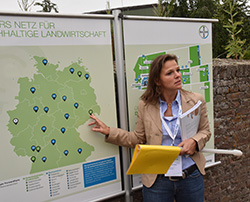
Belinda Geisen-DruseWith only a few episodes left in my series from the 2016 IFAJ Congress Bayer Tours we’ll continue the focus on the Bayer ForwardFarming Initiative. In this episode we got a look at the the bigger picture in Germany which includes Damianshof Farm near Neuss. Walking us through the overview was Belinda Geisen-Druse.

In Germany there are 22 farms that cooperate with Bayer’s ForwardFarming Initiative. These farms make use of three basic components of Bayer ForwardFarming:

1. Integrated crop solutions – these are based on the use of high quality seeds as well as chemical and biological crop protection products. The company offers agronomic consulting and diagnostics for weed, disease and pest control.

2. Proactive product stewardship – this stands for safe and high product quality, including the continuous improvement of operator and consumer safety as well as environmental protection.

3. Partnerships – these are between all players along the value chain to ensure that the full potential of modern agriculture is leveraged for the benefit of all stakeholders.

You can listen to the presentation here or watch below: Belinda Geisen-Druse Overview


2016 IFAJ Congress Photo Album

Coverage of the IFAJ Congress is sponsored by Coverage of the IFAJ Congress is sponsored by Bayer
Agribusiness, Audio, Bayer, Environment, Farming, IFAJ, Sustainability, Video

Rural Infrastructure is Hot Topic

Cindy Zimmerman

AEMagripulseHope you are planning on attending the Rural Infrastructure Summit, sponsored by the Association of Equipment Manufacturers (AEM), in conjunction with Agri-Pulse Communications. The event is being held Monday, August 29 in Ames, Iowa, the day before the 2016 Farm Progress Show kicks off right next door in Boone.

AEM Senior VP Charlie O’Brien says they are working with Agri-Pulse to bring more awareness to the infrastructure issues facing rural America. “We are looking towards the future and don’t see a lot of movement in Washington DC in terms of fixing the infrastructure we’ve got,” said O’Brien. “We want to raise the visibility of how important this issue on infrastructure is and then start to develop the solutions.”

aem-obrienHe adds that roads, bridges, locks and dams that need repairs and improvements impact agriculture in a number of ways. “We’re moving fairly significant equipment from farm to farm,” O’Brien said. “Then we also have the movement of the product from the farm to the market.”

The program will consist of two panels moderated by Sara Wyant, Editor of Agri-Pulse – “Rural Infrastructure and the Ag Economy: The Good, the Bad and the Ugly” and “Disruptive Innovation: Not Just for Silicon Valley.” The summit will be held at the Iowa State Center’s Scheman Building, in Ames from 2:00 pm – 5:00 pm and followed by a networking reception.

Learn more in this interview with Charlie and watch for our coverage from Ames: Interview with Charlie O'Brien, AEM

AEM, Agri-Pulse, Audio

Media Ready for Farm Progress Show

Chuck Zimmerman

Farm Progress Show Media DayThis week agricultural media members took part in a tour of the Farm Progress Show near Boone, IA. ZimmComm team members were not able to go but we could see who was there via social media!

At the Farm Progress Show Media Day attendees heard from FPS staff and then got onboard the shuttle to tour around and see what’s new. It’s a very handy opportunity for those of us covering the event when we have a short time to be somewhere for an appointment.

Cindy, Kelly, Clint, Joanna and I are making final preparations for our coverage this year. We want to thank our sponsors that include New Holland, GROWMARK and BASF. We’ll be setting up on Monday afternoon and hope everyone traveling to the show is safe and that we have good weather this year.

Coverage of the Farm Progress Show is sponsored by
Coverage of the Farm Progress Show is sponsored by New HollandCoverage of the Farm Progress Show is sponsored by BASFCoverage of the Farm Progress Show is sponsored by Growmark
Farm Progress Show, Media

New Farm Podcasting Tools

Chuck Zimmerman

Farm Podcasting ToolsIt has been a while since I’ve seen some new farm podcasting gadgets that really interested me. However, I have just acquired several from Zoom North America that I’ll be working with next week in Iowa during the Farm Progress Show. Let’s get started.

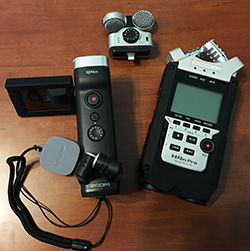
In the photo you can see:

Zoom H4n Pro Handy Recorder – This audio recorder is a little larger than what I’m used to but still compact enough for extreme travel on the agriblogging highway. Besides adjustable built-in microphones, I can plug in the Golden ZimmComm Microphone or audio from another source. It records up to four separate audio tracks too. I’m pretty much a mono sort of guy for small file size interviews, etc. that are easy for our audience to download but I like the possibilities. There are actually a couple new versions of this recorder but they are more than I wanted to spend and have more features than I need.

Zoom Q4n – I have been looking for a small form camera that will record HD video and awesome sound. That’s what this device promises. We’ll see. It will also record audio only if that’s what I want. I can plug in an external microphone or audio source when needed. I’m interested in quality and battery life and will be giving it a workout.

Zoom iQ7 – I started using my iPhone to record interviews with an earlier version of this device. The new iQ7 is a major improvement and very simple to use. There are just times when I don’t want to carry a microphone/recorder/cable and this is well, just plain handy. I use the Zoom Handy Recorder App with it too btw. I just have to remember to turn my iPhone on airplane mode and I’m good to go.

So there you have it. Three new farm podcasting tools for you to consider for your Mojo (mobile journalism kit). I’ll let you know more after I’ve put them through their paces.

Gadgets, Podcasts

Feeding America PSA Featuring Voice of Julianne Moore

Jamie Johansen

Feeding AmericaFeeding America has partnered with the Ad Council and McCann New York to launch new public service advertisements (PSAs) designed to raise awareness about child hunger in the United States. Featuring the voice of Julianne Moore, who volunteered her time and talent, the PSAs call upon Americans to help children facing hunger in America by supporting the Feeding America nationwide network of food banks.

Research shows that proper nutrition, particularly in the first three years of life, is critical to a child’s physical and emotional development. Children from families struggling with hunger may be more likely to:
– repeat a grade in elementary school;
– experience developmental impairments in areas like language and motor skills; or
– have more social and behavioral problems.

“Hunger is harmful to people of all ages, yet we know it is particularly devastating for children,” said Diana Aviv, CEO of Feeding America. “We hope that these PSAs serve as a wake-up call on behalf of children in every community in our nation who need our help, whose basic needs are not being met.”


Advertising, Ag Groups, Food

Agrible & The Equity Partner to Offer New GoSmart Tools

Kelly Marshall

agrible-logo Agrible, Inc. and The Equity (formerly Effingham Equity) are working together to offer the predictive analytics tools inside Agrible’s Morning Farm Report to The Equity’s GoSmart Analytics customers. GoSmart Analytics users can now access industry-leading data insights as well as help with on-farm decision making.

By signing up for GoSmart Analytics, growers receive up-to-date weather forecasts, in-season yield forecasts, and the ability to benchmark yield results with other GoSmart customers. They also receive a Morning Farm Report account with access to forecasts and recommendations on pests, nutrient availability, and more. For an additional fee, growers can add the Morning Farm Report Field Logistics AgriBundle, which includes hour-by-hour field conditions, soil temperatures, wind speed and direction, and a pollinator risk guide.

The Equity“The Equity has built a reputation as a leader in innovation and service,” said Chris Harbourt, CEO of Agrible. “Their philosophy is a perfect fit for Morning Farm Report, and we look forward to bringing the power of big data to their GoSmart Analytics customers.”

The new system will allow GoSmart Analytics customers to use the Morning Farm Report’s predictive analytics for planning and data-based decisions. Then at harvest growers can benchmark their return on investment for each field without needing to add their data to another system.

“With GoSmart Analytics, we are looking to turn big data into value for our customers,” said Tim Bence, Agronomy VP at The Equity. “We’re confident that the predictive analytics tools in Morning Farm Report will compliment the GoSmart system and help us accomplish that goal.”

Learn more from your salesperson or find additional details at www.TheEquity.com.

Ag Groups, data

NAMA Professional Development Award Winners

Jamie Johansen

NAMA LogoNAMA announced the winners of the 2016 Professional Development Awards. Each year, NAMA recognizes industry leaders at the very top of their respective fields. These prestigious awards acknowledge excellence in the areas of marketing communications, public relations and sales.

The 2016 Marketing Communications award recipient is Marcy Tessman, President and Partner at Charleston|Orwig. In her tenure with Charleston|Orwig, she has risen from account service to agency partner and president. She works with clients throughout the food system while ensuring that the agency provides flexible, positive career paths for every member of the team. Her specialty is to ensure that client brands are well defined and resonate with their respective audiences. She has led major branding initiatives with clients in production agriculture as well as consumer-facing retail food brands including Arm & Hammer Animal Nutrition and Zoetis. Marcy is active in the Badger NAMA Chapter, having helped organize activities over the years. She has served as a judge for the Student Marketing Competition and advisor to the UW-Madison Student NAMA Team.

The Professional Development Award for Public Relations goes to Bill Brozak, Director of Communications for Colle+McVoy/Exponent PR. Bill is a leader of the agency’s agriculture practice. His expertise has played a vital role in expanding business for some of the agency’s leading agriculture clients, which include the Land O’Lakes agriculture brand, Winfield. Additionally, he has developed successful communications programs for clients such as Granular, Progressive Ag Foundation, Purina Animal Nutrition, DTN/The Progressive Farmer, Schneider Electric, General Mills and others. Bill has been an active NAMA member for five years, serving as treasurer, vice president and active president of the North Central NAMA Chapter. Over the years, he has helped plan events, recruit members and facilitate relationships between the organization’s members and agency clients.

Matt Herman is awarded the Professional Development Award for Sales. As Associate Publisher for DTN/The Progressive Farmer, Matt continues to be the leader in elevating the print, digital, custom publishing and event offerings of the company within the agricultural advertising community. In addition to serving as the strategic lead on key agricultural accounts, Matt has direct sales responsibilities on some of the most impactful ag partners to the media business. He was integral in launching the first ever DTN/Progressive Ag Summit and has been a leader in developing programs and opportunities that combine the integrated offerings of the DTN digital platform with The Progressive Farmer. A long-time member of NAMA, Matt has been engaged as a committed leader in the North Central Chapter, as well as on a national level as a member of the Boot Camp Committee.

Ag Groups, Marketing, NAMA