
I think it’s a sign of the times. Some might says it’s because of the economy. I don’t. The media has changed and it’s not going to change back to the way it was.
Thanks to a heads up from Steve Drake, Drake & Company, I learned that the American Society of Newspaper Editors has canceled their 2009 Convention. Here are some particularly telling excerpts from their news release. I’ve highlighted some elements myself:
This is only the second time since ASNE was founded that it has foregone holding a convention. ASNE also canceled its convention during the last critical days of World War II in 1945.
In the meantime, Hall said the organization will increase reliance on the Web to help editors share what they are learning as they reinvent their news organizations for multiple platforms.
ASNE had planned votes at the Chicago convention on bylaws changes that would drop “paper” from its name and expand its membership to include editors of online-only news Web sites and leading journalism educators. That, and the annual election of new board members, will now occur electronically.
“We intend to press on with our transformation of ASNE to ensure its relevance in the digital age,” Hall said. “As we broaden our membership, we will aggressively advocate for innovation in journalism, access to public information, First Amendment rights, diversity and ethical standards.”
How are ag communications groups continuing to be relevant to their members? I’ve mentioned that the lines between print, broadcast and web are blurring. If we’re all doing the same things (photos, video, audio, writing, web editing, social networking) do we still need multiple organizations? Are we duplicating efforts? I’m just posing the questions. I’m a member of all the different ag groups and I’m seeing less differences in them all the time, especially when you have a growing amount of crossover membership with companies that are using multiple communications platforms.
I think this concept of media change needs to also be taken into consideration by ag organizations who hold conventions and meetings to which they invite and credential the media. When was the last time you reviewed your policies? How are you keeping the services you offer relevant and useful to the media attending?
 In this week’s program you get to meet Brooke Hoelscher and Megan Ott. They’re the Monsanto Future Ag Journalist Fellowship students who were set up to cover the Commodity Classic on blogs created by Monsanto –
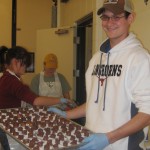 For animal and meat science students from across the country, the opportunity was available to take part in these legendary training sessions at the American Meat Science Association Student Leadership Conference held on Feb. 23-25, 2009 in Las Vegas, Nev. Five South Dakota State University participants competed in a meat product development contest during the event with chocolate, peanut butter, cinnamon bacon rolls. I know…intense. I had the opportunity to try these bacon rolls, and I can assure you that they were delicious (calorie count aside). Pictured here is SDSU team member, Jarrod Bumsted, with his bacon rolls.
 Everyone at Commodity Classic this year seemed to be impressed that attendance was as good or better than ever, despite the economy.
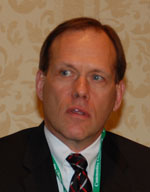 Rick says he was pleased to see the producer organizations for four different commodities coming together for the first time under one banner. “We’re too small in agriculture to be fighting among our selves,” Rick said. “Things like Commodity Classic bring us together and help us realize how much we have in common.”
 and
and 
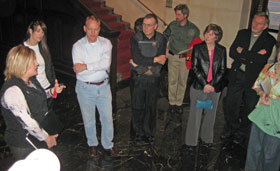 The IFAJ/AMS planning committee got together since so many of us ag media types were in town for Commodity Classic. Yesterday the group went to Billy Bob’s and the Stockyards before heading to the upcoming conference hotel, the
 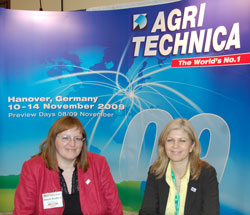 Agritechnica representatives Annette Reichhold (left) and Dr. Malene Conlong were talking with farmers at the Commodity Classic this week about planning a visit to Hanover, Germany for the event November 10-14.
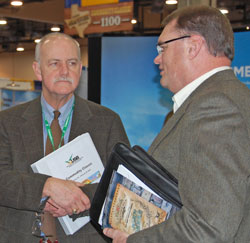 As things slowed down today I got to sit down and visit with Hugh about his new position. It made for a good Commodity Classic week ZimmCast. Hugh is a very good friend and I’m glad for this opportunity he has. He’s be working on obtaining, managing and working with farmer driven organizations, not for profit groups, agricultural associations as well as governmental organizations. This fits right in with the kind of work that he’s been doing which includes working with the United Soybean Board and other checkoff groups.
 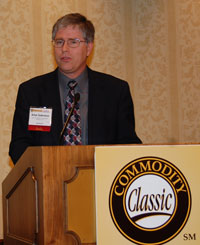 BASF hosted a panel at the conference to examine how today’s technology can help manage disease in wheat and cereals to meet the growing global demand for grain. The panel featured analyst Arlan Suderman of
 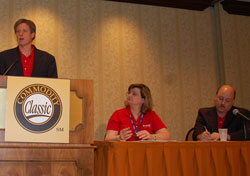 After Suderman’s comments, BASF technical experts on plant disease, Drs. Gary Fellows and Gary Schmitz, talked about how BASF products can help increase global production of wheat and other cereal grains by controlling the most aggressive diseases that affect those crops.
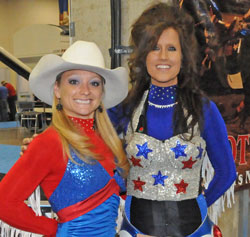 Trish Lynn (r) and the