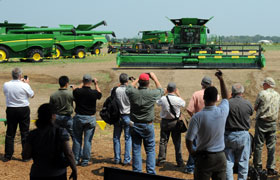
 It’s always great to see farm broadcasters as featured speakers at events, so it was fun to see our good friend Dale Minyo with the Ohio Ag Net as luncheon speaker at the Conservation Technology Information Center tour August 9 in Northwest Ohio.
Dale talked about the importance of messaging for agriculture. “Sometimes we’ve got to clear up the message,” he said, using the example of increasing profitability in farming. “The way we’ve been able to make a profit is we’ve become more efficient,” Dale said. “It’s more about efficient, it’s about environmental concerns, it’s about being more effective about what we’re doing.”
Dale was pleased that the CTIC chose the Ohio region around Lake Erie to showcase some of the important initiatives that farmers are doing.
Listen to my interview with Dale here: Dale Minyo on CTIC Tour
 The luncheon where Dale spoke was on the Mavis Farm near Edgerton, Ohio. The corn and soybean operation is a fourth generation farm owned by Gary Mavis (pictured) and his wife Pat with son Scott and his wife Jenny. Gary says they follow a corn-soybean rotation on nearly 3,000 acres and divide each field into different yield zones. “We started yield mapping back in ’95 and after a few years of collecting data was able to established yield zones that we felt comfortable with,” he said. “Now we’re applying fertilizer based on those yield zones and we’re varying the rate as we go across the field it might varying 150-200 pounds depending on what the soil test has showed.”
That results in more efficient use of fertilizer and lime, less pounds applied, and money saved.
Listen to my interview with Gary here: Gary Mavis on CTIC Tour
CTIC 2011 Conservation in Action Tour Photos
AgWired coverage of the CTIC Indian Creek Watershed Field Tour is sponsored by AGROTAIN John Deere has been a partner with CTIC since the T stood for Tillage. Now the T stands for Technology, and John Deere’s relationship with the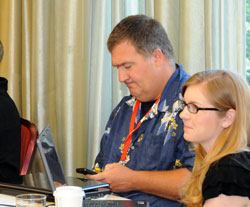
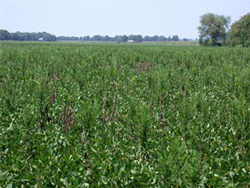 The problem of resistant weeds, especially glyphosate-resistant broadleaf weeds, continues to become more worrisome, but some weeds have always had a tolerance for certain weed killers.
 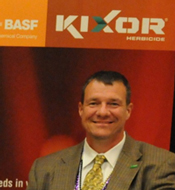 Resistance is different because it develops over time. “With resistant weeds, you’ve gone from getting essentially total control of a population to selecting a biotype, or individual weed that has the ability to tolerate that herbicide,” and Dan says those resistant biotype populations can then expand and dominate in a field.