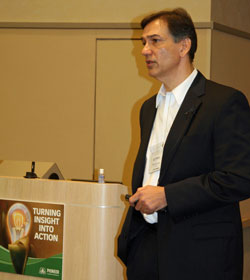
Outstanding Young Farmers Attend Ag Day Activities

Chuck Zimmerman

During National Agriculture Day activities we heard from 2011 National Outstanding Young Farmer Chad Budy and his wife Danielle from Oklahoma. They were introduced during our Meet & Mingle lunch. Chad and Danielle were introduced by Orion Samuelson.

Both Chad and Danielle come from families with five generations in farming. They have a diversified farm of row crop and livestock. You’ll hear why they’re considered outstanding in their remarks.

Listen to remarks from our Outstanding Young Farmers here: Remarks from Outstanding Young Farmers

2012 National Agriculture Day Activities Photo Album

Coverage of the 2012 National AgDay Activities is sponsored by the American Seed Trade Association
Ag Groups, Audio

The Expanding World of Hog Feed Choices

Cindy Zimmerman

Once upon a time, commercial hog diets consisted mainly of corn and soybeans, but the menu has greatly expanded out of necessity since commodity prices increased a few years ago.

That expansion has brought with it both opportunities and challenges for producers, according to Iowa State University Professor of Animal Science Dr. John Patience, who spoke to swine veterinarians last week at the Boehringer Ingelheim Vetmedica (BIVI) Swine Health Seminar in Denver. “Corn and soybean meal are relatively uniform ingredients. Now that we’ve moved to using products like wheat middlings, bakery by-products, and distillers grains, those are ingredients that are quite variable in their nutrient composition. So, we have to do a lot more quality control, for example,” he explained. “We also have to make sure when we use these ingredients that they fit into our feed manufacturing system since some of them are a lot less dense, bulk-wise.”

Dr. Patience says we are seeing diets now with 20% or less corn in them. “Right now the Europeans have a lot more experience with using these diverse kinds of diets than we do, but we’re catching up,” he said, adding that the U.S. pork industry is extremely innovative and responsive to new information “and that has really shown itself remarkably well in the last five years.”

Listen to my interview with Dr. Patience here: ISU Animal Scientist Dr. John Patience

BIVI Summit at Mile High 2012 photo album

Audio, Boehringer Ingelheim, Feed, Pork, Swine

Increasing Productivity Through Innovation

Chuck Zimmerman

I met Lykele vanderBroek, Global COO, Bayer CropScience, during the 2012 Ag Issues Forum. He was on the welcoming committee to all the media who attended this event. When it was my turn for an interview with him I asked him what take away message he wanted us to have. He says that global trends like increasing population, higher affordable income, dietary shifts and others, contrasted with our inability to add much more farmland, make it important to increase productivity both in terms of quantity as well as quality. Lykele believes we can only increase productivity through innovation and that it should be done in a sustainable way so we can continue to do so in the future. He thinks that innovation needs to be centered around the grower keeping in mind what his customers want.

When it comes to how Bayer CropScience is creating customer solutions to the issues created by these trends he points to their investment in research and development of new products. They also want their products to be used in a responsible way. An example of how they encourage this is with their Respect the Rotation Initiative.

You can listen to my interview with Lekela here: Interview with Lykele vanderBroek

2012 Bayer CropScience Ag Issues Forum Photo Album

Agribusiness, Audio, Bayer, Biotech

Important Issues to Sorghum Producers

Chuck Zimmerman

During Commodity Classic I got to visit with Terry Swanson, Chairman, National Sorghum Producers. I asked him what his message is to not only sorghum producers but all the farmers belonging to the four commodity groups at Classic and he says, “We have to be unified.” He says that altogether they’re still a small group of people that need to speak with one voice.

Terry farms in Colorado which he calls the “epicenter of the dust bowl.” This means that a safety net and crop insurance are critical for them. Conservation is also an important issue for him. He says that NSP is looking at ways that the sorghum crop can play a role in water conservation. He also says that a third of the sorghum crop is used to make ethanol, a third to livestock feed and a third is exported. Biofuels and issues surrounding them like the RFS are very important to sorghum producers. He says the RFS creates markets and that’s important to producers.

Listen to my interview with Terry here: Interview with Terry Swanson

2012 Commodity Classic Photo Album

Coverage of the 2012 Commodity Classic Show is sponsored by BASF and New Holland
Ag Groups, Audio, Biofuels, Commodity Classic, Ethanol, NSP, sorghum

Stabilized Nitrogen For Faster Plant Start

Chuck Zimmerman

The Director for Agronomy for Koch Agronomic Services, Greg Schwab, visited with me in the media room at Commodity Classic. Greg runs the company research program. He says they have twenty five land grant universities working on their products. He coordinates that effort.

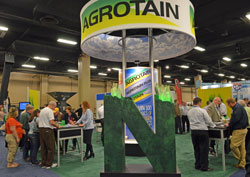
Since it’s planting season I asked him what advice he has for growers. Greg says that with farmers managing larger amounts of land these days it is becoming increasingly important to get in the field to plant quickly and that the planting date means a lot in terms of final yield. He points to their AGROTAIN nitrogen stabilizer which allows a farmer to use a broadcast application of urea instead of a more traditional incorporated or injected application. The AGROTAIN treated urea prevents volatilization loss that would normally occur with surface applied urea. This means a faster start for plants. He says growers are also finding a split application helpful.

Listen to my interview with Greg here: Interview with Greg Schwab

2012 Commodity Classic Photo Album

Coverage of the 2012 Commodity Classic Show is sponsored by BASF and New Holland
Agribusiness, Audio, Commodity Classic, Fertilizer

How #1 Pork Producer Deals With High Feed Costs

Cindy Zimmerman

When you’re the number one pork producer in the world, higher feed costs take a big bite out of the bottom line.

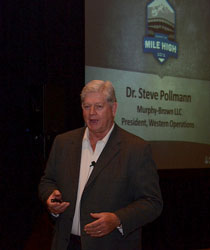
At the Boehringer Ingelheim Vetmedica (BIVI) Swine Health Seminar in Denver, Dr. Steve Pollmann, President of Western Operations for Murphy-Brown, LLC shared some of his thoughts on dealing with high feed costs in commercial pig production. “We’re the live production part of Smithfield Foods,” he said. “We have about 850,000 sows located in 12 different states and we produce about 17 million pigs.

That’s a lot of pigs to feed, so when feed costs go up, the cost of production can increase dramatically. “We all know that feed is the biggest single cost of production,” Steve said. “A 25 cent change in corn price per bushel, with that comes a $20 change in soybean price, all of the sudden you’ve got a $1.60 a hundredweight cost of production (increase).” He says the higher feed costs in the last five years or so have meant feed as a percentage of total production costs has risen from 60% to 70%.

Like all pork producers, Murphy-Brown has had to adjust to the higher feed costs by becoming more efficient. “When things get that kind of difficult, you’ve got to get better and if you don’t, you die,” he said.

Listen to my interview with Dr. Pollmann here: Dr. Steve Pollman, Murphy-Brown

BIVI Summit at Mile High 2012 photo album

Audio, Boehringer Ingelheim, Feed, Pork

Get Registered For 2012 Agri-Marketing Conference

Chuck Zimmerman

You will find Acres of Innovation at the 2012 Agri-Marketing Conference. Let’s start with the featured speakers. Get registered now if you haven’t done so yet.

How do you turn good ideas into action that influences customer behavior and accelerates the buying process? How do you grab market share and stay relevant to your clients and customers for years to come? What are the simple tools you need to rebound from setbacks stronger than ever? Join NAMA for the 2012 Agri-Marketing Conference and get the answers to these pressing questions and more!

This year’s keynote speakers are going to flip your thinking and challenge you to ask yourself the tough questions that will set you apart from the pack. Learn to identify and amplify your unique strengths to focus, stay on track and deliver remarkable results.

  • Opening General Session – Peter Sheahan – Making It Happen: How to Turn Good Ideas Into Great Results
  • Second General Session – Ross Shafer – Are You Still Relevant?
  • Closing General Session – Walter Bond – No One Can Stop You, but YOU


Listen to Peter Sheahan give you a preview of what you’ll find. You might want to be there just to hear his accent!

Ag Groups, NAMA

Dupont Cellulosic Ethanol Program

Chuck Zimmerman

During the recent Pioneer Hi-Bred media event, “Turning Insight Into Action,” Chet Holingshead visited with Steve Mirshak, Global Business Director for Dupont Cellulosic Ethanol. Steve conducted a presentation titled, “DCE – Achieving Sustainable Residue Harvest Goals for Energy Independence.” The company is constructing a cellulosic ethanol plant in Nevada, IA with construction to start later this year. Steve talks about the planned 27.5 million gallon plant which will be built on land purchased from Lincolnway Energy. He says there are synergies with working closely with Lincolnway Energy.

The biomass that will be used in the plant will be corn stover. Steve says the goal is to collect about 2 tons of stover per acre from area growers. The stover will be bound into rectangular bales and stored until needed at the plant. He says that corn growers who work with Dupont Cellulosic Ethanol will find that this market and use of stover will fit nicely into their residue management program.

You can listen to Chet’s interview with Steve here:Interview with Steve Mirshak

Agribusiness, Audio, Corn, Energy, Ethanol, Pioneer

Talking Corn and Soybeans with BASF

Cindy Zimmerman

Weeds were a big topic of concern for farmers who visited the BASF Crop Protection exhibit at Commodity Classic this year and with planting season now upon us and commodity prices looking good, growers are really looking to control those yield-robbers.

In soybeans, early-season weed competition poses a potential 6 to 10 percent yield loss. In corn, weeds allowed to reach 4 to 6 inches in height can reduce yield potential by 3 percent and 7 percent, respectively. The potential losses due to weeds total almost $10 billion, based on current national projected yields and commodity prices.

BASF Soybean Market Manager Bryan Perry says from his conversations with growers this year, the big issue is weed resistance management. “We’ve launched a couple of new products, like OpTill PRO this year, to help manage resistance. But keeping weeds out of the field at any point helps maximize yield.”

The warm winter is causing fields to green up earlier, which will make burn down more important for some growers going into planting. “We launched Kixor® herbicide technology a couple years ago, great burn down, and OpTill PRO has Kixor in it, plus two other sites of action, so you’ve got a product that burns down the weeds and has phenomenal residual to keep them from coming back.”

Listen to or download an interview with Bryan here: BASF Soybean Market Manager Bryan Perry
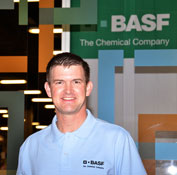
BASF Corn Market Manager Mike Hofer says he talked with southern farmers at Classic who expected to start planting the following week, but they too were concerned about weed resistance. “Farmers continue to tell us that they’re battling more weeds that have developed resistance to multiple herbicides that farmers have used over time,” Mike said. “We just recently launched Armezon™, which is a new HPPD inhibitor, and it essentially controls those tough broadleaf weeds post-emerge in corn. It’s unique because it is safe to all types of corn varieties.”

Mike notes that BASF offers several different programs to help farmers called the Grower Advantage offers. “We have a really unique offer this year that we’re calling Investment Advantage for growers that purchase a high yield package,” Mike says. “If they purchase that by March 15 and commodity prices significantly decline into harvest time, BASF would offer a partial refund on the purchase of those products. It’s the first time that a company is partnering with growers to help them manage risk after they purchase crop protection products.”

Investment Advantage has a March 15 deadline, but there is still time to participate in BASF’s other offers, including Headline Advantage, Finance Advantage and Insurance Advantage. Information on all BASF Grower Advantage offers is available at growersadvantage.basf.us.

Listen to or download an interview with Mike here: BASF Corn Market Manager Mike Hofer

2012 BASF Science Behind Photo Album

Coverage of the 2012 Commodity Classic Show is sponsored by BASF and New Holland
Audio, BASF, Commodity Classic, Corn, Soybean

Alltech Announces #AgFuture Blog Contest

Chuck Zimmerman

Hey ag bloggers. Alltech has a contest you might be interested in. Three winners will get to attend one of the best private agricultural events on the calendar.

In 2050 the population will be over 9 billion. How will we feed that many people? What does the future of agriculture hold for you?

We are inviting ag bloggers to imagine the future of agriculture and their place in it. What would you like to change? What would you like to preserve? Where do you want to go and who do you want to be? What does the future of agriculture hold for you?

Three winners will receive free registration to Alltech’s 28th Annual International Symposium, May 20th – 23rd in Lexington, Kentucky and $500 for travel and lodging.

It’s simple to enter:

Send a guest blog post to contest@alltech.com.
We will post all of the entries on our blog on Tuesday March 27th.
Send your readers to the post to vote for you.
Voting closes on Tuesday April 10th.
The three bloggers with the most votes win.

Official Rules

Entries must be received no later than 11:59 PM EST Tuesday March 27th, 2012.
Voting opens at 12:00 PM Wednesday March 28th, 2012.
Voting closes at 12:00 PM Tuesday April 10th, 2012. Winners will be contacted at that time.
Alltech reserves the right to reject posts.
Winners must attend Alltech’s 2012 Symposium to receive $500 for travel and lodging.

Agribusiness, Alltech