
Few Ag Names on Dot Domain List

Cindy Zimmerman

There’s no dots for agriculture, corn, or cows on the list of nearly 2000 new generic top-level domain (or gTLD) name applications announced yesterday by the Internet Corporation for Assigned Names and Numbers (ICANN).

There’s .beer but not .beef, there’s .porn but not .pork, there’s .soy but not .soybean. There is .farm on the list, by one of several companies that paid $185,000 per name to apply for multiple generic domains, and Farmers Insurance has applied for .farmers. DuPont and New Holland both applied to have dot domains, but Pioneer was requested by a Japanese company and there is no .JohnDeere on the list. No .BASF or .Monsanto or .Syngenta, either.

The application window for the gTLDs opened in January and closed on May 30. The full list of nearly 2,000 applications, including duplicates for popular names like .app and .blog, was revealed yesterday starting a 60-day public comment period to allow anyone to object to the domain being awarded. Introducing the list on Wednesday, ICANN chief Rod Beckstrom said, “The internet is about to change forever.” Well, maybe by sometime next year. All the applications need to be reviewed, and multiple applications for the same name need to go through an arbitration process. The winners will get the chance to pay $25,000 a year to keep the domain extension and do whatever they want with it.

See the entire application list here.

Internet

2012 IFAJ Congress Full

Chuck Zimmerman

If you were waiting to make reservations for the 2012 International Federation of Agricultural Journalists Congress then you waited too long. It’s full! I’m looking forward to a trip to Sweden later this year thanks to our good friends at Pioneer Hi-Bred.

The Swedish Congress is now completely full. All the available rooms at the congress hotel Sånga-Säby are booked and there is unfortunately not possible to take any more registrations. Those who are registered for the congress will be the very first guests at the new hotel building. It has its official opening on August 13th.

We’re going to have free wifi at our hotel. That is a good thing. Wish they all had it free.

IFAJ

President Exec Order To Speed Up Broadband Dev

Chuck Zimmerman

Today President Obama will sign a new executive order to make broadband construction cheaper and easier according to the White House. This would mean more people in more places can join the AgWired community!

The Executive Order (EO) will require the Departments of Agriculture, Commerce, Defense, Interior, Transportation, and Veterans Affairs as well as the US Postal Service to offer carriers a single approach to leasing Federal assets for broadband deployment. The EO also requires that available Federal assets and the requirements for leasing be provided on departmental websites, and it will require public tracking of regional broadband deployment projects via the Federal Infrastructure Projects Dashboard (permits.performance.gov). In addition, the Executive Order will direct departments to help carriers time their broadband deployment activities to periods when streets are already under construction—an approach that can reduce network deployment costs along Federal roadways by up to 90 percent.

You can find a fact sheet on this here (pdf).

Internet

Soft and Plush

Melissa Sandfort

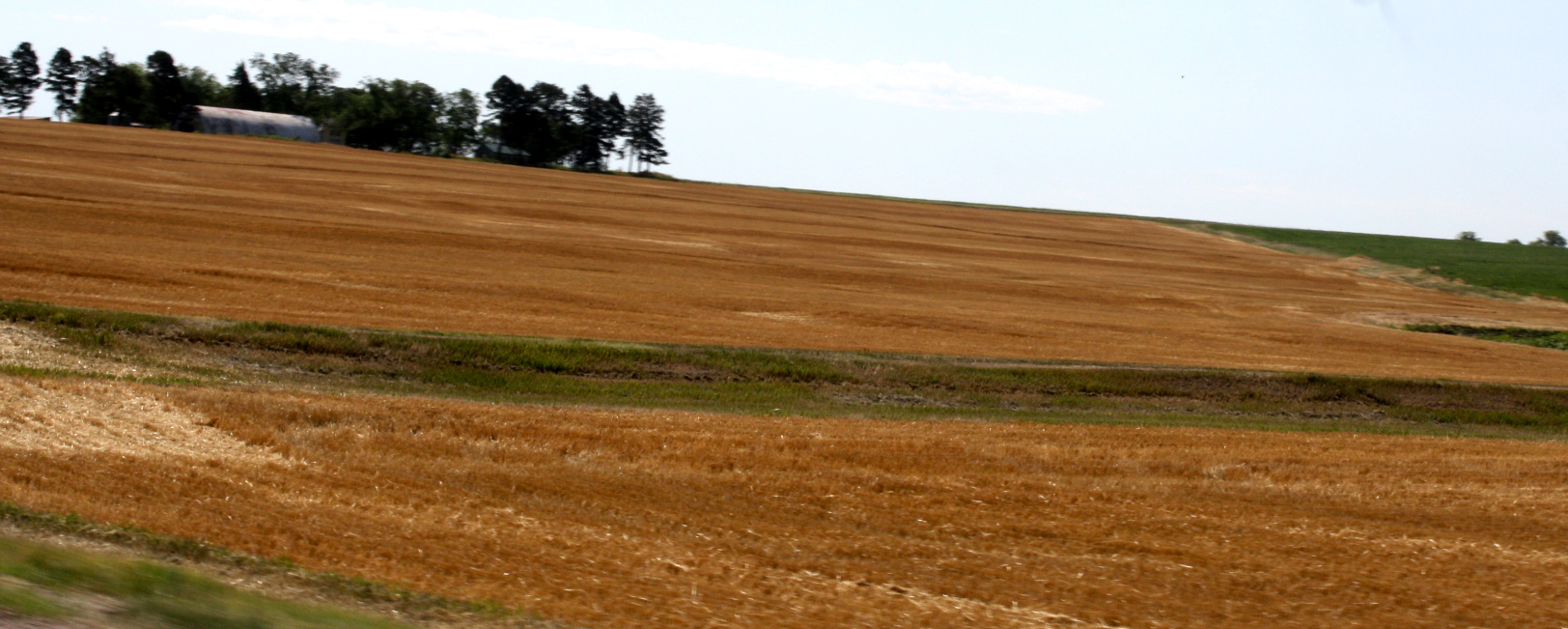
This week, one of our neighbors combined his wheat fields and this is the stubble that’s left. From the road it looks like butter. Or yellow cotton candy. Like running my fingers through a little chick’s peach fuzz.

It’s wheat stubble though, so I’m sure it’s not soft and plush.

I wanted to write about wheat because in our area, 99 percent of the field are corn and soybeans and it’s nice to see a different color. In western Kansas though where my husband’s family farms, wheat is most common. That’s why finding a month to get married was hard – when my family was in harvest, his dad was spraying and when his dad was harvesting, mine was planting.

I’ve interviewed a lot of farmers in the past five years and it’s fun hearing about the diversity of crops, even within our own state. I’ve talked to corn, soybean, wheat, sunflower, popcorn, dry edible bean, grass seed and sorghum growers – and that’s just here in Nebraska. Again, that’s what I love about spring/summer … the colors and contrast of agriculture. It’s much prettier than looking at houses that sit 25 feet apart and drab office buildings.

Until we walk again …

Uncategorized

Looking at the Future of Farmers

John Davis

How the world’s farmers will handle feeding the projected 9 billion people the earth is expected to have by 2050 … and where those farmers to feed that hoard will come from … was the subject of a presentation to the BASF Agricultural Solutions Media Summit in Chicago last week.

Christophe Pelletier, futurist and president of Happy Future Group, told the agricultural journalists gathered for the event that while technologically we should be able to produce enough food, many more questions remain… including who will own the farms of the future, will farmers be able to afford to buy their own farms, and what will be the average age of farmers 40 years in the future?

“Average age of farmers [today] is 58. [In 2050], are we going to say the average age of U.S. farmers is 90-something? Who are going to be the farmers of the future? How can we attract new people? I think that is one of the big challenges, because in the end we need food, so someone needs to produce it.”

Pelletier said if we can’t attract as many people to the profession, then we’ll need to rely on robotics more and more … something he points is already coming to fruition in the vast array of precision-guided tools available today. He added that while some would like a one-size-fits-all solution for all of agriculture, we need to take a pragmatic approach and take the best methods learned from the best farmers and apply them to what a particular area of the world needs. And he concluded by telling the group that suppliers will also need to be more flexible and more responsive to the changing needs of their farmer clients.

“I think the magic phrase in the future is not so much, ‘I have a new product and you should try it;’ it’s going to be ‘What can I do for you.'”

Listen to more of what Pelletier had to say here:
Christophe Pelletier, futurist and president of Happy Future Group

Photos from BASF Ag Media Summit

Audio, BASF, Food

Split Vote on Corn Sugar vs. HFCS

Chuck Zimmerman

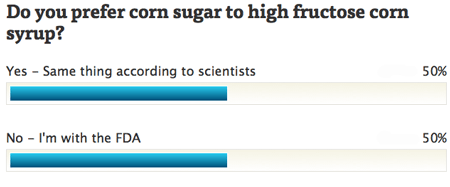
Our latest ZimmPoll asked the question, “Do you prefer corn sugar to high fructose corn syrup?” In what is a first for our poll, the response was split evenly! See the chart below.

Recently the FDA denied a request from the Corn Refiners Association to allow food labels to use the term corn sugar instead of high fructose corn syrup. Nutritionally, there is no difference in regular table sugar and HFCS so I don’t see why FDA ruled like they did. Their reasoning had to do with their definition of sugar as a crystalline solid. This is basically a public relations war over words since the “problem” with either cane or corn sugar is how much someone consumes. Nothing wrong with cane sugar or corn sugar, regardless what you call it, in my opinion. I like them both. Apparently consumers like HFCS better according to this story. What do you think?

Our new ZimmPoll is now live and asks the question, “Does your business have an interest in Pinterest?” This online pinboard is now being used by political campaigns to target key demographics. Even President Obama’s wife is using it! Seems like there might be some good reason for agribusinesses, farm and food groups to start pinning away. What do you think?

ZimmPoll is sponsored by Rhea+Kaiser, a full-service advertising/public relations agency.

Corn, Food, Social Networking, ZimmPoll

Twive to the AgChat Foundation

Chuck Zimmerman

It is better to Twive than receive. Especially if it benefits the AgChat Foundation. To help this effort out all you have to do is make a donation here. My name is Chuck Zimmerman and I approve this message.

AgChat Foundation was selected to take part in a nationwide giving event on Thursday,June 14th. Across the nation, not-for-profit organizations will be competing to receive $30,000 in prizes in a day long Twive and Receive event. YOU can help the agriculture community come out on top. As far we can tell, AgChat Foundation was the only agriculture organization selected for this event. By winning, our agriculture community will show the nation that farmers and ranchers really do care about the mission to connect with others to tell our story.

Winning Thursday’s Twive and Receive event will also mean:

Support of the weekly #AgChat conversation,
Continuation of the premier social media training conference,
More regional social media training conferences in YOUR area.

Here is what you can do help:

On Thursday, June 14th make a donation on the AgChat Foundation Twive and Receive fundraising page. Any donation amount helps! Consider donating a dollar a day ($365). That amount will help sponsor one person to the highly successful AgChat Foundation Training Conference. If you are a past participant, you know how powerful meeting and training with other agvocates is. Give the gift of agvocate empowerment to someone else.

Share that you support agriculture and the AgChat Foundation mission. On June 14th follow and use the hashtag #Twivereceive to see AgChat Foundation’s progress on Twitter. After you make your donation grab a Twive and Receive Twibbon for your avatar. Also, make sure to share the AgChat Foundation Facebook page to let others know that you support “Agvocacy.”

We are really pumped up for this event! I hope that you can join AgChat Foundation and all of agriculture on that day and show your support for our mission of empowering farmers and ranchers to connect in communities using social media platforms.

Remember: Donations must be received on June 14th. Any amount helps!

Thank you to everyone who supports our mission. We cannot do it without you!

Uncategorized

World Faces Economic, Not Caloric, Famine

John Davis

Farmers of the world are producing enough food to meet the demands of wiping out all hunger in the world. But hunger still exists. Why? Dr. Chris Mallett, Corporate VP of Research and Development for Cargill explains it’s a case of economic, not caloric, famine.

“[It’s] not the lack of ability to feed people, but it’s the lack of willingness and commitment to doing so,” said Dr. Mallet at last week’s BASF Ag Media Summit in Chicago. Mallet told those in attendance that when looking at food production globally, it can be easy to forget about the realities of the socio-economic conditions on the ground in places such as Africa, where small land holders have actually been hurt by more developed countries’ abilities to produce food at cheaper prices and ship it to those small land holders’ markets. While this has put more food into the overall system, it has taken away those local producers’ markets and made them less able even to buy food… while simultaneously eliminating their desire and ability to raise their own food for that region.

Mallet cited some examples of how his company, in partnership with BASF, is working on providing the key elements to make sure small farmers all over the world can remain viable. “In Vietnam, we’ve trained farmers in how to grow sustainable cocoa. And we will train more than 25,000 farmers in the Ivory Coast in a similar way to gain certification [in sustainable agriculture].” He said Cargill has also trained an additional more than two million farmers in the past year.

You can hear more of what Mallet had to say here:
Dr. Chris Mallett, Corporate VP of Research and Development for Cargill

Photos from BASF Ag Media Summit

Audio, BASF, Food

Pork Industry Concerned about Egg Bill

Cindy Zimmerman

Pork producers are concerned that a bill regulating egg production could make it into the farm bill, which could impact more than just the poultry industry.

“Some people have asked us why is the pork industry concerned about an egg bill,” said National Pork Producers Council director Bill Luckey of Nebraska during a press conference at World Pork Expo last week about the legislation they refer to as the “Farm Takeover” bill. “When you set a precedent of regulating a production system, if it’s in the poultry industry, a lot of activists might just try to move that into another species.”

Listen to comments from Bill here: NPPC director Bill Luckey

The egg bill, which was stand-alone legislation introduced in the House earlier this year, has indeed been proposed as an amendment to the Senate farm bill. Essentially it would provide for “a uniform national standard for the housing and treatment of egg-laying hens, and for other purposes.” NPPC VP of Domestic Policy Issues Audrey Adamson went into some greater detail of why other sectors of animal agriculture are concerned about the bill, which was developed as an agreement between the United Egg Producers and HSUS.

“If the egg industry decides they want to set standards, God bless them,” said Audrey. “We think it’s wrong-headed to do it in federal legislation, we think farmers know best.” She noted that similar legislation in Europe has resulted in less egg production and exorbitant prices for those on the shelves.

Listen to comments from Audrey here: NPPC's Audrey Adamson
2012 World Pork Expo Photo Album

Audio, Boehringer Ingelheim, NPPC, Pork, World Pork Expo

FFA is Connecting Students with Employers

Melissa Sandfort

The National FFA Organization has announced a first-of-its-kind formation of partnerships to assist its members’ efforts toward career success. Through the Agricultural Career Network (AgCN), FFA will work in collaboration with Career Cruising, a provider of age-appropriate career planners, assessments and other resources; and AgCareers.com. These partnerships will provide valuable tools and assistance for students in their pursuits of more than 300 careers in agriculture.

Launched last December, AgCN is a nationwide system designed to help FFA members document their educational achievements, create robust portfolios and pursue award, scholarship, internship and employment opportunities. The network will provide a database of students who are interested in particular career fields within the industry.

Through the National FFA Organization’s relationship with Career Cruising, members will have easy access to career information within selected fields of interest. Career Cruising will provide online career exploration tools that lead to recommending classwork and hands-on learning opportunities while guiding members along a path tailored to their abilities. With its ccInspire platform, Career Cruising connects individuals to career mentors and employers in their community

The partnership with AgCareers.com will allow members to search for career opportunities within their particular field of study or within a selected geographic area through a very robust job board. By including these tools on AgCN, FFA members will have a convenient home for career exploration. The partnership will continue to provide members with job placement access throughout their postsecondary educations as they pursue internship and career options.

AgCareers, Agribusiness, FFA