Seed Shindig in Chicago

Cindy Zimmerman

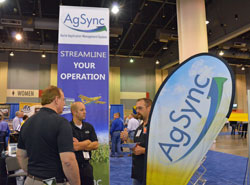
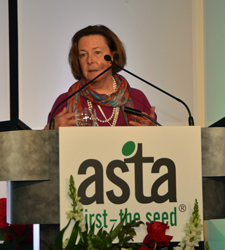
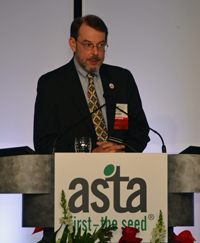
It’s all about the seed next week in Chicago at the CSS 2012 & Seed Expo. That’s short for the 67th annual Corn & Sorghum Conference, 42nd annual Soybean Seed Research Conference and 36th Seed Expo which will be held December 4-7 at the Hyatt Regency.

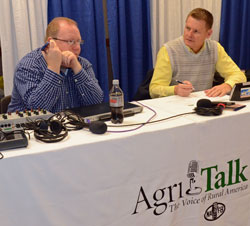
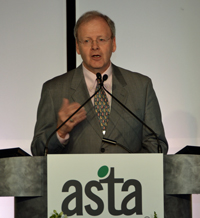
American Seed Trade Association (ASTA) Chairman Blake Curtis of New Mexico says this is a great event for anyone in the industry to learn about everything from new traits and equipment to issues impacting the industry, such as “The Accord” – as the new agreement regarding the transition of biotechnology traits is called. “As we end up with expiring rights associated with the patents of these traits, the question is how do we move forward?” Curtis said in an interview at the NAFB Trade Talk earlier this month.

The technical name for the first part of “the accord” is the Generic Event Marketability and Access Agreement (GEMAA) and it was opened up for signature on October 31 through the efforts of ASTA and the Biotechnology Industry Organization (BIO).

Under the GEMAA section of the Accord, signatories to the agreement that have developed proprietary regulatory information to support the authorizations for events globally would be required to provide notice of patent expiration three years before the last patent on the biotechnology event expires and provide access to the generic event at patent expiration. Additionally, the regulatory data owner must elect to either maintain regulatory responsibility on its own for the whole marketplace for at least four years after the last sale of the product, or share or transition this responsibility with other users. If no interest is expressed by other signatories, the owner could discontinue the event.

In addition to the GEMAA, the BIO-ASTA group continues to work on a Data Use and Compensation Agreement (DUCA) that complements the GEMAA and will have additional provisions related to structured access to regulatory data, and data compensation, to compliment the bilateral negotiated process in use today by companies to create novel combination products. The DUCA is targeted to be open for signature in the first quarter of 2013. “It’s a great opportunity to make available these traits and this information to everyone in the seed industry,” said Craig.

We will be attending the CSS and Seed Expo next week to learn more about this issue and to celebrate the signing of a new MOU between US and China seed associations.

Listen to Chuck’s interview with Blake from NAFB: Interview with ASTA Chairman Blake Curtis

2012 NAFB Convention Photo Album

ASTA, Audio, Biotech, Seed

Zimfo Bytes

Melissa Sandfort

    Zimfo Bytes

  • The Capper/Hayes paper on the environmental and economic effects of removing productivity-enhancing technologies from U.S. beef production has been officially published.
  • The national report for the 2011 Economic Analysis of Animal Agriculture, conducted by Agralytica Consulting, is attached and can be found by clicking here.
  • Brighton agency recently hired several new employees including Sally Thomas, Kathy Meyer, Carrie Doza, Allison Stein and Kelli Naegeli.
  • Ten scholarships of $1,500 each are being awarded to outstanding students studying for a future in the beef industry.
Zimfo Bytes

US Wheat Associates Fight For Farm Bill

Jamie Johansen

US Wheat Associates sat down with me during the National Association of Farm Broadcasting’s Trade Talk to discuss how their checkoff dollars are used to promote and market US wheat and what the lack of a farm bill come January will mean to US wheat producers.

Dan Hughes, Vice Chairman for US Wheat Associates, shared his passion for the industry as a farmer and as an advocate for other US wheat producers.

“US Wheat Associates is a group of 19 states that has wheat checkoffs. These are funds generated by producers in each state to help in marketing and promotion. We take those funds and leverage with USDA funds. We get grants from the Market Access Program and the Foreign Market Development Program. For each dollar the producer puts in we get a grant for $2 or $3 from USDA. That is how we fund our overseas offices. We have 15 offices around the world. From Korea to Africa. From these locations we service the buyers of US wheat.”

“The lack of a farm bill is a great concern for us right at the moment. As I mentioned earlier we rely heavily on MAP and FMD funding from USDA. Currently without a farm bill those program have expired. So by the end of January we will have to begin closing offices overseas. That is really not expectable because we are not the only wheat supplier in the world.”

Listen to my complete interview with Dan here: Dan Hughes - US Wheat Associates

2012 NAFB Convention Photo Album

Audio, BASF, Farm Bill, NAFB, Wheat

Zimfo Bytes

Melissa Sandfort

Zimfo Bytes

BASF Closes Deal for Becker Underwood

Cindy Zimmerman

BASF has completed its acquisition of seed treatment company Becker Underwood.

BASF purchased Becker Underwood from Norwest Equity Partners for $1.02 billion (€785 million). With the acquisition, BASF is now a leading global provider of technologies for biological seed treatment as well as seed treatment colorants and polymers. BASF has also expanded its product portfolio in the areas of biological crop protection, turf and horticulture, animal nutrition and landscape colorants and coatings.

“The acquisition fits very well with our long-term growth strategy. It will provide our customers with an even broader range of innovative solutions for agriculture. And it also provides our new colleagues with access to BASF’s global R&D platform as well as new markets and customers,” said Dr. Andreas Kreimeyer, member of BASF’s Board of Executive Directors responsible for the Agricultural Solutions segment and Research Executive Director.

Most businesses of Becker Underwood will join the newly established global business unit “Functional Crop Care” as part of BASF’s Crop Protection division where BASF will merge its existing research, development and marketing activities in the areas of seed treatment, biological crop protection, plant health, as well as water and resource management with those of Becker Underwood. Becker Underwood’s animal nutrition business will be integrated into BASF’s Nutrition & Health division.

The newly formed global Functional Crop Care unit will become effective January 1, 2013. It will be headed by Dr. Juergen Huff, Senior Vice President. Dr. Peter Innes, currently CEO of Becker Underwood, has accepted the position of Global Senior Advisor to the Crop Protection division. He will support the integration of Becker Underwood into BASF and the implementation of the Functional Crop Care unit.

Read the BASF press release for more information. BASF will be having a media briefing on the acquisition next week in Chicago at the CSS 2012 & Seed Expo, which we will be there to cover.

BASF, Crop Protection, Seed

Winners of Intl. Intercollegiate Meat Judging Contest

Melissa Sandfort

The American Meat Science Association announced winners of the International Intercollegiate Meat Judging Contest, held Nov. 18, 2012, at Tyson Foods, Inc. in Dakota City, Neb. In total, 99 contestants representing 16 teams participated in the contest.

Top Individuals, Senior Division:
1. Bo Hutto, Texas Tech University
2. Valerie Manning, Texas Tech University
3. Brandy Cleveland, Kansas State University
4. Thomas Buckham, Kansas State University
5. Colton Christian, Texas Tech University
6. Morgan Neilson, Oklahoma State University
7. Sara Sieren, Iowa State University
8. Devin Gredell, Oklahoma State University
9. Kelsey Steketee, Michigan State University
10. William Haas, University of Illinois

Top 5 Teams, Senior Division:
1. Texas Tech University;
2. Kansas State University;
3. Oklahoma State University;
4. Michigan State University;
5. Angelo State University.

Official committee members for the Intercollegiate Meat Judging contest were John Unruh, Dale Woerner, Tom Carr, Keith Underwood, Ian Shann, Dan Hale and Darrell Dowd.

Agribusiness

Deeper Roots, Strong Yield With Drought-Tolerant Corn

Melissa Sandfort

A root comparison study conducted this season at Monsanto’s Gothenburg Water Utilization Learning Center in Gothenburg, Neb., provided a dramatic demonstration of just how important a deep, strong root structure is to help corn plants withstand drought conditions.

The research program evaluated the performance of a DEKALB® drought-tolerant corn product versus two competitor products – a Pioneer® Optimum® AQUAmax™ hybrid and a shallow-rooted product. A root dig conducted in mid-September showed that the DEKALB product had a significantly deeper, more evenly spread root structure than the other two products.

The result was healthier ears and a yield advantage for DEKALB of 12 bu./A versus Pioneer Optimum AQUAmax and 15 bu./A versus the shallow-rooted product.

This December DEKALB will continue a tradition of introducing innovative new products with the stewarded introduction of Genuity® DroughtGard™ Hybrids in the Western Great Plains for 2013 planting. These products combine the DEKALB brand’s drought-tolerant genetics, developed through the brand’s industry leading breeding program, with the industry’s first drought-tolerant biotech trait and agronomic practices. The DEKALB DroughtGard Hybrids available for planting in 2013 delivered farmers more than 5 bu./A versus competitor products in field trails this year.

Click here to see time-lapse photos of the root dig and video interviews with the participants.

Agribusiness, Corn, Research

Ag Leader Technology – Independent and Innovative

Chuck Zimmerman

The Ag Leader Technology team talked to farm broadcasters at the recet NAFB convention. I sat down with Lori Costello, Marketing Communications Manager (seated on right), and we talked about the great anniversary year Ag Leader is having.

There are some unique things about Ag Leader Technology that you may not know. For example, Lori says Ag Leader Technology is independently owned and they take great pride in that. The also, “develop, manufacture, ship and support” all of their products right from their office in Ames, IA. When it comes to training Lori says, “We want everyone to be an agnerd.” That’s why they developed the Ag Leader Academy.

Lori says that Ag Leader Technology’s founder, Al Myers, has a main goal to keep being an innovator and bring products that farmers need to the market. It was 20 years ago that Al started the company so that’s the anniversary that the company is celebrating.

Listen to my interview with Lori to find out what else sets the company apart in the precision ag arena here: Interview with Lori Costello

2012 NAFB Convention Photo Album

Ag Leader, Agribusiness, Audio, NAFB

Headline Helps Indiana Great Grower’s Crop

Cindy Zimmerman

The last crop progress report on the corn harvest was issued by USDA on November 5, the earliest end to the reporting season since 1985 when they first started tracking the harvest progress. But, as of November 7, Kip Tom of Indiana was one of the growers with the 5% of corn nationwide that was not yet in the bin. “That’s a good thing,” Kip said during an interview at the National Association of Farm Broadcasting Trade Talk. “We’re maximizing the use of our equipment and we had higher yields than we expected.”

Kip gives the credit for his higher than expected yields for both corn and soybeans to the use of BASF Headline, despite the incredibly dry weather. “Doesn’t matter if it’s a low yield or a high yield environment, it (Headline) paid its way,” said Kip. “So we will continue to use that in the future no matter what the weather that Mother Nature gives us to deal with.”

Tom Farms covers land in seven counties in northern Indiana, some of which Kip says was right in the middle of the worst drought region. “In early July, we had beans at R3, R4 barely knee-high,” he explained. “After we applied the fungicide we recognized an average yield of 67 bushels per acre on about 4000 acres of beans.”

Kip, who is one of the AG CONNECT Expo Masters & Mavericks, says weed control was a big challenge with the 2012 drought but he is most concerned with resistance to glyphosate so he is looking forward to the impending release of dicamba tolerant technology. “We’re seeing weed resistance pop up clear up in Michigan,” Kip said.

Kip says they intend to “stick to our game plan” in preparing for the 2013 season. “We’re going for a bumper crop and we’re going to make sure that we use all the resources we have available to us to produce that bumper crop,” he said.

Listen to my interview with Kip here: Kip Tom interview

It has been great following this BASF Great Grower through the season this year.
We first talked to Kip in April when planting just started and he was well ahead of schedule.
Then in June we talked to him and his son Kyle and they said it was “definitely dry.”
By the time we caught up with Kip and his grandson Kamden in September at the Farm Progress Show, it was really dry. “In my 39 years of practicing this occupation, I can very easily say this is the most challenging year we’ve ever faced in regards to dryness and high temperatures,”

Audio, BASF, Farming

Beef Producers Unite for Alltech’s Global 500

Jamie Johansen

It is just a week before Alltech’s 5th Annual Global 500 kicks off. Dairy and beef leaders from across the world will come together to share ideas and educate themselves on new and cutting edge technologies.

They are expecting over 500 beef producers to attend this year’s event. Steve Van Dyke, cow/calf producer from South Dakota, attended his first Global 500 last year and can’t wait to attend again.

“The Global 500 was different from other beef events I’ve attended because it offers a worldwide perspective on beef production, beef sustainability and beef quality improvement,” said Van Dyke. “Alltech’s Global 500 provides information to people in all phases of beef production, but always in an insightful way.”

“The food animal industry is changing rapidly, both in the US and globally,” Van Dyke added. “At Global 500, we were challenged to look at things from a new perspective. The lessons I learned at Global 500 made me a better manager, producer, and steward of the industry I love.”

This year’s agenda seeks to once again offer some insight on topics such as branding beef, social media, employee training, decreasing carbon footprints and mycotoxins as well as many presentations that will address the core theme for the event, the EPS Principle: Efficiency, Profitability and Sustainability.

I am excited to attend this years event and during the National Association of Farm Broadcasting’s (NAFB) Trade Talk I had a chance to talk with David Butler, Web Marketing Manager for Alltech. He offered insite to the upcoming event and shared what hot topics will be discussed. Check my interview with David here.

Also during NAFB I spoke with Ann Kopecky, Alltech’s North America Field PR Coordinator, about Alltech’s recent launch of their 37+ Program. This new mass spectrometry technique investigates 38 different mycotoxins allowing for a broader analytical approach into the contamination.

Listen to my interview with Ann here: Ann Kopecky - Alltech

2012 NAFB Convention Photo Album

Agribusiness, Alltech, Audio, Beef, Education, NAFB