Zimfo Bytes

Talia Goes

Zimfo Bytes

Zimfo Bytes

Secretary Vilsack Talks T-TIP in Europe

Cindy Zimmerman

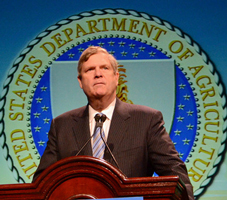
vilsack-usdaAgriculture Secretary Tom Vilsack is in Brussels today starting a week-long trip to Europe to meet with European agricultural and trade officials and other industry stakeholders. In addition to Brussels, Vilsack will visit with officials in Luxembourg, Paris, and Dublin.

While overseas, Vilsack will discuss the expansion of agricultural trade, the importance of agriculture’s role in the U.S.-European Union (EU) Transatlantic Trade and Investment Partnership (T-TIP), and the benefits the trade agreement will have to both the American and European economies.

During a brief conference call with reporters this morning, the secretary said he had just concluded a working lunch with 28 agricultural ministers and representatives from the EU. “It was important for me to express to all the members states my belief that we have much in common in terms of agriculture,” said Vilsack. “Our farmers are faced with the same concerns and opportunities as European farmers are.”

Regarding T-TIP, Vilsack says agriculture must be a significant part of the negotiations. “I was very candid with my colleagues that absent a real strong commitment to agriculture in this trade agreement, it will be very difficult for Congress to get the votes necessary to pass T-TIP,” he said.

Listen to or download Vilsack’s call here: Vilsack press call from Brussels

Audio, International, Trade, USDA

BASF Panel on Future of Food and Agriculture

Cindy Zimmerman

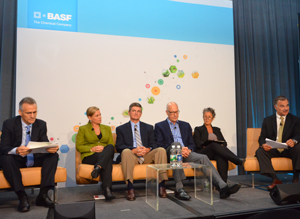
basf-14-panelThe Future of Food and Agriculture was the focus of a panel at the BASF Ag Media Summit last week in North Carolina, moderated by one and only Max Armstrong.

Members of the panel included (left to right):
Brazilian farmer Aurelio Pavinato, celebrity chef Cat Cora, North Carolina producer Bo Stone, Futurist.com founder Dr. Glen Heimstra, and University of California professor Dr. Julie Guthman.

The conversation included much discussion about the challenges facing agriculture, perceptions of consumers, and organic agriculture. I recorded the first part of the panel, which you can listen to here: BASF Panel segment

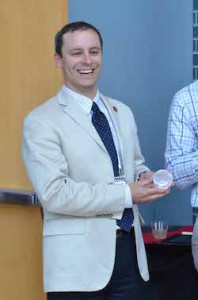
basf-bo-stoneYou might recognize this face as Bo Stone is one of USFRA’s Faces of Farming. Bo, his wife Missy, and his parents own P&S Farms in North Carolina, a very diversified operation that includes cattle, hogs, row crops, strawberries and sweet corn.

Bo has really enjoyed his time traveling around the country talking with consumers on behalf of USFRA and he appreciated being a part of the BASF Ag Media Summit. Listen to my interview with him here: Interview with Bo Stone, North Carolina producer

Not only did Iron Chef Cat Cora participate on the panel, she also treated us to a taste of her culinary expertise. Watch the video below and learn how to make her yummy Watermelon Gazpacho. Watch and learn below.

2014 BASF Ag Media Summit Photo Album

Audio, BASF, Food, USFRA, Video

FuSE Celebrates 10 Years of Training Young Seed Execs

Jamie Johansen

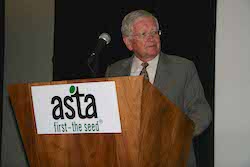
asta-14-255-editedDuring the 131st American Seed Trade Association’s Annual Convention in Indianapolis, IN. the Future Seed Executives (FuSE) held a joint FuSE/Management Skills committee meeting focused on the Power of Inclusive Leadership. I spoke with FuSE founder and Vice President, Business Development for Gro Alliance, Jim Schweigert, and he shared what lead him to start this group for young professionals in the seed community.

When Jim attended his first ASTA convention he was shocked with how few young people were present. He expressed this observation with then chairman Don Wertman. Don simply said, “Well, why don’t you do something about it.” Jim knew that if he didn’t feel welcomed into this association, then other people probably didn’t as well.

With help from other young people in the industry, Jim put together the basic concept of what is now known as the FuSE. This year FuSE is proudly celebrating their 10 year anniversary and are still focused on educating and supporting future seed industry executives. Their programs are designed as regional opportunities to expand learning, cultivate management skills, promote networking, and improve general understanding of the seed industry.

“I think the real big change is that seed companies are now using the FuSE programming as part of their normal process for new industry executives. In the past the large companies trained within their own organizations, but now they are engaging in the industry as a whole. For smaller companies, it’s really invaluable because they don’t have the same training infrastructure. Now they have an opportunity to network with other industry professionals and see the industry as a whole not just the company they work for.”

Listen to my interview with Jim here: Interview with Jim Schweigert, FuSE Founder

ASTA Annual Meeting Photo Album

Ag Groups, ASTA, Audio, Education, Seed

ASTA First Vice Chair from Oregon

Cindy Zimmerman

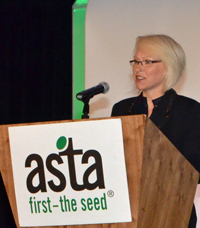
asta14-risaWe’ve talked with American Seed Trade Association (ASTA) first vice chair Risa DeMasi a couple of times before – a year ago when she was elected as the first woman officer of ASTA and again in December at the Seed Expo when we learned more about her company Grassland Oregon, which is very involved in the development of new cover crop species.

With Risa’s leadership, ASTA has started a cover crop working group. “Our whole focus is going to be on communication and collaboration,” Risa said, noting that the group includes representatives from conservation organizations and government as well as growers. “I think a lot of us are all trying to do the same things and it’s just a matter of putting the pieces together.”

Two counties in Risa’s home state of Oregon just voted overwhelmingly to ban the production of genetically modified crops, which she says shows how emotional the conversation has gotten. She believes using words such as new technology or advancements would be better than genetic modification or biotechnology. “We focus on GMO and it becomes this big, bad ugly monster,” she said. “Nobody wants to get rid of their cell phone, but if we hadn’t allowed that technology, where would we be today?”

Listen to my interview with Risa here: Interview with Risa DeMasi, ASTA First Vice Chair

ASTA Annual Meeting Photo Album

ASTA, Audio, Biotech, Conservation, Seed

BASF and Functional Crop Care

Cindy Zimmerman

basf14-huffFunctional Crop Care is the newest division of the BASF agricultural business, broadening what it means for the company to protect crops and help farmers get the most out of every acre.

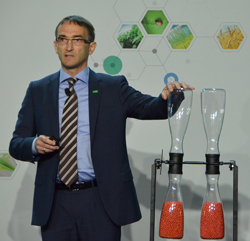
BASF Functional Crop Care Senior VP Dr. Jürgen Huff says the division addresses additional needs beyond conventional crop protection. “Functional Crop Care consists of three segments: soil management, seed solutions and crop care,” said Huff. “None of them will work in isolation. We always look at the whole set of tools that we provide for farmers in making their corn and soybean farming more successful.”

Dr. Huff talked about BASF’s new LIMUS technology coming to the market in 2015 to boost efficiency of urea-based fertilizers. “Urea breaks down in the soil and it’s decomposing into ammonia and carbon dioxide,” said Huff. “LIMUS will provide an extended protection of urea-based fertilizers during the critical growth stages of crops.”

The Functional Crop Care division was really started with the BASF acquisition of Becker Underwood in 2012, which brought with it important seed treatments such as polymers for flowability. Watch his demo below of how that can help farmers during the busy planting season.Interview with Dr. Jürgen Huff, BASF Dr. Huff media event presentation

2014 BASF Ag Media Summit Photo Album

Audio, BASF, Crop Protection, Seed, Video

Zimfo Bytes

Talia Goes

Zimfo Bytes

  • The online Master of Arts in Mass Communication with a specialization in Social Media teaches professionals how to develop, implement, track and analyze campaigns in social media, and to employ strategic and tactical approaches to contemporary media challenges.
  • Syngenta announced that Tyler Ring has been appointed head of North America Sugarbeet Seed business.
  • Mitsui Chemicals Agro, Inc. and BASF announced the signing of an exclusive global development and license agreement for a new insecticide (MCAG’s development code “MCI-8007”).
  • Federal Aviation Administration (FAA) announced that BP and unmanned aircraft manufacturer AeroVironment received permission to use drones for flyovers of the Prudhoe Bay oil field.
Zimfo Bytes

How BASF Innovation Yields Results

Cindy Zimmerman

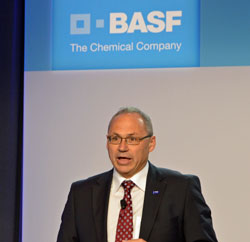
basf-media14-peterInnovation and new technology are what have enabled farmers to continue feeding a growing population throughout history, and BASF Plant Science President Peter Eckes says that is what will take us into the future.

“Ag is a great place to be and I think if you look at the last 100 years, technology has driven that,” said Eckes. “That has been a great story and I do not see an end to that.”

Eckes says BASF is proud to be an innovator and to partner with other innovative companies like Monsanto to bring new technologies to market such as the Genuity® DroughtGard™ Hybrids. “Monsanto is our most important partner,” said Eckes. “It had a great reception last year in the western part of the corn belt where you see a lot of drought. The product showed an average five bushel per acre advantage. This is good news for our growers.”

Eckes also spoke about work being done to develop newer and better fungicides and herbicides in this interview. Interview with Peter Eckes, BASF

2014 BASF Ag Media Summit Photo Album

Agribusiness, Audio, BASF, Crop Protection, Crop Science

Top Researchers Share Insights on Food Security

Jamie Johansen

asta-14-170-editedTwo World Food Prize winners shared their insights and experiences during a general session at the 131st American Seed Trade Association’s Annual Convention. Each shared what the seed trade industry can do to help feed the growing global population while sitting on a panel and taking questions from attendees.

Professor Emeritus of Food Science at Purdue University, Dr. Phillip Nelson, was the World Food Prize Laureate in 2007 for his work with aseptic bulk storage, which simply means ‘bag in a box.’ This has impacted the distribution of fruit concentrates in over 135 countries.

Dr. Nelson believes the seed trade industry can make sure that what is being produced in those developing countries is being preserved and not lost. He says we need to work with them in not only producing more, but producing a higher quality product.

When asked about what keeps him optimistic about the future, Dr. Nelson replied with the amount of young people who are passionate about the industry. He feels education is the key. Grants will provide funding to bring students from developing countries to U.S. labs and get them excited about what can be done and then take it back to there home countries and put it to work.

Listen to my interview with Dr. Nelson and his complete remarks here: Interview with Dr. Phillip Nelson Remarks from Dr. Phillip Nelson
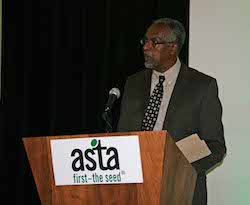
asta-14-168-editedWorld Food Prize Laureate, Dr. Gebisa Ejeta’s development of drought tolerant and parasitic weed resistant sorghum has made him a celebrity in his home country of Ethiopia. He currently serves as the Director of the Purdue Center for Global Food Security and Professor of Plant Breeding & Genetics at Purdue University.

Dr. Ejeta also believes higher education is imperative. He says of all the things that we can do for those that don’t have much, building the educational opportunities should be on the top of our lists.

Public and private partnerships are another key element Dr. Ejeta believes needs to take place creating a win-win opportunity for both sides of the table. He says the seed industry can do a lot by expanding the market base and sharing knowledge and experiences.

Listen to my interview with Dr. Ejeta and his complete remarks here: Interview with Dr. Gebisa Ejeta Remarks from Dr. Gebisa Ejeta

ASTA Annual Meeting Photo Album

Agribusiness, ASTA, Audio, Food, Seed, World Food Prize

AgWired Transformation is a Positive

Talia Goes

New Holland ZimmPollOur latest ZimmPoll asked the question, “What do you think about the new AgWired look?” It seems as though the transformation of the site draws a strong line between love and like, which we’re glad to hear! Sometimes change is a hard thing to swallow, but it seems like AgWired readers and pleased with the direction the site has gone.

Our poll results:

  • Love it – 33%
  • Like it – 33%
  • Hate it – 11%
  • Meh – it’s ok – 11%
  • Don’t care – 11%
  • Our new ZimmPoll is now live and asks the question, “How would you rate the job farmers are doing telling consumers where their food comes from?” We’ve seen a lot more engagement from producers whether it be by participating in panel discussions, being active on social media, or just telling their story out in the country. What do you think – have you been hearing more positive stories from farmers or do they still need to speak up?

ZimmPoll