
The Peterson Brothers (Greg, Nathan and Kendal) are at it again with a new parody music video of the song, “All I Do is Win,” by DJ Khaled done by the Peterson Farm Bros (Greg, Nathan, and Kendal)! It’s a great look at farming life that touches on important issues like conservation and family. Please enjoy and they say to share it out.
Animal Health Companies Pursuing IPOs
 According to the folks at Husch Blackwell we’re seeing a growing phenomenon of animal health companies pursuing IPOs. I visited with Jim Ash and Stan Baker last week about this largely unnoticed trend. Husch Blackwell is a national legal firm with a Food & Agribusiness team. They even have a D.V.M. on the staff – Stan Baker!
 According to these guys, animal health IPOs didn’t even exist 18 months ago. However, since when Pfizer spun off Zoetis first of last year there have been several more and there are more in the works. Apparently the type of public information provided by a deal like the Zoetis one has helped provide the industry with valuable data to help potential investors gauge the potential value of an investment.
Here are a few reasons they say have caused this increased activity:
- Animal health companies’ valuations have increased
- Increased news coverage of animal health issues
- A belief among investors that the regulatory process for bringing animal health products to market is easier, which is actually incorrect in many instances
- Additional funding needs not met by “angel” investors
- Improving market has led to more companies being willing to step into the space
Husch Blackwell has been involved with two animal health IPOs to date, serving as licensing counsel in one and as regulatory counsel in both. So Stan and Jim have experience to speak about the differences in the filing process that have emerged, including regulatory schemes and the adjustments between human and animal medicine. They say these differences are subtle but extremely important.
Listen to this week’s program here: Animal Health IPOs
Thanks to our ZimmCast sponsor, GROWMARK, locally owned, globally strong, for their support.
Subscribe to the ZimmCast podcast here.
Soy Checkoff Request for Referendum Results
 USDA just announced the results of the request for referendum on the Soybean Research and Promotion Program. There were 355 request-for-referendum forms received, of which only 324 were valid, from Farm Service Agency offices. The 355 forms represent 0.06 percent of all eligible U.S. soybean farmers. That result falls short of the 10 percent needed to prompt a referendum.
“These results show that U.S. soybean farmers overwhelmingly see the value in our soy checkoff,” says Jim Call, soybean farmer from Madison, Minnesota, and United Soybean Board (USB) chairman. “It’s more important than ever that the volunteer farmer-leaders of USB continue to invest soy checkoff funds to maximize the profit potential for all U.S. soybean farmers.”
If 10 percent of the 569,998 U.S. soybean farmers had requested a referendum, with no more than one-fifth of the 10 percent coming from one state, USDA would have conducted the referendum on the soy checkoff within 12 months. USDA conducts the request-for-referendum vote every five years, as required by the Soybean Promotion, Research and Consumer Information Act. The most recent period took place from May 5 through May 30.
Farmers certifying that they or the entity they represent paid into the checkoff at any time between Jan. 1, 2012, and Dec. 31, 2013, were eligible to participate in the petition for referendum. Eligible farmers who did not want a referendum did not need to take any action.
USDA requested and approved a notification by USB to inform U.S. soybean farmers about the request–for-referendum period. USB placed paid notifications on the request for referendum in national, regional and state agricultural publications and also distributed the notification to all Qualified State Soybean Boards and the news media. In addition, USDA’s Agricultural Marketing Service and Farm Service Agency distributed the information about the request-for-referendum period.
American Ethanol Winning Races
 Ever since I met Ryan Hunter Reay as the driver for the Indy Team Ethanol Car I’ve been following him as his racing gets better and better. He showed it this weekend when he roared to a dramatic finish and won the Iowa Corn Indy 300, presented by Dekalb. He’s pictured here with board members of Iowa Corn.
With the Indy cars running on the same fuel that we can put in our flex fuel vehicles – E85 – this renewable fuel was on the big stage again. In addition to the Indy race last weekend NASCAR held the American Ethanol 200 presented by Enogen, NASCAR Camping World Truck Series, on Saturday. Our Joanna Schroeder was there courtesy of Syngenta and will have some stories to share from that event over on Domestic Fuel. You can see her first post that describes how Syngenta and Quad County Corn Processors have teamed up to begin commercial production of cellulosic ethanol here.
Zimfo Bytes

- The 37th session of the Codex Alimentarius Commission will take place Monday 14 July to Friday 18 July 2014
- Acclaimed late night TV host Jay Leno will give the closing session keynote address at the 96th AFBF Annual Convention and IDEAg Trade Show in San Diego on Jan. 12, 2015.
- Already an agriculture industry leader for online and mobile media, Farm Journal Media announces its latest mobile application—the AgWeb App Finder.
- Paulsen Marketing has promoted Hannah Gebauer to client service manager (CSM).
2014 Cooperative Communicators Winners Showcase
 Want to see who the winners are in this year’s Cooperative Communicators Association Communications Contest? Here’s where you can see the best writing, publication, photography and more.
Welcome to the 2014 Winners Showcase
This showcase features all of the winning entries in this year’s CCA Communications Contest. Here you’ll find the best of the best of cooperative communications, from writing and photography to publications, programs, and projects. Below are links to PDFs of the lists of winners in each division. These lists are available to members and nonmembers alike.
Writing Winners
Publication Winners
Photography Winners
Programs and Projects
Farm Bill Toolbox
 Here’s a Toolbox farmers might want to add to their arsenal. It’s the University of Illinois farmdoc Farm Bill Toolbox. You’ll find articles, videos and FSA documentation.
This website provides educational outreach on 2014 Farm Bill related decisions and tools which are currently under development.
Previously, articles on farmdoc Daily have provided details regarding the efforts to inform readers about the 2014 Farm Bill, particularly with regard to farm program decisions that will have to be made (those articles are available here and here). As the next step in that project, today we introduce the Farm Bill Toolbox as the one-stop resource for farm program decisions, information and analysis, as well as providing further information regarding the ongoing efforts for the Farm Bill.
On July 1, 2014, the University of Illinois as the lead university for the National Coalition for Producer Education (NCPE) entered into a cooperative agreement with the Farm Service Agency for development of web-based decision tools to help producers and farm owners with the decisions and programs in the Farm Bill. This effort will involve the development of three different tools by the Illinois-led NCPE, as well as training, education, outreach and analysis on the tools and programs: (1) a tool for the ARC/PLC program decision, including base acre reallocation, payment yield updating and SCO/STAX; (2) a tool for the new dairy Margin Protection Program and Livestock Gross Margin-Dairy insurance policy; and (3) a tool for the new Noninsured Crop Disaster Assistance Program (NAP) provisions regarding buy-up coverage.
Well Cow – Bluetooth Connection to Your Cows
 We’re hearing a lot about health applications of mobile and wearable technology lately. The anticipated iWatch from Apple is expected to open some new doors into that technology. But that’s for humans. What about cows? Well a Scottish company is introducing a bluetooth way to monitor cow and herd health – The Well CowTM Bolus.
Monitor the health of your herd remotely
The Well Cow bolus wirelessly monitors rumen pH and temperature, allowing optimisation of nutrition management for cows to improve their health and welfare. Farmers can use the data to optimise the diets for their cattle and consequently improve production efficiency and ultimately the profitability of their business.
Well CowTM has now also demonstrated the world’s first automated continuous long term measurement of rumen pH in dairy herds using its unique wireless telemetry bolus system. This enables the dietary health of herds to be monitored and early indications of problems which will adversely affect milk yields to be identified.
In the future Well CowTM technology will have the potential to also deliver the automated detection and measurement of other health and disease markers. This technology together with the latest developments in Wide Area Network communications will provide farmers with immediate alerts on the status of their herds on PC’s and mobile devices.
Thanks to CNET for the heads up.
McCarthy’s Comments on WOTUS in Missouri
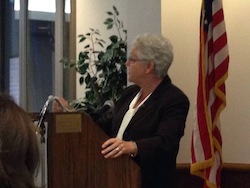 Environmental Protection Agency Administrator Gina McCarthy addressed the Agricultural Business Council of Kansas City yesterday. Her goal was to defend and explain the Administration’s proposed rules defining Waters of the United States (WOTUS) under the Clean Water Act (CWA).
In a media call on Wednesday before her trip concerns were expressed from those in attendance. During her speech yesterday, she addressed a few of them.
“Yesterday, we heard very clearly some of the concerns about our proposed rule. Let me clear up some of that: We heard fears that EPA is regulating groundwater. This is not true; groundwater regulations do and will fall under the purview of the states. EPA is not regulating all activities in floodplains, or every puddle, dry wash, and erosional feature. In fact, we’re doing just the opposite. If cattle cross a wet field – let them. That’s a normal farming practice, and all normal farming practices are still exempt. The bottom line is – if you didn’t need a permit before this proposed rule, you won’t need one when it’s finalized.”
McCarthy said their goal is for the practices to be reasonable and consistently applied. She added that everyone playing by the same rules allows farmers and ranchers to work with confidence and certainty.
“So let’s talk about the interpretive rule and the 56 conservation practices that are good for production and good for water quality. That rule seems to have generated lots of confusion. So, why did we want to list out those 56 practices? Those 56 are an attempt to clear the path for slam dunk conservation practices. We did not narrow exemptions; those 56 are a subset to the existing exemptions for normal farming, ranching, and silviculture. No one should have to think twice about taking advantage of these conservation practices.”
“Some mistakenly think that this means additional federal standards with which to comply, but that’s wrong. Conservation practice standards are not federal regulatory standards. They just provide a roadmap for producers to make sure they’re squeezing all they can out of their practice.”
“New exemptions are ‘self-implementing,’ which means no one needs to notify or get approval from EPA or the Corps. There’s no need to double check with anyone at any time. I’m sure farmers agree that the best discussion on jurisdictional determinations is one that never needs to happen. We added 56 exemptions because we want to boost conservation without boosting bureaucracy. Is the interpretive rule the best way to do that? Let’s figure that out together. I am about outcomes, not process.”
You can listen to her complete comments here: Administrator McCarthy’s Comments on WOTUS
Zimfo Bytes
- Forbes, in partnership with SVG Partners and The Steinbeck Innovation Cluster, announced that it will host the “Forbes Reinventing America: The AgTech Summit” in Salinas Valley, California, in July 2015.
- The farmers of the American Soybean Association (ASA) honored Sen. Mike Johanns of Nebraska with the association’s Soy Champion Award in Washington.
- The Midwest Organic and Sustainable Education Service (MOSES) is seeking nominations for the “2015 MOSES Organic Farmer of the Year” award, which will be presented at the 26th annual MOSES Organic Farming Conference in La Crosse, Wis., Feb. 26 – 28, 2015.
- Martinez Creative Group of St. Charles, Ill. received a 2014 Telly Award for Max Armstrong’s “Tractor Boy” music video in the category of Internet/Online Video – Entertainment.