
Gathering Data & Using It

Jamie Johansen

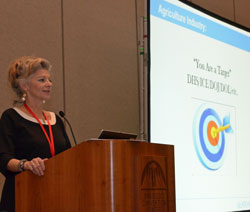
bivi-prrs-14-1103-editedThere are different tools producers and technicians can take advantage of when coordinating disease control. Dr. Erin Johnson, Boehringer Ingelheim (BIVI), talked about a couple of these during the North American PRRS Symposium at BIVI’s breakout session.

“One of our big data gap problems is we have a lot of data on the farm, but we don’t translate it very well into usable information. We evaluated four different apps that are readily available to anybody and we selected iFormBuilder. It’s simply an app that you can put in any survey and gather that information easily on a phone, upload it and use the information quickly and easily.”

Dr. Johnson says they hope to gather information as simple as medications given and farm mortality rates. This could expand to farms involved in vaccine trials or other projects.

“We are just showing people that there are tools out there that they can use. We can help them use them and evaluate which is best. The challenge is when they (producers) are worried about confidentiality. Who has access to that information, who can download it and see it. Again, they have to be able to use the information. If you are not going to use it. There is no point in collecting it.”

Learn more about the iFormBuilder app and how it can be utilized on the farm in my complete interview with Erin here: Interview with Dr. Erin Johnson, Boehringer Ingelheim

Find all the photos from the event here: 2014 BIVI PRRS Seminar Photo Album

Agribusiness, Animal Health, Audio, Boehringer Ingelheim, Swine

Zimfo Bytes

Talia Goes

Zimfo Bytes

  • Five Sorghum Checkoff board directors were sworn in during the Dec. 10, 2014, board meeting in Lubbock, Texas.
  • As a follow-up to its Stacked Income Protection Plan/Farm Bill workshops, the National Cotton Council is hosting four regional information webinars.
  • The Board of Directors of the American Soybean Association has confirmed Wade Cowan from Brownfield, Texas, as its newest President and moved outgoing President Ray Gaesser from Corning, Iowa, to the position of Chairman.
  • The U.S. Department of Agriculture has published its final Environmental Impact Statement, concluding that Monsanto’s Roundup Ready 2 Xtend soybeans and Bollgard II XtendFlex cotton should be fully deregulated.
Zimfo Bytes

Research Looks at Value of Neonicotinoids

Cindy Zimmerman

asta-css-14-nowakThe agriculture industry is working to show the benefits of neonicotinoids in the face of an EPA report released in October concluding that the seed treatments “provide little or no overall benefits to soybean production in most situations.”

During the ASTA CSS and Seed Expo last week, Dr. Pete Nowak with AgInfomatics discussed some of his findings on the value of neonics in North American agriculture to respond to the EPA findings. “A good $4 billion plus, direct costs to our economy if we lose neonicotinoids,” says Dr. Nowak summarizing the cost to all agricultural and green industry crops. “A very significant impact, not only on the producer, but also on the consumer in terms of food costs, as much of the four billion dollars would be passed on to the consumer.”

Several reports focused on different industries – such as soybeans, citrus and ornamentals – have already been released and a few more are expected by the end of the year. Since the EPA report focused specifically on soybeans, Nowak says they spent a lot of time listening to those growers. “I traveled around to all the major ag production areas in North America and spent a lot of time listening to growers and local agri-professionals,” he said. “These farmers were very frustrated by what they see as emotion driving much of the discussion and they felt that science really has to play a much more important role in establishing policy relative to neonicotinoids.”

Listen to Dr. Nowak talk about the research here: Dr. Pete Nowak, AgInfomatics

The research has been commissioned by Growing Matters, which is a group formed by a collaboration between Bayer CropScience, Syngenta, Valent and Mitsui, to help let the industry know what is happening on the federal level. The public comment period on the EPA analysis is open until December 22 and information on how to comment can be found by going to Growing Matters or AgVoice4Choice.com.


2014 ASTA CSS & Seed Expo photo album

Coverage of CSS 2014 and Seed Expo brought to you by
Coverage of CSS 2014 and Seed Expo brought to you by the American Seed Trade Association and Coverage of CSS 2014 and Seed Expo brought to you by BASF Ag Products
ASTA, Audio, pesticides, Seed

CRomnibus Passes Congress

Cindy Zimmerman

capitol-nightAfter passing a short term extension early in the day on Saturday to give them more time to consider longer term spending legislation, the Senate decided by evening to put a bow on the so-called “CRomnibus” and wrap it up.

The $1.1 trillion measure to keep the government funded through September 2015 passed the Senate by a vote of 56 to 40 and includes several provisions important to agriculture that were included in the House. “This legislation contains important policy provisions that prevent the government from reaching into the lives of ordinary American citizens,” said Rep. Tom Cole (R-OK). “Provisions like those that prevent the Army Corps of Engineers from regulating farm ponds and irrigation ditches.”

House Energy and Water Development Appropriations Subcommittee chairman Mike Simpson (R-ID) says the legislation prohibits funds for the Corps to act on the proposed Waters of the U.S. interpretive rule outlining agricultural exemptions under the Clean Water Act. “This is a major victory for our country’s farmers and ranchers who … are concerned about the potential of the EPA and the Army Corps of Engineers overreach into their operations,” said Simpson. The bill cuts funding for the EPA by $60 million.

House Appropriations Committee chairman Hal Rogers (R-KY) says another provision prevents the listing of the sage grouse on the endangered species list, “a premature action that would have severe economic consequences on Western states especially.” Other provisions prevent USDA from implementing a second beef checkoff and require the agency to make recommendations for changing the country-of-origin labeling law (COOL) to bring it into compliance with the World Trade Organization.

There were some downsides for agriculture. American Soybean Association president Wade Cowan of Texas calls the bill a “mixed bag,” noting further cuts to conservation programs on working lands like the Conservation Stewardship Program (CSP) and Environmental Quality Incentive Program (EQIP). Cowan noted that the association is pleased with the increase in funding that the bill provides for the Agriculture and Food Research Initiative, which was given a three percent boost in funding.

President Obama is expected to sign the bill this week.

ASA

Forbes Ranks Feeding America 3rd Largest Charity

Cindy Zimmerman

feeding-americaFeeding America, the nation’s largest domestic hunger-relief organization, has moved up to the number three spot on the Forbes Magazine’s list of the 50 top charities for 2014. The charity had been rated fourth by Forbes in 2012 and 2013.

Forbes notes that Feeding America’s recorded gifts of $1.86 billion for the fiscal year ending June 30, 2013, mainly donated food, were up by 22.7 percent from the previous year, adding that Feeding America has a 99 percent fundraising efficiency, and a 98 percent charitable commitment.

“This tremendous accomplishment was made possible by our donors and supporters who enable us to meet the daunting task of providing food and groceries to more than 46 million Americans this year,” said Bob Aiken, CEO of Feeding America. “It is gratifying to see our organization continue to grow, but we are acutely aware that our growth has been necessitated by the significant challenge of meeting the needs of the one in seven Americans who now turn to us for help.”

As year-end approaches, Feeding America encourages people to give the gift of meals to those facing hunger. Each $1 donated helps to provide ten meals to Americans struggling with hunger.

Food

Specialty Crop Growers to Get Better Insurance

John Davis

usda-logoGrowers of fruits, vegetables and other specialty crops will get some better protection courtesy of the U.S. Department of Agriculture (USDA). This USDA news release says the agency will now provide greater protection from the Noninsured Crop Disaster Assistance Program for crops that traditionally have been ineligible for federal crop insurance as part of the 2014 Farm Bill.

“These new protections will help ensure that farm families growing crops for food, fiber or livestock consumption will be better able to withstand losses due to natural disasters,” said [Agriculture Secretary Tom] Vilsack. “For years, commodity crop farmers have had the ability to purchase insurance to keep their crops protected, and it only makes sense that fruit and vegetable, and other specialty crop growers, should be able to purchase similar levels of protection. Ensuring these farmers can adequately protect themselves from factors beyond their control is also critical for consumers who enjoy these products and for communities whose economies depend on them.”

Previously, the program offered coverage at 55 percent of the average market price for crop losses that exceed 50 percent of expected production. Producers can now choose higher levels of coverage, up to 65 percent of their expected production at 100 percent of the average market price.

The expanded protection will be especially helpful to beginning and traditionally underserved producers, as well as farmers with limited resources, who will receive fee waivers and premium reductions for expanded coverage. More crops are now eligible for the program, including expanded aquaculture production practices, and sweet and biomass sorghum. For the first time, a range of crops used to produce bioenergy will be eligible as well.

More information on the expanded Noninsured Crop Disaster Assistance Program is available through an online tool, available at www.fsa.usda.gov/nap.

Insurance, USDA

Commodity Classic Gets New Mobile App

John Davis

commclassic2015Attendees of the upcoming Commodity Classic will have an easier time planning their schedules during the event. The mobile app, which can be downloaded from a variety of operating systems’ app stores, will give attendees fresh information on sponsors, trade show floor events, locations for sessions and exhibits, and other up-to-the-minute information on the nation’s largest farmer-led, farmer-focused convention and trade show, Feb. 26-28 in Phoenix, Arizona.

“We expect to break a number of records in Phoenix in terms of both attendees and exhibitors as Commodity Classic returns to its roots,” said soybean farmer Sam Butler of Alabama, Commodity Classic Co-Chair. “With the new Commodity Classic app, attendees can easily keep track of the tremendous line-up of educational sessions, outstanding speakers and a huge trade show. And this year, we’ll be adding a number of special events and activities related to the celebration of the 20th Commodity Classic.”

For a complete listing of the 2015 educational sessions, conference information, and to register online, visit www.CommodityClassic.com. Money-saving early registration ends Jan. 15. “With the new app, people planning to attend Commodity Classic can begin creating their schedule right now—months in advance of getting to Phoenix,” Butler added.

Commodity Classic brings together the National Corn Growers Association, American Soybean Association, National Association of Wheat Growers and National Sorghum Producers.

Ag Groups, Apps, ASA, Commodity Classic, Corn, NAWG, NCGA, sorghum, Soybean

Zimfo Bytes

Talia Goes

Zimfo Bytes

  • The North American Meat Association (NAMA) and Executive Director Philip H. Kimball announced that he has stepped down after eight years of service to the North American Meat Processors Association (NAMP) and NAMA.
  • Archer Daniels Midland Company announced that it has selected Erlanger, Kentucky, as the site for its new information technology and support center.
  • The Livestock Exporters Association (LEA) will hold the fourth annual Livestock Exporting 4.0 seminar on Monday, February 16, at the Ameristar Casino Resort Spa in St. Louis, Missouri, in conjunction with the United States Livestock Genetics Export (USLGE) annual meeting.
  • Trimble announced that the Federal Aviation Administration (FAA) has granted an exemption that will allow the company to conduct commercial operation of its Trimble® UX5 Aerial Imaging Solution in the U.S.
Zimfo Bytes

Follow Your Management Rules to Tackle PRRS

Jamie Johansen

bivi-prrs-14-192-editedWith over 20 years of research into PRRS, Dr. PH Rathjen with Boehringer Ingelheim (BIVI), is no stranger to the virus. As one of the speakers at the BIVI sponsored session at the North American PRRS Symposium he shared his experiences dealing with PRRS from his home in Denmark and how utilizing both Area Regional Control (ARC) and vaccines can work together to combat the virus.

“All the participants need to come together and agree on the goals. I think if you are not in line with all you won’t succeed. Both the communication between vets and farmers has to be good. Everyone has to help each other.”

One key phrase Dr. Rathjen said he wanted everyone to remember was the importance of sticking to your management rules. “We can see that if we fail it’s not do to the program. The program was perfect. It comes down to the basic rules in the management. If you don’t follow the rules on optimum flow or other management rules, it will be the small things on a single farm that can put the project at risk.”

Dr. Rathjen continues to share insights into their PRRS project in Denmark along with results and challenges looking back one year later in my complete interview with him. Interview with Dr. PH Rathjen, Boehringer Ingelheim

Find all the photos from the event here: 2014 BIVI PRRS Seminar Photo Album

Agribusiness, Audio, Boehringer Ingelheim, Swine

UF Prof is Biotech Advocate

Cindy Zimmerman

asta-css-14-foltaHearing food and health “celebrities” spread misinformation about agriculture really annoys plant molecular and cellular biology professor Dr. Kevin Folta, who spoke at the CSS 2014 and Seed Expo this week in Chicago.

Folta, who has a blog where he calls himself “a scientist in a scientifically illiterate nation at a time when we need science the most,” took the Food Babe to task on social media after she made an appearance on his home turf at the University of Florida. “She misinformed our students, said stuff that was just not true, she made chemistry and safe food additives look bad,” he said. “It was a promotion for her and really an unfortunate one because I really believe her heart’s in the right place but she gave our students bad information – and not on my watch.”

Folta was prepared to challenge her at the forum where she spoke, but since she did not take questions as expected, he did a blog post to refute her and he stresses the importance of food being a social debate. “Dr. Oz has an audience of five million people every day, I have an audience of a dozen,” he said. “We have to amplify our message by getting more of us involved.”

Interview with Kevin Folta, University of Florida professor


2014 ASTA CSS & Seed Expo photo album

Coverage of CSS 2014 and Seed Expo brought to you by
Coverage of CSS 2014 and Seed Expo brought to you by the American Seed Trade Association and Coverage of CSS 2014 and Seed Expo brought to you by BASF Ag Products
ASTA, Audio, Biotech