
White House Announces Companies’ Climate Pledges

Joanna Schroeder

White house logoThe White House has announced additional commitments from companies across the U.S. who are joining the American Business Act on Climate Pledge to reduce their environmental footprint and use of natural resources. Eighty-one companies have signed on the dotted lines including many in the agricultural arena including Cargill, Campos Brothers Farms, Coca Cola, General Mills, Hershey’s and more.

The companies have come on board prior to the climate talks in Paris set for December in an effort to show other countries the commitments being made by the U.S. in doing our part to reduce climate change emissions. By signing the pledge, companies have agreed to increase low-carbon investments, deploy more clean energy and take other actions to build more sustainable businesses.

For example, Campos Brothers Farms has committed to:

  • Reduce the amount of CO2 being released into the atmosphere by an additional 166.4 Million pounds by 2025.
  • Reduce our waste by another 25% through additional efficiencies and directive to utilize shells and orchard prunings for co-generation.
  • Through increasing our solar power utilization by 400%, purchase of additional electric equipment/vehicles we will move from being nearly carbon neutral, to becoming carbon negative with respect to greenhouse gases.
  • Reduce dust into the atmosphere by 60% by 2025.
  • Improve our company-wide recycling rate to 95% by 2025 up from our 2009 baseline of 75%
  • Reduce water usage by at least an additional 10% through technology, soil and tree improving on our baseline of 33% reduction in 2009 by converting to micro/drip irrigation.
  • Invest in additional research funding for Project Apis M to enhance the health and vitality of honey bee colonies.
  • Participate in a new USDA-funded pilot project between the Almond Board of California and the Environmental Defense Fund and others designed to give both almond and corn growers greater access to greenhouse gas markets like those under California’s cap-and-trade program.

The American Business Act on Climate Pledge was launched in July 2015 and this announcement marks the third round of pledges. The measures taken by these hundreds of companies helped President Obama set an ambitious but achievable goal of reducing greenhouse gas emissions economy-wide by 26-28 percent. To date, 150 countries representing more than 85% of global carbon emissions have reported post-2020 climate policies to the United Nations. To read the American Business Act on Climate Pledge as well as to read the 81 companies’ pledges, click here.

Agribusiness, Environment, Sustainability

Ag Biologicals Can Play Starring Role in Productivity

Joanna Schroeder

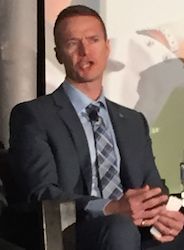
Colin Bletsky, Vice President of BioAg, Novozymes was a participate in the panel discussion following the 2015 Gap Report release during World Food Prize. In an interview, he says that Novozymes came on board with Global Harvest Initiative because the company has a mission to help develop sustainable technologies. Bletsky is also passionate about this mission in his role as a farmer from eastern Saskatchewan in Canada.

Colin Bletsky BioAg NovozymesHe says that to see a farmer from anywhere in the world smile because he had a good crop, a better yield than the year before, it makes him smile. Novozymes, he stresses, wants to bring technologies to people to help them.

Novozymes main work is on developing agricultural biological products, or in other words, naturally occurring organisms found in the soil. They ferment these microbes and sell them as seed treatments, folio applications or as a topical on soil. What these ag biologics do is help nutrient efficiency or nutrient uptake. They also help with root and plant health, plant growth as well as mitigating insects, disease and weeds.

Bletsky notes there is a huge gap in understanding about biologicals in ag and a strong need to educate farmers around the world on their benefits.

Bletsky says their main focus right now is around fertility enhancement. Their products are another tool in the toolbox to help farmers produce more with less. They currently sell their biologics in 42 different countries and are continuing to take their technologies to other farmers around the world. “If we can help a grower reduce his cost by putting our microbe in and produce more, we’re happy.”

Learn more about ag biological products’ role in improving productivity in my interview with Colin Bletsky: Interview with Colin Bletsky, BioAg Novozymes

2015 World Food Prize photo album.

Coverage of the World Food Prize Global Harvest Initiative is sponsored by Coverage of the World Food Prize Global Harvest Initiative is sponsored by John Deere
Audio, Education, Precision Agriculture, Soil, World Food Prize

USFRA Chooses New Director of Communications

Kelly Marshall

USFRAKevin Aandahl has been announced as the new Communications Director of the U.S. Farmers and Ranchers Alliance (USFRA). The Alliance, an organization that fosters dialogue on food issues to build trust in America’s agriculture is excited to welcome Aandahl on board.

“I’m very pleased that Kevin is on our team since he brings more than 25 years of diverse expertise in corporate communications and military public affairs to USFRA. His unique skill-set enhances our on-going efforts to make an impact in the communications landscape on how consumers perceive agriculture. I am confident Kevin will play a key role in that regard” said Randy Krotz, USFRA’s Chief Executive Officer.

As Communications Director, Aandahl will manage and execute USFRA’s overall media communications outreach and engagement strategies through its established programs and resources. Prior to joining USFRA, he served as a US Navy public affairs officer including multiple deployments to Iraq and Afghanistan where he worked with U.S. Special Operations Forces. He has also held communications leadership positions with Blue Cross Blue Shield, National Corn Growers Association and DEKALB.

USFRA is comprised of more than 90 farmer and rancher-led organizations.  Their website provides resources and tools to answer questions about food raised and grown in America.

Agribusiness, USFRA

Hungry for Food-Based Information

Joanna Schroeder

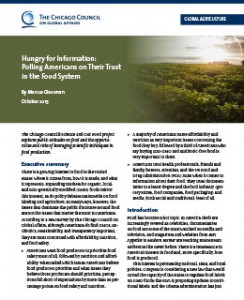
Science-and-Food-Flash-Poll-Brief-1According to a new report from the Chicago Council on Global Affairs, although Americans do find GMOs, antibiotics, sustainability and transparency important, they are most concerned with affordability, nutrition and food safety. This survey found that Americans care a great deal about how their food is produced: a full 78 percent of Americans say they are “very” or “somewhat” interested in how the food they buy makes its way to their plates.

In particular, the report found:

  • Americans want food producers to prioritize food safety most of all, followed by nutrition and affordability. When asked which issues Americans believe food producers prioritize and what issues they believe those producers should prioritize, perceptions fall short of expectations by more than 50 percentage points on food safety and nutrition.
  • A majority of Americans name affordability and nutrition as very important issues concerning the food they buy, followed by a third of Americans who say buying non-GMO and antibiotic-free food is very important to them.
  • Americans trust health professionals, friends and family, farmers, scientists, and the U.S. Food and Drug Administration (FDA) most when it comes to information about their food. They trust documentaries to a lesser degree and the food industry (grocery stores, food companies, food packaging) and media (both social and traditional) least of all.

The survey points to much of the food conversation being “hype” around want consumers want. Only three-in ten surveyed say they consider non-GMO or antibiotic-free to be very important food traits, and even fewer were concerned about food being organic, from a family farm, or locally produced.

Author Marcus Glassman writes, “These results suggest that the public discourse on these hot-button topics may be more noise than substance.”

Food, GMO, Nutrition, Organic, Research

#FeedNThrive Launched During #FoodPrize15

Joanna Schroeder

STEM was a hot topic during the World Food Prize in Des Moines with the kick-off session focused on how to encourage young women to go into STEM careers including science, technology, engineering and math. The STEM Food and Ag Council (SFAC) has launched Feed, Nourish, Thrive, a STEMconnector initiative that aims to inspire the next generation of innovators in food and agricultural production.

The program is designed to develop the workforce pipeline in the food and agricultural sectors. According to a recent USDA report, only 61% of STEM food and ag labor demand is currently being met through schools of food, ag and renewable natural resources. Feed, Nourish, Thrive aims to increase awareness of study and career opportunities that exist in the field through a dynamic interactive online platform.


“The challenge of sustainably feeding the world will require the best and the brightest innovators,” said Dr. Sherri Brown of Monsanto, SFAC Chair. “We must inspire the next generation to take on this challenge. Feed, Nourish, Thrive connects young people and those around them to high quality resources about exciting careers in food and agriculture. This resource will help raise awareness that careers in food and agriculture are not only fun and high-tech but also impactful.”

The initiative focuses on three characteristics of STEM careers in food and agriculture:

  1. Make a Difference – STEM Careers in food and agriculture are on the front line of helping sustainably and healthily feed the world’s growing population.
  2. Have Fun – STEM careers in food and agriculture are interesting and fulfilling.
  3. Earn a Living – STEM careers in food and agriculture pay well.

An interactive web portal for Feed, Nourish, Thrive features videos from young professionals and students from member organizations of the STEM Food and Ag Council. The videos link to career profiles developed by AgCareers.com. In addition, the platform will connect users to high quality, age-appropriate, interactive STEM resources. The platform is open for submissions of materials to be included in the site as well and will continue to add new materials and engagement opportunities with partner organizations. A social media dialogue with the hashtag #FeedNThrive, will encourage students, young professionals and the broader industry to join in the conversation on Twitter and Instagram.

AgCareers, Education, Video, World Food Prize

ZimmPoll Results – TPP Good for Ag?

Jamie Johansen

New Holland ZimmPollOur latest ZimmPoll asked the question, “Is TPP good for US agriculture?”

Most agree that the Trans-Pacific Partnership is full of winners for agriculture, but few believe all of it is good for the industry. Whichever you currently believe, you can’t argue that the future of U.S. agriculture must include trade.

Here are the poll results:

  • Yes, all of it – 18%
  • Some winners – 73%
  • Most losers – 0%
  • Bad deal for all – 9%

Our new ZimmPoll is now live and asks the question, How do you pass the time flying?

The ZimmComm Team really racks up some miles in the skies each year. Chuck and Cindy are currently in New Zealand and are experts when it comes to passing time in the air. So, we want to know how you pass the time when flying. Do you read, work or play?

ZimmPoll

John Deere Int’l Mobile Training Unit Sees Success

Joanna Schroeder

Geoff Andersen John DeereDuring the during the World Food Prize I had the opportunity to learn about a new mobile training unit pilot program from Geoff Andersen,  director, Global Citizenship and Strategic Planning with John Deere. The unit was first used in Ghana and Kenya to help more than 60,000 farmers learn how to increase productivity. Andersen was in country to work with the farmers and he said the program was a huge success and TechnoServe has been a great partner.

Rather than displace farmers to get training, the mobile unit was designed to take the training to them, to their farms, the fields and their communities. Andersen said they have really seen tremendous improvement in how farmers grow their crops and sell them at a higher price and reduce post-harvest lost. On average, farmers have increased their income up to two-fold in a matter of a couple of years.

They also supplement the grants with demonstration plots and provided equipment to TechnoServe to do demo plots right in these communities. This enables farmers to see right there how what they are getting trained on really works in their own fields.

Andersen said John Deere plans to expand the program and they appreciate any support that can be offered by other companies, governmental organizations and NGOs. He noted that there are other companies doing similar small-scale programs but to meet goals, they need to do more. “I really believe in this opportunity to come together to try to solve things on a much broader scale and optimize our collective levels of resources,” adds Andersen who encourages people to get in touch directly with him through the John Deere website.

Listen my interview with Geoff Andersen to learn more about their small-holder farmer mobile training unit: Interview with Geoff Andersen, John Deere

2015 World Food Prize photo album.

Coverage of the World Food Prize Global Harvest Initiative is sponsored by Coverage of the World Food Prize Global Harvest Initiative is sponsored by John Deere
Agribusiness, Audio, Education, John Deere, Precision Agriculture, World Food Prize

FFA Encourages Students to #SpeakAg

Kelly Marshall

ffa_logoThe National FFA Organization is encouraging students to share how they are growing their knowledge of agriculture with a social media challenge entitled

Members may participate by tweeting or instagraming a photo, video or story of how they are using knowledge gained in the classroom, from an SAE project or other FFA activity to inform their communities.  Once they’ve posted with the hashtag members should submit their post to the FFA website.  The current theme for October 11-24 is “Government.”

National officers will be sharing their favorite entires, so posts will be seen by hundreds of thousands of people.

speakag_logo_773x211The purpose of the project is to increase member’s ability to be fluent in the language of agriculture and sharing their knowledge.  By working to improve these skills they will be better able to make a difference in closing the communication gap between producers and consumers.

Ag Groups, FFA, Social Media

New Zealand’s Trade Minister at #IFAJ2015

Cindy Zimmerman

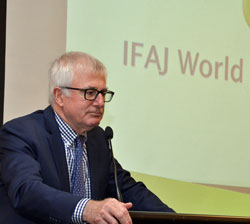
ifaj-groserOne of the hard news highlights of the 2015 IFAJ Congress was hearing from the man who was responsible for holding up the Trans Pacific Partnership agreement to get New Zealand’s dairy industry more access to other markets.

“The fundamental reason why New Zealand agriculture is so strong is we don’t have a choice, it’s export or die for us,” said Tim Groser, New Zealand Minister of Trade.

He calls New Zealand a “virtual water exporter” because the country is fortunate enough to have an abundance of water. “Water is central to the issue and we do not lack water,” he said. “We are gifted with water – we think we use only 3-5% of the water we have.”

In his address to the IFAJ Congress, Groser provided a long history of international trade negotiations, starting with the GATT Uraguay round where he was chief negotiator for New Zealand. He is considered to be one of the world’s leading experts on international trade. New Zealand Minister of Trade Tim Groser

2015 IFAJ Congress Photo Album

Audio, IFAJ, International, Trade

Farm Bureau Releases Food & Ag Resource Guide for Education

John Davis

afbfAg educators will have another tool in their belts to teach young rural and urban students agricultural literacy. This news release from the American Farm Bureau Foundation says the group has released a new Food & Ag Resource Guide, a curated list that features top recommended resources by age group.

“People in the agricultural community are often invited into local classrooms but do not have access to resources appropriate for students,” said Julie Tesch, executive director of the Foundation. “The Food & Ag Resource Guide provides appropriate and accurate activities and resources developed to help students learn about agriculture.”

The top-rated resources will be recognized at the American Farm Bureau Federation’s Annual Convention each year. The goal of the guide is to save educators time and energy by bringing the most relevant resources to their attention.

The guide provides a unique, easy-to-navigate source of activities that will be reviewed, commented on and rated by educators. Each year new submissions will be considered and the guide will be updated with the top 10 resources in each age group and area. The resources will be selected based on their ability to communicate key messages about the agriculture industry, as introduced in the Pillars of Agricultural Literacy http://www.agfoundation.org/resources/ag-pillars.

AFBF, Ag Groups