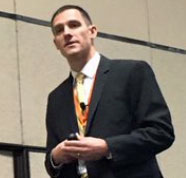
Comedian Damian Mason at #PotatoExpo

Cindy Zimmerman

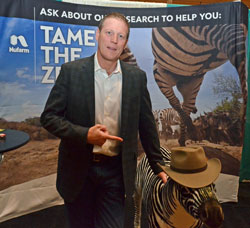
Comedian Damian Mason visits with Nufarm's Chip the Zebra

Comedian Damian Mason visits with Nufarm’s Chip the Zebra

Damian Mason is a very popular, very funny speaker for agricultural groups that we’ve heard several times at different events but he always has a serious underlying message for his audience.

One topic he hit on at the Potato Expo last week was the organic trend. “I’m not anti-organic, I’m actually pro-organic because it’s a profitable niche and it gives us a chance to do value added differentiation in the grocery store,” said Mason. “The problem with organic for normal, mainstream agriculture is we think it’s about science. It’s not about science … it’s about feelings.”

Mason calls organic the “Prius” of the grocery store. “On paper, you would never buy a Toyota Prius for the economics or the gas savings…people don’t buy a Prius because of the economics, they buy it for the social consciousness.”

Listen to more serious thoughts from this funny guy in this interview: Interview with Ag Comedian Damian Mason

Potato Expo 2016 Photo Album

Coverage of the Potato Expo is sponsored by Coverage of Potato Expo is sponsored by Nufarm
Audio, Marketing, Nufarm, Potato

Poll Shows Farmers Back Trump

Joanna Schroeder

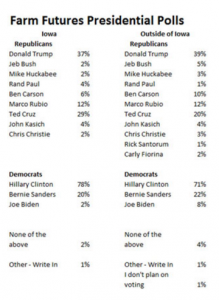
A new poll among farmers show Trump is the Republican forerunner for the nomination due to his strong support of agriculture. Conducted by Farm Futures, the poll found 37 percent of those favoring a Republican candidate said they would vote for Trump “if the election were held today.” Trump’s support among GOP farmers was even stronger at 39 percent from farmers outside Iowa, which holds its caucuses Feb. 1. Texas Sen. Ted Cruz finished second, with 29 percent in Iowa and 20 percent elsewhere among farmers. Florida Sen. Marco Rubio was third, with 12 percent in Iowa and elsewhere while former surgeon Ben Carson was fourth at 6 percent and 10 percent respectively.

Screen Shot 2016-01-18 at 1.06.15 PMTrump’s support is growing in the Farm Futures poll up from 20 percent last August. Farm Futures reports that Trump supporters seemed especially worried about the downturn in the farm economy. Some 57 percent of those outside Iowa said they worried about being able to pay back their debts, the most of any Republican. Trump supporters also reported slower growth, higher debt and lower income.

While hot-button issues like immigration and terrorism dominate the campaign among all voters, both sides of the farm aisle say the most important issue in the 2016 presidential election is “the way government in Washington operates.” Some 30 percent of Democrats and 32 percent of Republicans agreed. Another 10 percent of Democrats and 13 percent Republicans listed terrorism as the top issue.

Around 14 percent of Republicans and 13 percent of Democrats said the economy was the top issue. But the bipartisan consensus broke down on the economic battle lines. The second most important issue in the election for Republicans, with 19 percent, was the federal budget deficit, with only 6 percent of Democrats. But 18 percent of Democrats said “income and wealth inequality” was their number one concern. Support for that issue from Republicans was zero.

The survey was dominated by commercial-sized, full-time farmers with a majority of the response coming from the Midwest. The poll reflects thinking of the largest 10 percent of the more than 2 million farm operations. According to Farm Futures, approximately 85 percent or more of these growers typically vote for Republican candidates at the presidential level. Among those favoring Democrats, former Secretary of State Hillary Clinton was the leader. She gathered 78 percent of the support in Iowa, compared to 20 percent for Vermont Sen. Bernie Sanders.

Trump and Carson both enjoyed support from younger farmers, though Farm Futures notes that’s a relative term in a farm demographic whose average age is 57. The average age of Clinton supporters was the oldest of any of the candidates, both nationwide and in Iowa.

Agribusiness, politics

Zimfo Bytes

Talia Goes

Zimfo Bytes

  • Swanson Russell announces the additions of Sandra Baumgarner, Rachel Dicke and Emily Madden.
  • Woodruff Sweitzer (WS) recently announced the addition of Lindsey Woolsey and Brandon Thomas to its Kansas City, Missouri, office, Cynthia Kotovsky to its Columbia, Missouri, office and Halli Kubes to the agency’s Red Wing, Minnesota, office.
  • The Minnesota AgriGrowth Council is pleased to announce the re-election of Steve Peterson as chair of its board of directors.
  • Agriculture Night with the St. Louis Blues vs. the Anaheim Ducks is Friday, March 11, 2016, at the Scottrade Center in St. Louis.
Zimfo Bytes

All About Spuds and Politics

Chuck Zimmerman

ZimmCast 499In this week’s program we will meet the CEO’s of the National Potato Council and the United States Potato Board. I met both of these guys while covering the Potato Expo last week for my first time.

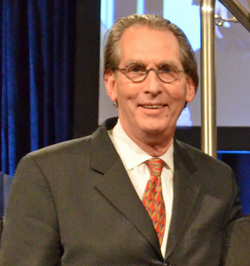
John KeelingLet’s start our with John Keeling, CEO of the National Potato Council. We focused on potato policy issues which as you might guess are very similar to other farm commodities. They include WOTUS and food labeling issues. Foreign trade is also a very critical issue for the sustainability of potato growers.

John says that potatoes fared well with the recent update to dietary guidelines. He says some have been trying to remove vegetable as the designation of what a potato is. I hope that doesn’t go anywhere.

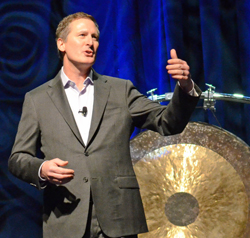
Blair RichardsonNext up I talked with Blair Richardson, President & CEO of the U.S. Potato Board. The gong you can see behind him was used at the close of his report to signal the unveiling of the Spud Nation Food Truck.

Why a food truck? Blair explains, “By 2017, food trucks will be a $2.7 billion market according to the National Restaurant Association,” he said. “Currently food trucks are only reaching about 50 percent of the U.S. population, but it’s one of the fastest growing market segments in foodservice, and several sources reveal there are huge opportunities for the future. Seventy-one percent of Americans polled in a recent survey indicated they are comfortable buying meals from food trucks. We need to be a leader and trend setter in this rapidly changing environment.”

Listen to this week’s ZimmCast to learn more about taters here: Potato Executives from Potato Expo

Potato Expo 2016 Photo Album

Coverage of the Potato Expo is sponsored by Coverage of Potato Expo is sponsored by Nufarm

The ZimmCast

sponsored by
The ZimmCast podcast is sponsored by GROWMARK
Locally owned, globally strong.
Ag Groups, Audio, Potato, ZimmCast

Expanding @NufarmUS Portfolio

Chuck Zimmerman

potato-expo-nufarmNufarm is the eighth largest crop protection company in the world and just keeps getting bigger while not changing its stripes.

At the 2016 Potato Expo last week, I talked with Nufarm North America‘s Vice President for Innovations and Regulatory Affairs Rob Schwehr about what’s new at Nufarm. “What we’ve done over the last couple of years is continue our portfolio expansion in our tree nuts/vines/vegetables segment, which includes potatoes, and as part of that we have expanded into bactericides,” said Schwehr. That includes the company’s big focus at Potato Expo on zebra chip disease in potatoes. “That is very much related to efforts Nufarm has put into citrus, where a very similar organism is causing a problem.”

Schwehr says Nufarm is investing quite a bit into research and development to help growers with these kinds of problems. “We listen to customers and try and address their needs as best we can,” he said.

Learn more in this interview: Interview with Rob Schwehr, Nufarm

Potato Expo 2016 Photo Album

Coverage of the Potato Expo is sponsored by Coverage of Potato Expo is sponsored by Nufarm
Audio, Nufarm, Potato

Meet New #Potato Council President

Cindy Zimmerman

npc-tiedeIdaho potato farmer Jim Tiede took over as the new president of the National Potato Council last week during the 2016 Potato Expo in Las Vegas.

Tiede is a third generation farmer from American Falls, Idaho who is looking forward to focusing on important issues to potato growers in the coming year, including TPP, WOTUS, and transportation. “We’re looking at truck weight increases for the highways, which will allow us to be more efficient,” he said. They will also be working on other trade and regulatory issues and they will all be on the plate during the NPC fly-in to Washington DC this year. “It should be a really good fly-in,” says Tiede. “I’m encouraging everyone to come because it makes a difference to have boots on the ground there.”

Normally the NPC summer meeting is in the home state of the president, but Tiede says he chose to go to Utah this year instead. “We just had it in Sun Valley (Idaho) two years ago, so we were looking for a new place,” he said.

Learn more in this interview with Tiede: Interview with Jim Tiede, National Potato Council

Potato Expo 2016 Photo Album

Coverage of the Potato Expo is sponsored by Coverage of Potato Expo is sponsored by Nufarm
Audio, Potato

Farmers Increase Profits with Solar Leases

Joanna Schroeder

You hear some news about farmers receiving payments for leasing land for wind turbines, but some growers are also receiving lease payments for solar power projects. For example, Farmland Partners recently entered into two ground lease agreements for photovoltaic solar power generation facilities on two farms in South Carolina.

Farmland Partners logoThe agreements offer the right to lease up to an aggregate of about 979 acres that may be converted, at the tenant’s cost, from farming operations to energy generation. The two farms are currently leased to local farmers for a blended annual rental rate of approximately $210 per acre for the 2,579 tillable acres of the farms. Under the lease agreements, the initial average annual rental rate will be $822 per acre for the 979 acres subject to solar development, with annual rent increases of 1.5 percent beginning in the fifth year of the lease terms. In other words, Farmland Partners will pay “rent” to the farmers to build solar farms on the land.

“These South Carolina solar leases further demonstrate the additional upside rent potential for non-ag uses we have on our farms,” said Paul Pittman, CEO of the Company. “We continue to focus on developing supplemental revenue streams for the farms we own in order to increase returns for our stockholders.”

With these Agreements, Farmland Partners will have three solar leases in place, on a total of 1,179 acres, and a wind lease on a farm, on approximately 28 acres, all located in North and South Carolina.

Uncategorized

Economist Reports to #AFBF16

Kelly Marshall

afbf16-land-valuesWeak crop prices and a dramatic decline in livestock prices lead to a decrease in the 2015 farm net income, according to an economist from the Federal Reserve Bank, Nathan Kauffman.  Since 2013 farm income has actually dropped by 55 percent, Kauffman recently told attendees of the American Farm Bureau Federation‘s 97th Annual Convention and IDEAg Trade Show.

“I don’t have the best of news to share this morning,” Kauffman said. The “sky is not falling,” he added, “but this is definitely a period of adjustment.”

The oddity is that the decline in income has not been followed by a decline in land values.

“Farmland values have, in many ways, defied expectations associated with lower crop values,” he said.

A gradual buildup of corn, soybeans and wheat in the global supply chain is one of the reasons for the lower commodity prices.  “Global inventory is very, very high,” he explained.

At the same time, key demand factors have also “softened significantly,” he said, specifically mentioning ethanol production, which has been nearly flat in the past few years, and U.S. exports to China, which have decreased steadily as growth has slowed in that market.

An additional factor is credit conditions, which have deteriorated in the past two or three years. A strong dollar, coupled with a somewhat sluggish global economy, has made selling crops overseas more difficult, he added.

Land values have stayed high, in part because of the lack of land on the market, but prices can very depending on the quality of the land. Marginal ground is seeing some decreases, but high-quaily land is still very much in demand. Rented ground has also been slow to follow the decrease in crop prices.

“It’s not what you would have expected when corn drops from $6 (per bushel) to $3,” he said.

AFBF, Ag Groups, Events

AGree Tells Prez Candidates to Focus on Ag & Food Policies

John Davis

AGree1A coalition of stakeholders in the food and agriculture systems is urging the presidential candidates to focus on the policies that can improve the health of America’s families, economy, farms and the environment. In this news release from AGree, the call includes a strategy for elevating food and agriculture as a national priority.

“Many people don’t realize the degree to which food and agricultural policies shape our nation,” said Dan Glickman, AGree co-chair and former U.S. Secretary of Agriculture. “Farmers and ranchers and the food and agriculture supply chain from ‘farm to fork’ contribute roughly 5 percent of the gross domestic product (GDP) and employ more than 12 million people, yet they face challenges with market volatility, drought, floods, disease, food safety and a reliable labor supply. Policy changes are urgently needed to overcome these challenges.”

AGree, a bipartisan group driving positive change in the food and agriculture system, has engaged more than 2,000 food and agricultural thought leaders to identify key issues and develop consensus recommendations to ensure American agriculture continues to thrive, providing the safest, most affordable food supply in the world. These recommendations are the basis of AGree’s Call to Action being presented to campaigns on both sides of the aisle.

“Food and agriculture-related businesses contributed $878 billion to the U.S. GDP in 2013, and it’s critical to enact policy changes that will enable agriculture to continue to drive innovation, allow access to a stable workforce, protect the environment and empower future generations to provide safe, nutritious, affordable food,” said Jim Moseley, AGree co-chair and former U.S. Deputy Secretary of Agriculture.

The Call to Action advocates smart policy changes to strengthen the food and agricultural sector, which, in turn, will strengthen our nation.

– Strongly support research and innovation for food and agriculture. Research drives innovation and agricultural research on weather volatility, obesity and water quality require greater focus, while addressing underfunding.
– Ensure a stable workforce through immigration reform. Agriculture faces challenges of an unreliable labor supply and would be helped by a simple, efficient and fair guest worker program and a system through which citizenship can be earned by undocumented immigrants currently in the U.S.
– Empower the next generation to ensure a safe and affordable food supply. The average age of U.S. farmers is 58 and new entrants face enormous challenges, including land and equipment acquisitions.
– Strengthen risk management policies and practices. Balancing risk protection and costs, while integrating data on soil, yield risk and conservation practices are needed.
– Bolster conservation and working landscapes. Regulations alone cannot ensure the landscape-level actions needed, so policies that encourage producer-led, watershed-scale efforts involving the supply chain and demonstrating effectiveness and a measurable return on investment must be implemented.

The group goes on to point out how improving health and nutrition can also help reduce health care costs.

Ag Groups, politics

#PotatoExpo is Big Event

Chuck Zimmerman

Since I had never been to the Potato Expo before I had no idea what to expect so I was surprised to find out what a huge event it really is!

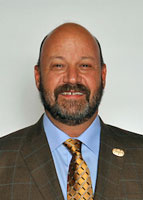
potato-expo-16-hardyRandy Hardy of Idaho is past chairman of the National Potato Board and was one of the co-chairs of the expo. “I was in on the initial thought process of having a Potato Expo about 10 years ago,” he said. “We felt if we had all of the attendees that attended the various potato meetings around the country we’d get 800 or 900 people. This year, we’re going over 2100 …the success has just been phenomenal.”

Hardy was excited about the roll out of the Spud Nation food truck but he was also very pleased with the technology seminars they offered at the expo. Next year he says the meeting will be in San Francisco.

Learn more in this interview – Interview with Randy Hardy, Potato Expo Co-chair

Potato Expo 2016 Photo Album

Coverage of the Potato Expo is sponsored by Coverage of Potato Expo is sponsored by Nufarm
Audio, Potato