Farm Bill Survey Helps Shape NFU Policy

Kelly Marshall

The National Farmers Union (NFU) is offering growers a chance to have their opinions heard regarding the next Farm Bill by offering a survey for farm and ranch families across the U.S.  The survey is in addition to multiple member listening sessions being held that also offer a chance for feedback.

national-farmers-union-logo“As a farmer-led organization, we work closely with our diverse membership to advocate for policies that support family farmers and ranchers and the communities where they live,” explained NFU President Roger Johnson. “After the review, we will be able to better gauge the effectiveness of current farm policies and identify our advocacy priorities for the next Farm Bill process.”

You can take the survey until July 31, 2016.  The site will then close and staff at NFU will analyze the responses to help create future policy proposals for the next Farm Bill debate.

“An educated and vocal membership is one of the things that makes NFU such a strong grassroots organization,” Johnson concluded. “We need to hear from a large number of our members to make sure the farm bill addresses the most serious challenges, including climate change and market consolidation, facing rural America today.”

Ag Groups, Farm Bill

Agronomist Authors Children’s Book on Soybeans

Lizzy Schultz

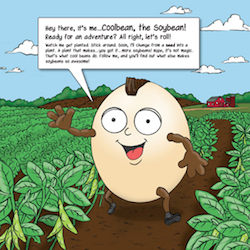
COOLBEAN_vFINAL_120313.indd In honor of Soy Foods Month this April, an agronomy professor has created an interactive book to help spread the message of Coolbean the Soybean and teach youngsters in grades 3-5 how to think like scientists about the important field of agriculture.

“I wanted to develop a fun, yet educational, tool to help teach today’s youth about where food comes from, career opportunities in agriculture, and explain why soybeans are so important, not only here in the US, but around the world,” says Author Shawn Conley, an agronomy professor and Soybean and Wheat Extension Specialist at the University of Wisconsin-Madison. “My daughters were the main reason for writing this book, but I also remember being inspired at an early age by my first and second grade teacher, Mrs. Swiggum. Hopefully this book can help inspire the next generation of agricultural scientists.”

The book, published jointly by the American Society of Agronomy, Crop Science Society of America, and the Soil Science Society of America in partnership with the Wisconsin Soybean Marketing Board, follows the life of Coolbean the Soybean.
Coolbean introduces kid to soybeans, agriculture, agronomy, and crop and soil sciences. Coolbean explains modern farming techniques, how a seed becomes a plant and then produces a crop. The book tells the story of how soil, sunshine, and water affect the growth of the plant.

“We chose to follow the format of the STEM (Science, Technology, Engineering, and Math) graphic novels and comics because it’s a style that kids are very comfortable with,” says Lisa Al-Amoodi, managing editor. “It also allowed us to package a lot of nonfiction science content into a cool story about a soybean.”

Soybeans are one of the most nutritious beans on the earth, and the protein-rich legumes are vital to a healthy diet, but nutrition and food is only one aspect of this amazing crop; they are also used in the production of cardboard, cars, crayons and more. Soybeans are also the second most planted crop in the U.S. and are vitally important to the economy. Soy production accounted for over $40 billion in revenue in 2014.

Coolbean the Soybean is available in both traditional and e-book formats at the Society Store website. In celebration of Soy Foods Month, use promo code, SOYFOODS, for 50% off from March 1-April 15.

Ag Groups, Agronomy, Food, Publication, Soybean

Deere Aligns with Hagie for High-Clearance Sprayers

Kelly Marshall

johndeerelogoDeere & Company and Hagie Manufacturing have entered into a joint venture.  Hagie is a national market leader when it comes to high-clearance sprayers.  In this new agreement Deere gains majority ownership of Hagie Manufacturing. The equipment produced in the current plant at Clarion, Iowa will continue to carry the Hagie brand, but sales and services will be integrated into Deere’s global distribution network throughout this year and next.

“Hagie Manufacturing is known for innovation and its strong customer understanding in high-clearance spraying equipment,” said John May, president, Agricultural Solutions and Chief Information Officer at Deere. “High-clearance spraying equipment is a new market for Deere. The expertise at Hagie allows John Deere to immediately serve customers who need precision solutions that extend their window for applying nutrients.”

HagieAlan Hagie, chief executive officer at Hagie Manufacturing, said, “We have great products at Hagie that help producers be more profitable but we need a business model that helps us reach more customers. This partnership with Deere allows our solutions to reach customers on a global scale and ensure they are supported with the world-class Deere dealer organization.”

The new agreement gives John Deere a wide range of sprayer options and Hagie will now be able to integrate Deere’s precision technology into their equipment at a lower cost.

Agribusiness, Equipment, John Deere

NCGA Partners with SoAR for Ag Research

Kelly Marshall

NCGA-Logo-3The National Corn Growers Association recently told us of their new strategic plan to increase demand and improve productivity and sustainability.  Now they’re showing us just what it is they plan to do about it.  The organization has now joined the Supporters of Agricultural Research (SoAR), a coalition of scientific, consumer and producer groups that seek out sound research policies to help feed the growing world.

“As a partner of SoAR, NCGA will be able to further its efforts to achieve public polices in the research arena that will benefit all U.S. Corn farmers,” said NCGA Research and Business Development Action Team Chair Larry Hoffmann. “While we work to build demand, it is also imperative NCGA maintains important efforts to keep the research pipeline flowing. As members of this respected group, we will amplify our voice by working with like-minded groups and ensure that research funding remains a top priority for Congress.”

soar-022SoAR works with major research institutions, farmer groups, scientific organizations, consumer groups and other private sector partners who believe a strong competitive grants program will encourage top scientists from multiple disciplines-from botany and biology to energy and engineering-to address the many agriculture-related challenges facing our country today.

SoAR advocates for full funding for the Agriculture Food and Research Initiative. AFRI is a program established by Congress in 2008 to award competitive grants for research projects-at any institution-that apply best ideas from any discipline to the many problems confronting today’s farmers and consumers.

The Foundation also takes on the job of educating stockholders about the importance of agriculture research.  They believe competitive grands are the best future for agriculture, pointing out how the approach has lead to much of America’s biomedical innovation.

For more information on SoAR, click here.

Agribusiness, NCGA, Research

US Ag Colleges Stand Out in World Ranking

Lizzy Schultz

Print The QS World University Ranking system has released its latest standings for the world’s top agriculture universities, showcasing fifty exceptional programs on their website. While the top spot went to Wageningen University in the Netherlands, the strength of American agriculture universities continues to shine as twenty two of the top fifty spots went to U.S. agriculture programs, including seven of the top ten programs.

The rankings aim to help prospective students identify the world’s leading schools in their chosen field, with the list of subjects extended each year in response to high demand for subject-level comparisons. As recent data from the website AgCareers.com suggests, interest in careers involving the agriculture industry has spiked 33% this year. Students interested in pursing a career in agriculture can take confidence in the quality of education offered to them in American programs.

The University of California-Davis took the number two spot on the list, followed by Cornell University in the number three rank, the University of California-Berkeley ranking in fourth place, and the University of Wisconsin-Madison tied for the number five spot with Agro, ParisTech. These four Universities boast outstanding research programs, with a large focus on research-based education. The schools are also considered large or extra large by QS standards, and have programs that are over 100 years old.

Other American Universities in the top ten are Michigan State University, Purdue University, and Iowa State University, highlighting the strong presence of successful agriculture programs throughout the Midwestern region of the United States.

The rankings are determined by analyzing the university’s academic reputation and employer reputation for graduates of their agriculture programs, the number of research citations per paper for research published from the University’s agriculture program faculty, and the University’s Hirsch Index, a way of measuring both the productivity and impact of the published work of a scientist or scholar. The index is based on the set of the scientist’s most cited papers and the number of citations that s/he has received in other publications.

Ag Groups, AgCareers, Education, International, University

Tweet a Bee, #FeedABee

Cindy Zimmerman

ZimmCast 507Bayer is gearing up to make a significant impact on pollinator health in 2016 by planting more forage and spreading the word about the importance of pollinators with the debut of the Feed a Bee song and video and new social media initiatives to help keep pollinators healthy. We talked with our favorite Queen Bee Becky Langer, Bayer Bee Care Program Director, about the new aspects of the 2016 Feed A Bee program and got to know a little more about the busy, buzzy little buggers and other pollinators

feedabeeWith the video, Bayer is re-launching FeedABee.com with new features so people can stay up to date on Feed a Bee activities throughout the year. The video features Beatrice Blum and her animated friends who spread wildflowers to beautify their world and help pollinators and is designed to connect with consumers and classrooms to tell the bee health story and encourage people to get involved. Viewers are encouraged to share Beatrice’s story on social media using the #FeedABee hashtag and “Tweet a Bee” emoji to have Bayer plant a flower on their behalf.

Learn more about #FeedABee in this week’s ZimmCast: ZimmCast with Becky Langer, Bayer Bee Care Program Director

Watch and share the new video below:


Subscribe to the ZimmCast podcast here.

The ZimmCast

sponsored by
The ZimmCast podcast is sponsored by GROWMARK
Locally owned, globally strong.
Audio, Bayer, Bees, pollinators, Social Media, ZimmCast

GROWMARK Announces Essay Contest Winners

Kelly Marshall

growmarklogoWhat can young people do to ensure the sustainability of agriculture?  Two FFA students answered this essay question for GROWMARK and are being announced as winners of their state’s contest.

Trygve Lien from Castalia earns the award in the state of Iowa and Logan Korff of Norborne takes top honors in Missouri.

Lien attends school at South Winneshiek CSD where his FFA advisory is Melissa Brincks.  In his essay he wrote:

“The current population of young adults must educate themselves about modern agriculture and its impacts on others. Young adults should also educate others who are not knowledgeable on the subject so there is a universal understanding of how agriculture works. We should also work with professionals in the industry to help learn about complex topics which can often be distorted in the media.”

His submission earns him a $500 award from GROWMARK at the Iowa FFA State Leadership Conference in April.  His chapter will also receive $300 to assist future students at his school.

Korff will receive his $500 award at the Missouri FFA State Convention.  His Norborne FFA chapter, under the advisement of Kelly Lee, will accept $300 as well.

Korff told readers in his essay: “Agriculture is more than just an industry or a job. I consider agriculture to be the heartbeat of our nation; it is the number one industry for many of our states and allows our country to fend for ourselves and still have produce to be traded in the global economy… Agriculture is more important to our world than most people realize, and that is why advocating for sustainable agriculture is incredibly important.”

This is the 23rd year for the Iowa essay contest, but the 1st year the program has been sponsored in Missouri.  Wisconsin and Illinois also offer this event to FFA students in their state.

GROWMARK

Farm Futures Predicts More Corn, Less Soybeans

Kelly Marshall

PrintFarm Futures is Penton Agriculture‘s market-leading ag business resource and they are seeing a lot of red on the ledgers right now.  In fact their latest survey suggests farmers may react to the agriculture market by cutting back almost 2 percent of the crop acreage this year.  Of the major row crops, only corn and cotton are seeing gains– but with levels that are still below those of two years ago.  The USDA will be releasing their first Prospective Plantings on March 31.

The biggest reason for an increase in corn could be weather, as prevented planting across 2.6 million acres kept last year’s numbers low, although some farmers in the northwest Midwest harvested record yields in 2015 and may increase acreage for that reason.  Numbers for cotton are expected to rise almost 11 percent, a comeback after low prices and poor weather conditions in 2015.

However, Farm Futures sees cutbacks on soybean acres of about half a percent, following back-to-back record crops and yields.  Sorghum’s rise from last year when Chinese buying brought prices to record premiums over corn doesn’t look to hold for this year since a surplus in the market has lowered prices again.  Reports suggest sorghum acres will be cut by 13 percent.  The north Plains may plant less spring wheat and farmers growing high protein grain plan to cut acreage as well leaving wheat at 5.5 percent lower than last season.

“Cotton prices aren’t profitable either, but growers don’t have many alternatives that look good in 2016,” said Bryce Knorr, Farm Futures grain market analyst, who conducted the survey. “That’s why overall acreage could continue to fall among major crops again this spring.”

“Corn appears to be gaining ground by default, because farmers are a little more optimistic about rallies during the growing season, thanks to a lot of talk about potential for the El Nino to end soon. Our research shows that would increase potential for at least modest gains,” Knorr continued.

Growers put their average price target for 2016 corn at a futures price of $4.12. By contrast the average futures price target for soybeans was only $9.27, a dollar or more below break-even levels.

Farm Futures surveyed 1,246 growers from March 7 to March 23. Growers were sent an invitation by email, with results recorded by an online survey form. Over the last eight years, Farm Futures’ March survey has deviated from USDA’s corn estimate by an average of 1.2%. For soybeans, the deviation is 3%.

“Farmers are banking on rallies because they still have a lot of 2015 production unpriced,” says Knorr. “Growers told us they have more than 40% of last year’s corn still in storage, with 30% of the soybean crop still unpriced.”

Agribusiness, Markets, Planting

I AM USFRA – Dawn Caldwell

Cindy Zimmerman

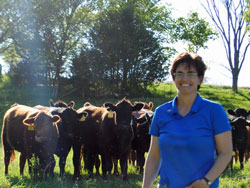
usfra-dawnDawn Caldwell is a very busy woman. Besides helping to run her family’s cow-calf operation in north central Kansas, not far from where they live in Clay County, Nebraska, the wife and mother of two works as head of governmental affairs for the Aurora Cooperative. In addition, she serves on the board of the Federation of State Beef Councils, and is treasurer of the U.S. Farmers and Ranchers Alliance (USFRA). Oh, and she’s also the Lady of Ag blogger in her spare time, whenever that is!

As a cattle producer, Dawn believes that USFRA is doing something that no single organization can do alone – dialogue with consumers about what agriculture is and does. “This is the one place where all of agriculture comes together as a community to send that good message about what very few of us in the country are doing to help keep food and fuel and fiber available,” she said. “Individually we can do good things, together we can do really great things.”

i-am-usfra-webDawn says that USFRA has been actively involved in addressing consumer concerns that directly relate to the beef cattle industry through Food Dialogues. “The top two questions we get are the use of hormones and the use of antibiotics,” she said. “We had one of my fellow Nebraska producers sit on a Food Dialogues panel in New York… and it ended up being a wonderful dialogue opening situation.”

She’s also pleased with what USFRA has been doing to reach out to school children in a variety of ways, such as the upcoming Virtual Field Trip, building off the successful documentary movie FARMLAND. “That’s given us a wonderful foundation, now with Discovery Education utilizing it in classrooms for science in high schools throughout the United States,” she said.

In this interview, Dawn shares more about how USFRA is helping farmers and ranchers share their story with consumers: Interview with Dawn Caldwell, Nebraska cattle producer

Audio, Beef, Beef Checkoff, USFRA

AgNerd Cloud – Samsung Galaxy S7 Edge

Chuck Zimmerman

Galaxy S7 EdgeI recently upgraded my backup phone from a Samsung Galaxy S6 to the new S7 Edge. Mine is covered with an Otterbox Symmetry case.

One of the features of I was most looking forward to is the camera that is supposed to be far superior in low light than even my iPhone 6S. I haven’t really had a good test for that yet but it does focus fast and takes excellent photos and video. Here are the basic specs:

5.5 Quad super AMOLED display
12 MP rear camera with dual pixel
CMOS 5MP front camera
32 GB storage, expandable to 200 GB
Marshmallow OS, Android 6.0
Battery: 3600 mAh
Water resistant up to 30 min in up to 5 ft of water

My first impression when I held it was how thin it is. It is also not as wide as my iPhone so it is easier to one hand text on it. I put a cover on it though because it is just so slick that I find it easy to slip out of my hand. The Otterbox case solves that issue for me.

The rounded edge has a handy function to bring up a short list of your most used apps, tasks and contacts. Once I realized how this works I found myself using the function quite a bit. The phone also has fingerprint security which is a feature I’ve loved on my iPhone. It works just fine.

A lot was said about this phone having much better battery life. Part of that is due to the new version of Android. My biggest complaint with the S6 was battery life. This phone is a huge jump forward in better battery performance. It still doesn’t last as long as my iPhone battery but it’s close. I can go almost two days without charging depending on how much I’m using it. I also purchased a wireless charger from Verizon and just set the phone on it and in a very short time it is fully charged. Much faster than plugging in via a cable.

The screen is beautiful and apps work noticeably faster. Speaking of apps, besides the form factor, battery, camera and screen the biggest surprise is how much more I like Android. Finally, an Android version is out that just seems to work faster and that makes using it more enjoyable.

I think Samsung has a winner here that I can recommend. If you’re an Android AgNerd this is the best phone I’ve had the opportunity to use. Next month we’ll be releasing a new version of our AgWired App and it will run on this latest version of Android. I’ll let you know when it is ready.

Apps, Technology