New Version of AgWired App Available

Chuck Zimmerman

AgWired AppHey AgWired Fans. We hope you already have our AgWired App on your mobile device but if you don’t now is the time to get the new version which is also compatible with iPad as well as iPhone. If you already have it just run your updates to get the latest version.

The new version has been built on a platform that will allow easy changes and new application opportunities. It is available now in the iTunes store: https://itunes.apple.com/us/app/agwired/id382820712?mt=8.

For the AgNerds out there, we have built a new backend on the app which allows it to actually be managed by AgWired itself> New functionality is planned and of course the app allows us to display banner advertising for our sponsors. A new Android version of the app will also be released shortly.

The AgWired App, which was introduced in 2010 as the first agricultural news and information app, allows users to easily keep up to date anywhere and provides multiple ways to see news filtered by key word categories. In addition, the app has a built in mechanism to provide the latest news produced by the ZimmComm News Network on alternative energy, the livestock industry and the latest in precision farming technology and efficiency.

The new app includes:

  • Most current news posted onto AgWired.com, including all key word category breakouts
  • Current news from all ZimmComm News Network on-line publications: Precision.AgWired.com, Animal.AgWired.com, Energy.AgWired.com, AgNewsWire.com and ZimmComm.biz
  • Weekly ZimmCast Podcast and regular Ethanol Report
Apps, ZimmComm Announcement

Chromatin Provides Relief to Growers Hit by Fire

Kelly Marshall

ChromatinThe Anderson Creek Fire destroyed more than 400,000 and now Chromatin, Inc. is moving in to help farmers and ranchers.  The company will be providing producers with seed that will rapidly feed livestock or cover the ground to prevent soil erosion.

“We are saddened to hear of the tragic damage caused by this fire to crops, pastures and livestock in the Kansas and Oklahoma areas. We are confident that sorghum can be part of a recovery program for the region, and Chromatin is pleased to devote resources toward this effort,” said Daphne Preuss, Chromatin’s CEO.

Sorghum grows well in tough conditions; it can be planted late in the season, requires limited water resources and grows quickly. Sorghum’s extensive root system can stabilize soil against wind and water erosion. Forage sorghum is especially useful in fire recovery, as it serves as a source of hay, silage feed, or as a cover crop in pastures for grazing.

“Our thoughts are with growers affected by the devastation of the Anderson Creek Fire, and we at Sorghum Partners are working with supportive local retailers to provide select products that are well adapted to the area at a significant discount,” stated Mike Battin, Director of National Sales.

Farmers and ranchers who suffered losses from the fire may contact these local retailers:

Anthony Farmers Cooperative (Sharon, Kansas), Contact: Aaron Schreiner

OK Coop (Kiowa, Kansas), Contact: Brett Courson

Farmers Cooperative Equity (Isabel, Kansas), Contact: Ted Behring

Farmers Cooperative Equity (Medicine Lodge, Kansas), Contact: Mike Snell

Farmers Cooperative of Carmen (Cherokee, Oklahoma), Contact: Alan Nusser

Growers and livestock producers can also call 1-855-SORGHUM for program details.

Agribusiness, sorghum

USDA Offers Grants for Value-Added Products

Kelly Marshall

USDAThe Value-Added Producer Grant program is gaining $44 million to help farmers, ranchers and businesses develop bio-based products and expand existing markets.  The USDA made the announcement just last week, and hope to help with grants to veterans, members of socially disadvantaged groups, beginning farmers and ranchers, and operators of small and medium sized family farms and ranches.

“America’s farmers, ranchers and rural business owners are innovative entrepreneurs and this program helps them grow economic opportunities for their families and communities by increasing the value of the items they produce,” Vilsack said. “The Value-Added Producer Grant program has a great track record of helping producers increase the value of products and expand their markets and customer base, strengthening rural America in the process.”

More information on how to apply is on page 20607 of the April 8 Federal Register. The deadline to submit paper applications is July 1, 2016. Electronic applications submitted through grants.gov are due June 24, 2016. Additional information and assistance is available through the USDA Rural Development Office serving your county.

Last year’s grant recipients include Shoshone-Bannock Enterprises in Fort Hall, Idaho who received $75,000 to conduct a feasibility study on processing and packaging buffalo meat, and Sappa Valley Poultry in Oberlin, Kansas who used $49,663 to expand the distribution of their free-range chicken products.

USDA

Do Americans Trust Their Food?

Kelly Marshall

Producers today face challenges of water shortages, urban sprawl, weed and antibiotic resistance, and the never ending battle with Mother Nature, but possibly the biggest hurdle to agriculture is consumer trust.  More than ever consumers are asking questions and requesting transparency in the food process.

How is the industry doing?

Research provided by FoodThink offers new insights into Americans’ understanding of where their food comes from, and notes actionable trends for agri-marketers.

“While the industry may face daunting news of labor shortages, demand for innovative products, environmental scrutiny, and more — here’s a topic that you can take action on,” said Ashley Daggs, animal and food science specialist and FoodThink’s Research Analyst. “Our research confirms that as people become more concerned about the food they eat, they are turning to the source of their food to learn more.”

FoodThinkFor those in the industry working to connect consumers with what happens on modern farms, FoodThink offers three areas to which agriculture can be more responsive.  First, perceptions of the food industry are on the rise.  Second, consumers care about how food is produced, and third, farms and ranchers come in a close second to friends and family in terms of trustworthiness.

While these areas are a good “in” with consumers, FoodThink continues their work to find ways to influence trends in a positive way.  You can download the free white paper, “Evolving Trust in the Food Industry” to learn more.

Ag Groups, Food, Safety

Remembering Merle

Cindy Zimmerman

nbc-07-20Back in the early years of the biodiesel industry, Merle Haggard was one of the stars who came out in support of the American-made biofuel.

The country music legend who died last week at the age of 79 made a legendary appearance at the 2007 National Biodiesel Conference, holding a press conference and performing for those in attendance. During the press conference Merle said that he was learning about the benefits of biodiesel. When asked what attracted him to the renewable fuel source his answer was “the smell.” He also he was happy about how the development of biodiesel was helping American farmers.

Listen to the legend talk about biodiesel with NBB CEO Joe Jobe here: 2007 Biodiesel press conference with Merle Haggard

Check out the photo album from the 2007 biodiesel conference for more photos of Merle.

Audio, Biodiesel, National Biodiesel Conference

Zimfo Bytes

Talia Goes

Zimfo Bytes

  • The American Farm Bureau Federation is accepting applications for its tenth Women’s Communications Boot Camp class, July 12 – 15 in Washington, D.C.
  • The U.S. Department of Agriculture’s (USDA) Foreign Agricultural Service (FAS) is accepting applications for fiscal year 2017 funding for five export market development programs.
  • In honor of Dr. Norman Borlaug’s 102nd birthday anniversary and International Women’s Day the World Food Prize announced the release of the 3rd Annual Iowa Hunger Directory.
  • broadhead, the Minneapolis marketing agency, announces the hiring of Maija Hoehn as vice president, director of engagement.
  • The Illinois Wheat Association will again hold a wheat yield contest open to all Illinois Wheat Association members.
  • The Georgia Peanut Commission (GPC) board of directors has approved $423,036 in research project funding for the 2016-17 research budget year.
Zimfo Bytes

What Do You Do About Statistics?

Jamie Johansen

New Holland ZimmPollOur latest ZimmPoll asked the question, “Do you have a degree in agriculture?”

Our latest poll solidifies what we already knew – there are plenty of careers for those interested in agriculture. We had an overwhelming response to this question and an overwhelming majority were proud to say they have a degree in agriculture and honored to work in the industry.

Here are the poll results:

  • Yes and work in agriculture – 59%
  • Yes, but work in other field – 5%
  • No, yet work in agriculture – 15%
  • No and work in other field – 9%
  • No college degree and work in agriculture – 12%

Media statistics used to be simple to calculate. We had Arbitron surveys for radio and television and basic subscription statistics for print. It was all so easy.

Then social media came along and it’s just not so simple anymore. Companies and agencies understandably still want to know if their advertising and messages are being seen and heard, but with the myriad of different ways that information is shared across the various social media platforms the task is daunting.

With the 2016 National Agri-Marketing Conference coming up, our new ZimmPoll asks the question – What do you do about statistics? This is a question for media, agri-marketers, companies and agencies – it impacts all of us!

ZimmPoll

NRGene Selects St. Louis for U.S. Headquarters

Jamie Johansen

BioSTLGlobalSTL, the initiative of BioSTL focused on attracting high-growth international companies to St. Louis, announced that Israeli genomics company NRGene has selected St. Louis as the location of its U.S. headquarters. NRGene is the fourth company to move to St. Louis through the GlobalSTL initiative.

NRGene develops advanced computational tools leveraging big data to identify genetic traits to improve yield, environmental tolerance, and disease resistance. It was the first to successfully assemble the whole genome sequence for wheat, one of the most complex plant or animal genomes, five times larger than the human genome, and has assembled more than 80 genomes in less than a year.

nrgene“Missouri as the ‘heartland’ of American agriculture is the natural U.S. home for NRGene,” says Gil Ronen, CEO of NRGene. “Our strong partnership with the Donald Danforth Plant Science Center brought us to St. Louis, and GlobalSTL convinced us to stay.”

“With each successful recruitment, we are building a cluster of world-class agritech companies that bring with them technology and talent that enrich the St. Louis ecosystem,” said Donn Rubin, President and CEO of BioSTL, which launched the GlobalSTL initiative in 2014.

The GlobalSTL team first encountered NRGene in Israel in April 2015 on a trip that brought together representatives from Monsanto, KWS, and the Donald Danforth Plant Science Center. NRGene connections with Danforth Center scientists influenced NRGene’s decision to consider St. Louis as its North America base. Since the initial meeting, GlobalSTL has hosted NRGene in St. Louis, introducing them to potential local corporate partners and customers, St. Louis’ innovation districts, and to state agencies to aid in relocation incentives.

Agribusiness, Research, Technology

New Insecticide Coming from @BASFAgProducts

Cindy Zimmerman

basf-newBASF Crop Protection is seeking regulatory approval for a brand new insecticide active ingredient called Inscalis™.

Inscalis is the pioneer solution from a novel chemical class, the pyropenes, offering an alternative mode of action for the control of key insect pests and providing an essential tool to farmers for use in resistance and integrated pest management programs. Inscalis controls critical piercing and sucking insect pests such as aphids, whiteflies, psyllids, scales, and leafhoppers. First registration dossiers were submitted to the authorities in the U.S. and Canada for use on a wide range of crops such as vegetables, fruit, row crops, and ornamentals.

“Insect species causing crop damage are extremely diverse and adaptable,” said Livio Tedeschi, Vice President Global Strategic Marketing, Insecticides, BASF’s Crop Protection division. “That is why developing new insecticides is critically important for the sustainable management of devastating pests, especially those that have developed resistance to other insecticides. We are excited to bring this important innovation another significant step closer to market introduction.”

The company also notes that Inscalis has a favorable environmental profile and low acute toxicity to pollinators. Inscalis was co-developed with the Japanese company Meiji Seika Pharma Co. Ltd. and will play an integral role in BASFʼs insecticide portfolio worldwide. Pending regulatory approval, first market introductions of Inscalis-based products are expected in 2019.

BASF, Crop Protection, Insecticides

I AM USFRA – Jeanette Merritt

Cindy Zimmerman

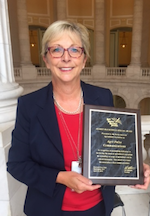
usfra-merrittLike most farm women, Jeanette Merritt wears many hats. A wife and mother of three, the 4th generation Indiana hog and soybean farmer is a Purdue University graduate who serves Hoosier State agriculture in a variety of ways.

Jeanette is a former farm broadcaster and agricultural journalist who has put her experience to work as a public speaker and PR specialist for the industry. She’s served the Indiana Wine industry and is Director of Checkoff Programs for Indiana Pork. At the same time, she sits on the board of the Indiana Soybean Alliance and in that capacity was chosen recently to serve on the board of the U.S. Farmers and Ranchers Alliance (USFRA).

i-am-usfra-webBecause of Jeanette’s broad background in agricultural communications, she sees the great need for USFRA to unify the voice of the nation’s farmers and ranchers. “I think it’s important that we all have the same message,” she said. “We’re all trying to educate consumers. Maybe the way we farm is different from state to state, but we still have the same goal.”

That’s why she thinks it’s important for state commodity organizations to support the work of USFRA as much as possible. “Being able to participate brings that local feel to a national organization,” she said, adding that she believes it has been an effective use of farmer checkoff dollars in Indiana. “Being able to work with other commodity organizations and combine those dollars to make our effort even bigger I think is a great use of the checkoff.”

Jeanette believes USFRA has already made a difference in the short five years of its existence with programs such as Food Dialogues, the FARMLAND movie spinoffs, and the Faces of Farming and Ranching.

Listen to Jeanette’s thoughts on USFRA here: Interview with Jeanette Merritt, Indiana soybean member of USFRA board

Audio, Soybean, USFRA