
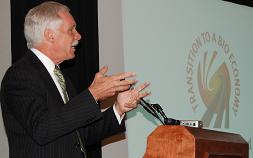
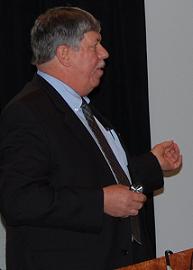
 U.S. Secretary of Agriculture Ed Schafer has just finished addressing the folks attending the latest Farm Foundation’s Transition to a Bioeconomy Conference going on in St. Louis, Mo.
Schafer reminded the crowd how hard the current administration has worked to promote the biofuels field in this country, and thus, how hard it had worked to help the farmers who are either directly or indirectly tied to this change to a bioeconomy.
He said that now, more than ever, we need to keep exploring new technologies and new ideas to secure our energy independence and in turn, our national security. Schafer added that ethanol and biodiesel, as well as other renewable energy sources such as wind and solar, will be key to that energy security and independence.
I’ll have some more audio from Schafer’s address to the Farm Foundation, but for now, let me give you a little bit of what he told reporters who caught him for just a few minutes before he had to head out.
I asked him about the importance of a meeting such as this, where diverse opinions are brought together to come up with a consensus as to what might be the best direction to go.
“These conferences are very important because what you get is that diverse viewpoint. And when you’re challenging one another, you end up picking up the good pieces and forging good public policy and direction.”
He added that this isn’t solely a price issue or an environmental issue or an economics issue… all must be looked at for a biofuel policy for America.
Listen to Schafer’s comment here: Schafer1.mp3
 The President of the
 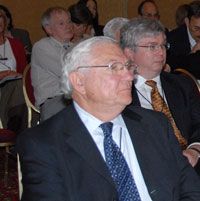 One of the participants in the 2008 World Food Prize symposium who caught my eye yesterday was Dr. Gale Buchanan, USDA Under Secretary for Research Education and Economics. I saw him sitting in on every session I attended, so I caught up with him for an interview about the event and what he thought.
  This year’s World Food Prize winners are former Senators Bob Dole and George McGovern, who are being honored for their work to expand USDA’s school feeding program. Dr. Buchanan says it is nice to see USDA’s program recognized for its world feeding efforts. “The department has a vital role to play in addressing these issues,” Buchanan said. “The focus of this conference is not looking inward but looking outward to every country around the world.”
 Today is World Food Day in case you didn’t know it. This is a FAO-organized event held every year. I applaud their desire to bring attention to the plight of the hungry around the world.
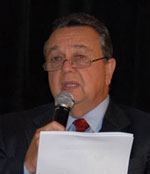 Among the presenters was Brazil’s former minister of agriculture Roberto Rodrigues, co-chair of the
 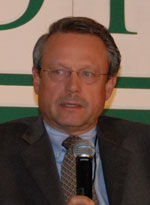 Another speaker on the same panel was Pioneer Hi-Bred International president Paul Schickler who talked about all the improvements in seed technology and how it has increased production. He took the first question to the panel, which was “How optimistic are you that the world can reduce hunger by half by 2015?”
 The amount of water that goes into growing the corn that goes into ethanol has been a big topic of conversation between those for and against production of the green fuel. That’s why it is a topic of conversation at the Farm Foundation’s Transition to a Bioeconomy: Environmental and Rural Impacts Conference in St. Louis this week. This gathering of government officials, academics and industry leaders is designed to take on the tough questions facing Rural America as it moves to a bioeconomy.
 One of the people in the ethanol/water discussion is Noel Gollehon, a senior economist with the USDA’s Natural Resources Conservation Service. He says the amount of irrigated corn is particularly concerning.
 Today has been “Blog Action Day” and the theme this year is poverty. Coincidentally, that is the basic theme here in Des Moines at the
 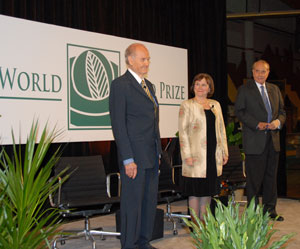 This year’s winners are former U.S. Senators George McGovern and Bob Dole, who are responsible for legislation creating an international school-feeding program which has provided meals to feed more than 22 million children in 41 countries. They are pictured here during a dialogue held at the event with 2003 World Food Prize winner Catherine Bertini, former executive director of the World Food Program.
 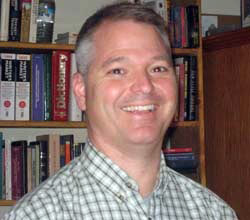 Meet John Davis in case you haven’t. I meant to let you know earlier that he’s covering the Farm Foundation’s Transition to a Bio Economy: Environmental and Rural Impacts Conference in St. Louis this week while Cindy is in Des Moines at the World Food Prize Symposium and I’m at Sunbelt Ag Expo.
 I got an overview of Sunbelt Ag Expo today. By overview I mean from the control tower for this airport which was formerly a military airfield. I climbed up and took a few photos early today.
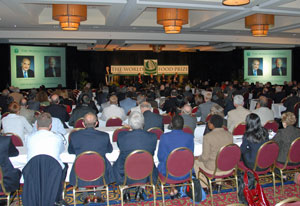 Even though the word “crisis” is being used liberally here at the
 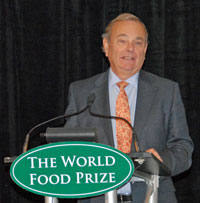 Conway stressed the need to address why we want to produce biofuels and the urgency to move quickly into second and even third generation biofuels – such as cellulosic ethanol from switchgrass and biodiesel from algae. “Maybe we should have a new World Food Prize on this,” Conway said. “In which we transform the world from one dependent on fossil fuels for energy and production of chemicals, into one that depends on plants as a basic source of our economy.”