If You Haven’t Already, Reach Teach Learn

Joanna Schroeder

Have you ever summited Mt. Everest? I haven’t but Lance Fox has. He is a technical service veterinarian for Alpharma, and his successes both in his job and in his personal life have trained him to become a natural role model for children across America as part of the Reach Teach Learn ag educational program.

Alpharma on top of the world titled“My role is to educate students and make them more aware of agriculture and agribusiness and share some of my personal adventures and experiences,” Fox told AgWired during the Ag Media Summit.

Climbing to the top of Mt. Everest was a 12 year dream for Fox and he has some great advice for our future leaders, “If you have a dream pursue it. Pursue your passion. If you work hard everything is possible.”

In its second year, the Reach Teach Learn program is designed to provide youth with the information they need to ensure that honest, educated decisions are made. The program consists of two main initiatives including a college student video contest and a high school student essay contest. College students will be able to use imagery to depict current ethanol agricultural practices while for the first time, younger students will provide their perspective writing of an essay on agriculture based on the book, “The Man Who Fed The World.” As far as you know, I’m not a high school student but I will be providing my insights about the book as well.

AlPharma2I was also able to chat with Jeff Mellinger, Global Leader – Sales & Marketing for Alpharma. “What we’re really trying to do is reach out to young people in the U.S. is to get them to understand the agriculture industry because they will be the spokespersons in the future. We want them to be more informed in making positive choices and viewpoints because they’ll be the future leaders in developing views about agriculture.”

Mellinger also noted that the ag industry is seeing a lot more public opinion that is not accurate and that they are trying to bring accuracy to the conversation. Agriculture, he says, is a positive industry and still important to the United States.

More than 12 states have signed up to participate in the essay contest and others are welcome to join. You can learn more about Reach Teach Learn on their website. BTW – in addition to my essay on the book, I’ll be submitting a video as well, right here on AgWired.com. Now this you won’t want to miss.

You can see all our pictures from the Ag Media Summit in the IFAJ/AMS 2009 Photo Album.

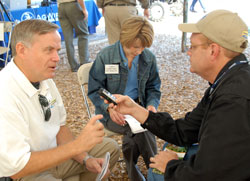
You can listen to my back-to-back interviews with Jeff Mellinger and Lance Fox here.

Ag Media Summit, Audio, IFAJ, Novus International, Pioneer, Video

Proud to be an Omnivore

Cindy Zimmerman

Boehringer IngelheimWhile in North Carolina for the Boehringer Ingelheim Swine Health Seminar over the weekend, I had some of the best pork I have ever eaten. The hotel served up a fresh whole hog with a tasty vinegar sauce that was fabulous. The best thing about the airport in Charlotte (which I spent an inordinate amount of time in on Sunday) was the real Carolina BBQ I had for lunch – as good as the porker the night before – with a fried pickle on the side! It ranks as the best airport meal I have ever had.

Made me think about the fact that humans eat meat because it tastes good and because that is what we are meant to do. We are omnivores – we eat both plants and animals. That’s our nature. And the great North Carolina pork producers at the event in Carolina Beach produce some of those tasty animals for us to eat, and do it as economically and efficiently as possible. That’s why things like PETA’s “Unhappy Meals” and HSUS really annoy me.

Missouri farmer Blake Hurst wrote an excellent essay in the Journal for the American Enterprise Institute called the “Omnivore’s Delusion” that cries out against the “agri-intellectuals” like PETA and HSUS and Michael Pollan who criticize modern agricultural production. Blake writes:

I’m so tired of people who wouldn’t visit a doctor who used a stethoscope instead of an MRI demanding that farmers like me use 1930s technology to raise food. Farming has always been messy and painful, and bloody and dirty. It still is.

Messy and painful, yes – but rewarding as well, or people like Blake and rest of the agricultural producers in this country who provide us with both plants and animals for food wouldn’t keep doing it. Read Blake’s essay and pass it on to everyone, especially those omnivores you know who are not in agriculture.

BIVI swine health seminar photo album

Animal Activists, Boehringer Ingelheim, Food, Pork

Some Statistics On Social Media

Chuck Zimmerman

Speaking of new and social media . . . eConsultancy has a great post titled, “20+ more mind-blowing social media statistics.” There are some great statistics that Jake Hird has put together that might help put into perspective what’s happening with communications today. Here’s a couple to give you a sample of what you’ll find.

  • Around 64% of marketers are using social media for 5 hours or more each week during campaigns, with 39% using it for 10 or more hours per week.
  • It took radio 38 years to reach 50 million listeners. Terrestrial TV took 13 years to reach 50 million users. The internet took four years to reach 50 million people… In less than nine months, Facebook added 100 million users.
Social Networking

BASF Going More Social

Chuck Zimmerman

BASF is one of the latest companies to start moving into the social media world more and more. Recently you could start following @BASFAgro on Twitter. Now they’re loading new videos onto YouTube like this one that describes BASF Plant Sciences in the United States. Where do these companies get these ideas about using social/new media? Hmmm?

Agribusiness, BASF, Social Networking

Barley Bin Builder Winner

Cindy Zimmerman

Osage Bio Energy, along with co-sponsors Perdue AgriBusiness, the Virginia Farm Bureau Federation and General Motors, recently announced the overall grand prize winner of the 2009 Barley Bin Builder Yield Contest.

Osage barley winnerBobby Hutchison of Hutchison Brothers Farms in Cordova, MD, won the grand prize of a brand new GM Flex Fuel pickup truck with his yield of 130 bushels per acre. Cash prizes of between $500 and $1000 were also awarded to the top-yielding farmers in Delaware, Kentucky, Maryland, North Carolina and Virginia.

“We are thrilled to reward these leading farmers for their outstanding barley yields in what was a tough year for small grains in the Mid-Atlantic,” said Craig Shealy, president and CEO of Osage Bio Energy. “The average yield per acre among all entrants to the yield contest was over 100 bushels an acre, with an average yield in Virginia of approximately 109 bushels an acre. These are nice results, especially considering the weather prior to harvest.”

Osage Bio Energy plans to sponsor another yield contest next year. Details will be available this fall through the company’s Web site, www.osagebioenergy.com, and through local extension agents.

Osage Bio Energy is scheduled to open the first major barley-to-ethanol bioprocessing facility in the United States, located in Hopewell, Va., to coincide with the 2010 barley harvest. The facility will use barley as its primary raw material in ethanol production, creating a new market for the local barley. Barley also will be used to produce a high-quality barley protein meal for livestock, along with fuel pellets and food-grade carbon dioxide.

Ethanol, Farming

United Soybean Board Committed to the Success of Soybean Farmers

Joanna Schroeder

AgWired coverage of IFAJ 2009 is sponsored by:
Pioneer-HiBred Successful Farming and Novus International

I sat down with Keith Dunn with the United Soybean Board (USB) during the Ag Media Summit to see what their main initiatives currently are. Dunn explained to me the importance of animal agriculture and how supportive the USB was of this industry.

KeithDunn“Currently in the United States 98 percent of the soybean meal goes for animal feed for poultry, beef cattle and dairy cattle,” explained Dunn. “So we feel that animal agriculture is very important to the industry.”

Other important elements of the USB program include its work with biofuels as well as a responding to a recent request for referendum. Less than 1/10th of 1 percent of the growers requested a referendum on the soybean checkoff and Dunn mentioned that it shows that soybean farmers are very confident in their soybean checkoff and the work that is being done.

Biofuels is a hot topic and one that is very important to USB. “We’re concerned with the new renewable fuels standard and we want to make sure these are based on sound science, factual and will work for the American people.”

You can see all our pictures from the Ag Media Summit in the IFAJ/AMS 2009 Photo Album.

You can listen to my full interview with Keith Dunn here.

Ag Media Summit, Audio, IFAJ, Novus International, Pioneer, USB

Football Great to Keynote Farm Bureau Meeting

Cindy Zimmerman

afbf bradshawQuadruple Super Bowl champion quarterback and Pro Football Hall of Famer Terry Bradshaw is the keynoter for the American Farm Bureau Federation’s 91st annual meeting in Seattle on January 11, 2010.

“Terry Bradshaw is an All-American icon, recognized for his accomplishments both on and off the field,” said AFBF President Bob Stallman. Bradshaw is renowned for his professional accomplishments in NFL football and sports broadcasting, in addition to achieving acclaim as an inspirational speaker, actor, author and gospel/country singer. To top it off, the former football great also owns an 800-acre ranch in Texas where he raises cattle and breeds horses.

afbfBradshaw will address more than 5,000 Farm Bureau members from across the nation who will gather in Seattle Jan. 10-13 to participate in the organization’s annual grassroots policy setting process. The meeting begins Sunday morning, Jan. 10 with the opening presidential address by Stallman. The annual Young Farmer and Rancher competitions, scheduled for Jan. 10 and Monday, Jan. 11, are just one of the highlights on the agenda. Another important feature on Sunday is the annual Farm Bureau Women’s luncheon and business session, which is open to all women attendees but advance purchase tickets are required to attend.

Farm Bureau members can register for the 91st AFBF convention through their state Farm Bureaus.

AFBF

Monsanto’s Commitment to Sustainable Agriculture

Joanna Schroeder

AgWired coverage of IFAJ 2009 is sponsored by:
Pioneer-HiBred Successful Farming and Novus International

A little over a year ago Monsanto made a commitment to people around the world to sustainable agriculture. The company is working on products that will produce more than double current yields while reducing the resources needed to grow the crops by nearly one-third. They are so committed that they launched a website to discuss this topic: www.producemoreconservemore.com.

I was curious to learn more about Monsanto’s initiatives in the sustainability department so I caught up with Kevin Eblen, Vice President Public Policy & Sustainable Yield for Monsanto.

Monsanto“What we’re trying to to get the world and the public to see and know is that we have the capability to produce more food and conserve resources at the same time,” explained Eblen. “So we went on record saying in the core crops that we focus on as a company which is corn, soybeans and cotton, that we can double the yields of these crops by 2030 with the starting year of 2000. And at the same time, through the use of technology we have and others’ have, that we could conserve resources by one-third to produce each unit of corn, beans and cotton.”

Eblen mentioned that the UN has determined that the world will need to produce as much food in the next 50 years that has been produced in the last 10,000 years. That is why Monsanto is working with farmers around the world to help them grow crops that are both sustainable and profitable.

You can see all our pictures from the Ag Media Summit in the IFAJ/AMS 2009 Photo Album.

You can listen to my full interview with Kevin Eblen here.

Ag Media Summit, Audio, IFAJ, Novus International, Pioneer

Nufarm’s New Product Line-Up a Hit

Joanna Schroeder

AgWired coverage of IFAJ 2009 is sponsored by:
Pioneer-HiBred Successful Farming and Novus International

As farmers are getting ready to harvest soon, it’s never too late to begin to think about products for the upcoming year. Nufarm is one of the largest crop protection companies in the world and is primarily at post patent company. After another company’s patent expires, Nufarm brings a similar product to market typically at a better value for the end user.

NuFarmI was able to learn more about Nufarm’s products during the Ag Media Summit when I sat down with Director, Branding & Marketing Services, Brian Rund.

“This year we introduced 13 new seed treatment products for all the major crops,” said Rund. “We have greatly expanded our product line for range and pasture weed control. We’re also in the process of introducing a very broad range of herbicides for small grasses.”

Nufarm would like everyone to know that they are a very committed player in ag business. “We’re post patent but we’re not generic,” said Rund.

You can see all our pictures from the Ag Media Summit in the IFAJ/AMS 2009 Photo Album.

You can listen to my full interview with Brian Rund here.

Ag Media Summit, Audio, IFAJ, Novus International, Pioneer

NASS Updates Farmer Computer/Internet Usage

Chuck Zimmerman

NASSAlmost 60% of of U. S. farms now have internet access and the use of DSL has become the most common method of accessing it. The National Agricultural Statistics Service just released its latest Farm Computer Usage and Ownership survey results. Here’s some key findings. Notice how much higher the numbers are for farmers with incomes over $100,000!

DSL was the most common method of accessing the Internet, with 36 percent of U.S. farms using it, up from 27 percent in 2007. In 2007, dialup was the most common method of accessing the internet. Dialup access dropped from 47 percent in 2007 to 23 percent in 2009. Satellite and wireless were each reported as the primary internet access methods on 13 percent of those U.S. farms with Internet access. Cable was reported as the primary access method
on 11 percent of the farms.

A total of 59 percent of U.S. farms now have Internet access, compared with 57 percent in 2007. Sixty-four percent of farms have access to a computer in 2009, the same level as 2007. The proportion of U.S. farms owning or leasing a computer in 2009, at 61 percent, was up 1 percentage point from 2007. Farms using computers for their farm business increased 1 percentage point from 2007 to 36 percent in 2009.

In 2009, 81 percent of U.S. farms with sales and government payments of $250,000 or more have access to a computer, 79 percent own or lease a computer, 69 percent are using a computer for their farm business, and 76 percent have Internet access. For farms with sales and government payments between $100,000 and $249,999, the figures are: 70 percent have access to a computer, 67 percent own or lease a computer, 52 percent are using a computer for their farm business, and 63 percent have Internet access. Of the farms with sales and government payments between $10,000 and $99,999, 62 percent reported having computer access, 59 percent own or lease a computer, 38 percent use a computer for their farm business, and 57 percent have Internet access.

For crop farms, 65 percent have computer access and 40 percent use a computer for their farm business in 2009, up 1 and 3 percentage points from 2007, respectively. Internet access for crop farms has increased to 60 percent in 2009, compared with 56 percent in 2007. In 2009, a total of 63 percent livestock farms have computer access and 58 percent have Internet access.

Farming, Internet, USDA