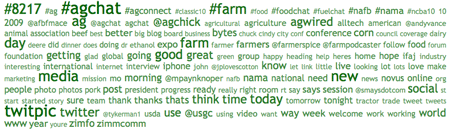
Spring is near and that means so is AgDay which is coordinated by the Agriculture Council of America. This year you can follow AgDay on Twitter and Facebook. AgDay also has a blog now too.
Tune in to the ZimmCast on Monday for an interview with ACA Chair, Linda Tank, CHS, Inc.
Every year, producers, agricultural associations, corporations, universities, government agencies and countless other across America join together to recognize the contributions of agriculture. This year, Ag Day will be celebrated on March 20, 2010, and Ag Week during the week of March 14-20, 2010.
The world’s population is growing and simultaneously, malnutrition is growing. The World Soy Foundation (WSF) is a nonprofit organization that is helping to eradicate malnutrition around the world through soy protein. I had the chance to spend a few minutes with Nathan Ruby, Executive Director of the World Soy Foundation to learn more about what they do.
Ruby explained that they address malnutrition issues through soy protein in four ways:
Food distribution of soy protein
Microenterprise – helping people start small businesses like the soy cow where people add 1 lbs of soybeans to 1 gallon of water to produce soy milk which they then sell in the local community
Research – studying soybeans in different nutritional settings
Education – working with people around the world to help them learn how soy protein can increase nutrition
WSF is currently working in areas with high malnutrition including Haiti. “Our program there is really about development,” said Ruby. “We’re not a diasaster relief agency so we’re more concerned about what happens when the television cameras leave and go away and the world kind of forgets about Haiti. We’re still going to be there developing and we have a long-range plan to do that.”
The organization is typically anywhere where people live in areas that are disconnected form the general flow of resources and opportunities. Currently, they are considering some programs in Iraq to help them learn how to farm soybeans and a similar program in Central America.
As a nonprofit, WSF is always looking for more people to become involved in their programs. Soybean farmers around the world can participate through the Acre Challenge. Ruby explained that in this program, soybean farmers donate the proceeds from one acre of production.
To learn more, click here and you can listen to my full interview with Nathan below.
Hey horse loving bloggers. Want to blog the upcoming 2010 Alltech FEI World Equestrian Games? Enter this contest.
Land O’Lakes Purina Feed is excited to announce the Purina® “Live from Lexington” Contest, an opportunity for horse lovers everywhere to showcase their blogging skills for a chance to attend and report live from the 2010 Alltech FEI World Equestrian Games™ in Lexington, Ky. The contest is sponsored by Purina Mills, LLC and co-sponsored by EquiSearch (www.EquiSearch.com) and Active Travel. Contestants can learn more about “Live from Lexington” and enter online at www.LiveFromLexington.com.
“Two grand prize winners of the contest will be our Purina blog-o-spondents and will report to our fans on the latest happenings at the Games,” said Brant Gilbert, marketing manager, Horse Business Group. “We know that Purina has some of the most loyal customers and horse enthusiasts in the industry, and we are excited to find the perfect duo to send to the competition and enjoy the festivities.”
Contest entries can be submitted online at www.LiveFromLexington.com between March 1 and May 31, 2010. To participate, entrants must submit a video of sixty seconds or less explaining why they want to be a Purina® Live from Lexington blog-o-spondent. Videos will be judged based on the entrant’s response, qualifications, articulation, and talent.
The National Pork Producers Council at its annual business meeting – the National
Pork Industry Forum – held March 4-6, elected new officers and members to its board of directors. Click here for a complete list.
Syngenta Seeds, Inc. announced it has submitted to the U.S. EPA an application for the registration of its Agrisure Viptera 3220 trait stack, featuring two modes of action against all major lepidopteran corn pests and a reduced refuge of 5% in the Midwestern Corn Belt.
The National Organic Coalition and Center for Food Safety are announcing more than 200,000 individuals have contacted the USDA saying they disapprove of the government’s potential deregulation of Monsanto’s Genetically Engineered Roundup Ready Alfalfa.
CVT stands for Continuously Variable Transmission and Case IH was spotlighting its benefits over power shift during Commodity Classic, both at their exhibit and during a WIN session.
“The advantage of having a completely variable transmission is that you can allow the computer to operate both the engine and the transmission to dial in the ‘sweet spot’ for power and for fuel consumption with the tractor,” says John Bohnker, Case IH marketing manager.
The technology has been around for many years, but Case just recently narrowed it up to use in row crop applications. CVT is now available on Case IH MagnumTM 180, 190, 210 and the new 225 tractors, as well as the Puma 165 to 225 series. “If you look at North America, the row crop tractor is the area where there’s a strong demand for variable transmission,” Bohnker said. “In particular, the sugar beet and potato areas, as well as the Midwest row crops.”
Listen to or download my interview with John below.
His wife calls him a “PMG” – Professional Meeting Goer – because Alan Kemper has been serving on the boards of state and national agricultural organizations for over two decades now.
Alan was a very busy guy at the Commodity Classic last week but I was able to do a quick interview with him while he was in the BASF exhibit presenting the annual BASF/ASA Scholarship award. He talked about the scholarship program, the attendance at Classic, his thoughts on Secretary Vilsack’s speech and the importance of the soybean export market. Listen to or download that interview in the player below:
The future of agriculture is important to BASF and that is why the company sponsors scholarships for young people along with both the National Corn Growers Association (NCGA) and the American Soybean Association (ASA).
The NCGA program awards five $1,000 scholarships to college students studying agriculture, while the ASA program chooses one student to award $5,000. So, each year for the past three years, BASF has helped six students pay for their future career in the field of agriculture. All awards are presented at the annual Commodity Classic
I talked with BASF North American Crop Protection Group Vice President Nevin McDougall about the scholarship programs as he was presenting the students with their awards during the Classic last week. “We have a very common base and understanding in terms of vision, values and goals for the respective grower organizations and we feel it’s our obligation to contribute to the long term sustainability to their membership, to help educate the young talent that will be contributing to the growth of our industry in the future,” Nevin told me.
Nevin enjoyed getting to meet the scholarship winners who were able to make it to the Classic to receive their awards and talk about their future goals, as well as getting to meet their families. “Our scholarship initiative is a good example of how we are trying to contribute to individual family farms, support their children in terms of their educational goals and to be a part of the future they’re trying to create,” he said.
Listen to my interview with Nevin in the player below:
The CME Group has started a blog.
The exchange launched Open Markets to communicate CME Group’s views and help spark a dialogue on a broad range of issues that affect a diverse, and increasingly interrelated, array of financial markets.
In addition to the blog, content will include testimonies and speeches, white papers and features from CME Group Magazine, video clips and your media articles that cover related issues.
Open Markets’ initial focus will be on the various proposals and discussions taking place in Washington, D.C. among regulators and lawmakers. Over time, content will expand to include a broad range of issues such as market access, technology and globalization.
There is a rare treasure nestled in the heart of the Ozarks in Southern Missouri – a college that offers students a degree in hard work.
I’ve lived in Missouri for 18 years but never knew about the College of the Ozarks until this week when I joined the Missouri Beef Industry Council (MBIC) for a luncheon and tour at the school located just south of Branson in a picturesque spot called Point Lookout. It was originally founded as a Presbyterian high school in 1906 and today is a Christian-based four year liberal arts college with 1500 students who pay their tuition by working 15 hours a week on campus and two 40 hour work weeks at the end of each semester. Students are chosen on the basis of financial need as well as academics and only about 1 in 7 who apply each year actually get the opportunity to attend.
The college offers 48 different degrees, including culinary arts, hotel and restaurant management, agribusiness, animal science, and ag education. There are about 125 students majoring in some area of agriculture there, but the school offers amazing hands-on experience for them, including hog, dairy and beef operations, a meat processing facility and a feed mill. They also have a beautiful center that is open to the public which features fine dining, historic lodging, meeting rooms, and more. During the 2008 presidential campaign, candidate Sarah Palin chose to visit the college as one of her stops in Missouri.
You can find out more about the college by listening to the MBIC podcast here or in the player below the video. And you can see all the photos from the tour online in this Flickr photo album.
One of the highlights of the tour was a culinary demonstration and gourmet lunch prepared by college Chef Robert Stricklin. The menu included Cranberry Cinnamon Biscuits, Pear and Feta Cheese salad with Baby Greens, Braised Short Rib Shank with roasted vegetables and rosemary jus, Black Walnut Coffee Toffee Ice Cream made by the students – and everything was fabulous! Chef Stricklin made his five star gourmet entree look amazingly easy to prepare in his short demonstration, which you can view below:
The National Corn-to-Ethanol Research Center (NCERC) is relatively new to Commodity Classic with this being their third year. You could tell when you talked with John Caupert, the director of NCERC, how excited he was to be there so I asked him why.
“There’s energy, there’s enthusiasm back around around ethanol and biofuels. Some people believe that corn ethanol is an old technology. We believe just the opposite. We feel the corn ethanol industry is still in its infancy and through technological advancements, there’s much more to learn and prove in corn ethanol production.”
Caupert explained that the NCERC is unique in that they bring together the ethanol industry, corn growers and livestock producers and one of their goals is to ensure that there is a long-term market for corn growers through the corn ethanol.
Recently, they have spent a lot of time reviewing data regarding how the value of how co-products improve the greenhouse gas footprint of fuel ethanol production. “I think more often than not, we forget about the fact a corn ethanol plant in addition to producing fuel ethanol, also produces this high value livestock feed called distillers grains,” said Caupert.
Caupert noted that although they don’t often work directly with farmers, they work closely with both the National Corn Growers Association as well as state corn groups.
I only touched on the work that NCERC is doing. You can hear more about their research by listening to my interview with John below.