
 Have you cast your vote for your favorite farmer’s market yet?
American Farmland Trust (AFT) is tracking the votes for its America’s Favorite Farmers Markets™ contest with an online leader-board of the top 20 markets in each of four categories. The lists of boutique, small, medium and large markets track up-to-the-minute results during the final month of voting, which closes on August 31.
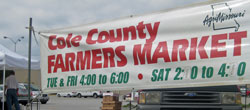 But your favorite market needs to be signed up for the contest in order for you to vote for them. I found that out today when I went to vote for our local Cole County (MO) Farmers Market, which sets up three times a week in the Kmart parking lot on Missouri Boulevard. I was pretty bummed to find out they were not in the running at all, since it is nice to visit them each week and get fresh, homegrown produce. I guess they would be in the “boutique” category, since they normally have less than 15 vendors.
According to the online leader board, the defending champion for the large market category – Davis (CA) Farmers Market – is in second place to the City of Rochester (NY) Public Market. Last year’s medium market winner, Williamsburg (VA) is only in fifth place right now, with Falls Church (VA) in first. And in the small market category, first place is currently Easton (PA), with last year’s winner Collingswood (NJ) in third. King George (VA) is in first place in the boutique category, which is new this year.
There are more than 1,200 farmers markets that enrolled in the contest, representing 49 states and the District of Columbia.
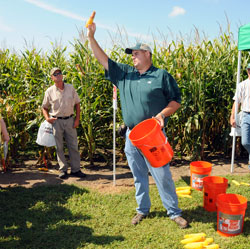 Not all corn comes out of the ear looking like you want it to. Sometimes there are factors affecting the kernel production that might yield some surprises. At the
  The media were very much in attendance at the
 Sam is president of the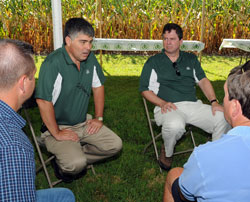
 Bill Rishel of North Platte, Nebraska is president of the Nebraska Cattlemen’s Association and owner of
  Bill is concerned that the GIPSA rule could jeopardize the alternative marketing programs that have benefited both producers and consumers if it pressures the processors to validate every price difference they would give for any greater quality of cattle. “Somewhere along the way they’re going to say “I’m not going to take all this risk, it’s just as easy for me to offer one price fits all” and it will become a commodity type business again and it will revert back 25 years to what we’ve worked so hard to get away from,” Bill said.