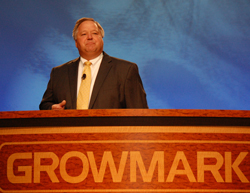
 As GROWMARK enters its 85th year, the Illinois Farm Bureau (ILFB) is proud to have watched the cooperative grow into something bigger and better over the years.
“The GROWMARK system started under the auspices of Illinois Farm Bureau years ago, so we’re kind of the parent of the organization,” said ILFB president Philip Nelson at the cooperative’s annual meeting last week in Chicago. “It’s been successful, they continue to grow in all regions of the country providing goods and services that farmers utilize.”
Phil conducted the nomination and election of new directors for GROWMARK during the business session. Five of the cooperative’s 16 director seats, established by geographic zone, were elected and will serve three-year terms. Bob Phelps of Rockton, Ill., who has served on the GROWMARK Board since 1997, David Watt of Murrayville, Ill., and Matt Heitz of Farley, Iowa were re-elected to the board. Jack McCormick of Ellis Grove, Ill., and Kim Fysh of Thamesville, Ont. were elected to first terms on the GROWMARK Board.
You may recall that when President Obama visited Illinois this month, Phil was able to challenge him about the regulations being considered by the federal government that could make it more difficult for farmers to do their jobs. “We’re not asking for a favor but we need some common sense or you’re going to regulate what we think is the biggest industry in the country right out of production,” Phil said he told the president. “I think the president addressed the question somewhat but I think it shows that we need to get further engaged with the EPA so that they better understand what they’re doing.”
I also asked Phil about the crops in Illinois this season – listen to or download the whole interview here. IL Farm Bureau President Phil Nelson
 It’s always great to see farm broadcasters as featured speakers at events, so it was fun to see our good friend Dale Minyo with the
 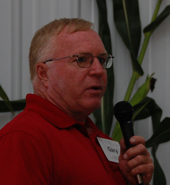 The luncheon where Dale spoke was on the Mavis Farm near Edgerton, Ohio. The corn and soybean operation is a fourth generation farm owned by Gary Mavis (pictured) and his wife Pat with son Scott and his wife Jenny. Gary says they follow a corn-soybean rotation on nearly 3,000 acres and divide each field into different yield zones. “We started yield mapping back in ’95 and after a few years of collecting data was able to established yield zones that we felt comfortable with,” he said. “Now we’re applying fertilizer based on those yield zones and we’re varying the rate as we go across the field it might varying 150-200 pounds depending on what the soil test has showed.”
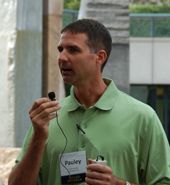 John Deere has been a partner with CTIC since the T stood for Tillage. Now the T stands for Technology, and John Deere’s relationship with the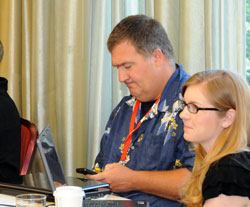
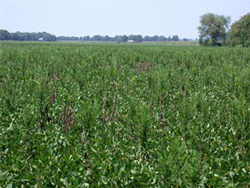 The problem of resistant weeds, especially glyphosate-resistant broadleaf weeds, continues to become more worrisome, but some weeds have always had a tolerance for certain weed killers.
  Resistance is different because it develops over time. “With resistant weeds, you’ve gone from getting essentially total control of a population to selecting a biotype, or individual weed that has the ability to tolerate that herbicide,” and Dan says those resistant biotype populations can then expand and dominate in a field.