Remembering 2008 World Food Prize

Cindy Zimmerman

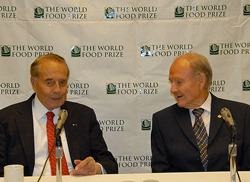
This is the second time I attended the World Food Prize – the first time was in 2008 when former Senators Bob Dole and George McGovern were recognized as Laureates for their bipartisan leadership in the 1970s to reform and expand school food and nutrition programs.

Sen. McGovern’s name has come up several times during this event as the 90-year-old is nearing the end of his life in Sioux Falls, SD with his family at his side. It made me go back and look at my coverage of the 2008 World Food Prize and was surprised to see I took so many photos of this great man at that event.

He and Dole joked around quite a bit during the event. When asked during a press conference if he thought it was a good idea to provide cash instead of commodities for food programs, McGovern said it was a good idea, quipping, “I myself would rather have this $250,000 prize that Bob and I are going to divide than a bag of potatoes, so I’m a little partial to cash.”

You can listen to that press conference here: 2008 World Food Prize Laureates George McGovern and Bob Dole
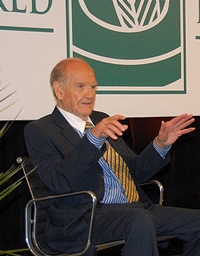
As I read the news reports that Sen. McGovern was close to death, I was struck by the fact that his life was summed up by the AP as “the Democratic presidential candidate who lost to President Richard Nixon in 1972 in a historic landslide.” I certainly hope he will be remembered instead for the great work he did in helping feed hungry children around the world. It is fitting that his family this week asked well-wishers to send donations to Feeding South Dakota instead of cards or flowers. That request was made on Wednesday and on Thursday WDLT in Sioux Falls reports the agency was swamped with donations.

The agency’s Development Director Kerri DeGraff will remember McGovern not as a failed presidential candidate, but rather as an advocate for the hungry who “worked hard to talk about the issues of hunger, create awareness and let individuals know that it is a solvable issue.”

Our prayers are with the McGovern family and the Senator as they prepare for his passage from this world into one where there is no hunger.

AgWired coverage of the World Food Prize is sponsored by Elanco
Audio, World Food Prize

USAID Issues Progress Report at WFP

Cindy Zimmerman

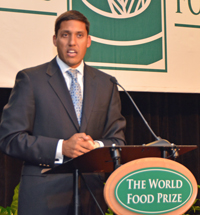
U.S. Agency for International Development Administrator Rajiv Shah released the first progress report and scorecard for Feed the Future at an address to the World Food Prize on Thursday.

The progress report highlights how Feed the Future is already making a difference in people’s lives in the developing world and the scorecard tracks how well we are changing our development and engagement process to more effectively meet our goals. So far Feed the Future has helped 1.8 million food producers to adopt improved technologies or management practices that can lead to more resilient crops, higher yields, and increased incomes. The initiative has also reached nearly 9 million children through nutrition programs, which can prevent and treat undernutrition and improve child survival.

Shah also announced new initiatives to help farmers and communities in developing countries, including two new lending facilities to help smallholder farmer organizations in Africa, and a partnership for educating the next generation of agricultural leaders and World Food Prize laureates.

Listen to Shah’s comments here: USAID Administrator Rajiv Shah

View the World Food Prize Photo Album here.

AgWired coverage of the World Food Prize is sponsored by Elanco
Audio, Elanco, Food, USDA, World Food Prize

General Mills “Hungry to Help” Africa

Cindy Zimmerman

General Mills CEO Kendall Powell says his company and his employees are very simply “hungry to help” people in Africa by increasing their food supply.

“We’re hungry to help the entrepreneur in Tanzania who is trying to package her products and access new markets,” Powell said during an address at the World Food Prize symposium on Thursday. “We’re hungry to help the food scientist in Zambia searching for solutions to retain food flavor and optimize nutrients. And we’re hungry to help the farmer in Malawi who, by selling her crop, will generate the money needed to support her family and pay for her children to go to school.”

Powell said General Mills is uniquely qualified to help Africa in a number of areas, such as food processing, but he believes all food companies will eventually be in Africa. “Africa’s economy grew 5.7% in the last decade and is expected to grow 5.5% this year,” he said. “The African continent is ripe with opportunity.” But, he says they are there today because they can help African processors, farmers and communities now.

Partners in Food Solutions
(PFS) is a nonprofit organization that links the technical and business expertise of volunteer employees from General Mills, Cargill and Royal DSM to small and medium-sized mills and food processors in the developing world. Powell announced an expansion of that effort through a renewed public-private partnership with the United States Agency for International Development (USAID).

Listen to Powell’s comments here: General Mills CEO Kendall Powell

View the World Food Prize Photo Album here.

AgWired coverage of the World Food Prize is sponsored by Elanco
Audio, Elanco, Food, World Food Prize

Global Hunger Index Score Still Serious

Cindy Zimmerman

Less people in the world are going hungry but less is still too many.

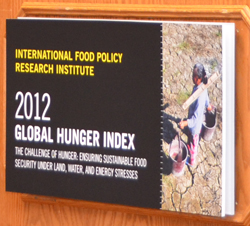
The 2012 Global Hunger Index (GHI) released by the International Food Policy Research Institute (IFPRI) at the World Food Prize symposium on Thursday shows that hunger on a global scale remains “serious” and 20 countries have levels of hunger that are “alarming” or “extremely alarming.”

The good news is that the 2012 world GHI is down 26 percent from the 1990 world GHI, from a score of 19.8 to 14.7.

Presenting the report during a breakfast on Thursday, IFPRI Deputy Director Claudia Ringler said they found that those countries facing high levels of hunger also face scarcity of natural resources, limited access to clean water and sanitation and modern forms of energy, and insecure land rights. “While the picture is somewhat grim in the report, the importance is to focus on the solutions and what we can do to reduce hunger and malnutrition levels, and there’s a lot we can do,” she said.

Listen to my interview with Claudia here: Claudia Ringler, IFPRI

View the World Food Prize Photo Album here.

AgWired coverage of the World Food Prize is sponsored by Elanco
Audio, Elanco, Food, World Food Prize

Books About Feeding the World

Cindy Zimmerman

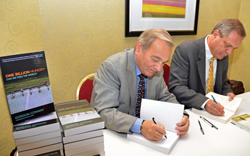
The moderator and one of the participants on the opening panel at the World Food Prize symposium Borlaug Dialogues have authored books aimed at increasing awareness of world hunger and how we can feed a growing population.

Sir Gordon Conway’s book “One Billion Hungry – Can We Feed the World?” basically is the long version of his simple answer “Yes.”

“But there’s lots of ‘buts,'” Conway clarifies. “Very simply it says that the routes forward to food security are through appropriate innovation, markets that connect small holders, through people – particularly the half billion small holders in the world, and finally through political leadership.”

Sir Gordon notes that animal protein is important for healthy young people, “but the bigger question is to what extent can we produce enough grain to feed the massive growth in livestock production?”

Listen my interview with Sir Gordon here: Sir Gordon Conway interview

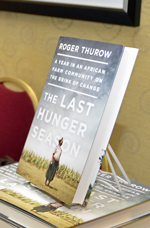
Roger Thurow is Senior Fellow with the Chicago Council on Global Affairs and former Wall Street Journal reporter who dedicated his life to raising awareness of world hunger after doing a series of stories on famine in Africa in 2003. “What I saw there basically changed my career, changed my life,” he said. “Instead of moving from story to story, place to place and country to country, this is the story I really need to cover. So, now I write books about it.”

Thurow has written several books on the topic of hunger, his latest being “The Last Hunger Season” which details a year in an African farm community. The Hunger Season refers to the time between when food from a previous harvest runs out and the next harvest begins. It is actually being made into a documentary and you can find out more about it on TheLastHungerSeason.com.

Roger made a great comment when I asked him about the role of GMO crops in places like Africa, noting that is important for those countries to be able to make up their own minds on the issue. “There’s a great African saying that ‘when elephants fight, the grass gets trampled’ … the elephants are the U.S. and Europe and the grass is Africa.”

Listen my interview with Roger here: Roger Thurow interview

View the World Food Prize Photo Album here.

AgWired coverage of the World Food Prize is sponsored by Elanco
Audio, Elanco, Food, World Food Prize

9th Annual LPC Royal Gala

Chuck Zimmerman

It’s time once again for a Royal Gala. A Livestock Publications Council kind of Royal Gala.

The funds raised during the annual LPC Royal Gala are used for the ongoing activities for LPC with the focus on the LPC Heritage Center at the American Royal in Kansas City, MO. This will be the 9th year for the Gala.

Here are the details:

When: Friday, November 2, 2012, 7-11pm
Where: American Royal Headquarters, 1701 American Royal Court, Kansas City, MO

At the event there will be the unveiling of the 2012 Hall of Honor inductees. Seating is limited. Send your ticket donation of $50/person asap since the deadline is tomorrow! At this point you may want to email Megan Crudup.

LPC, Media

DeLaval New Company Vision

Chuck Zimmerman

ZimmCast 370DeLaval has a new vision. I learned about it at World Dairy Expo from Christian Poggensee, Regional President, North America. Simply put it is, “We make sustainable food production possible.” Christian says it’s not a target but rather something the company wants to be perceived as. DeLaval became a sponsor of the U.S. Dairy Sustainability Awards earlier this year.

The company launched their sustainability initiative several years ago. New products development keeps four things in mind: Environment, Animal Welfare, Social Responsibility and Farm Profitability.

One of the more fun products by DeLaval that accomplish this are their Swinging Cow Brushes! These were on display in the DeLaval exhibit at World Dairy Expo.

The DeLaval swinging cow brush SCB is designed to improve cow health, comfort and welfare. The swinging cow brush SCB, which starts to rotate on contact, is a revolution in cow care and cow comfort. The unique brush which rotates at an animal-friendly speed, swings freely in all directions, smoothly up, over and alongside the cow to provide comfort all around.

Listen to this week’s ZimmCast to learn more about what’s new with DeLaval: The New DeLaval Vision

2012 World Dairy Expo Photo Album

Thanks to our ZimmCast sponsors, GROWMARK, locally owned, globally strong and Monsanto, Roundup Ready Plus, for their support.

The ZimmCast is the official weekly podcast of AgWired. Subscribe so you can listen when and where you want. Just go to our Subscribe page.

Agribusiness, Audio, Dairy, World Dairy Expo, ZimmCast

Panel Sets Stage for Borlaug Dialogue

Cindy Zimmerman

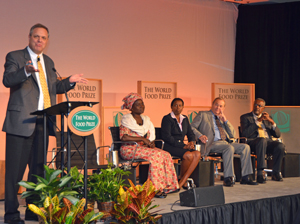
A panel discussion to set the stage for the Borlaug Dialogue at the 2012 World Food Prize symposium in Des Moines considered the question “One Billion Hungry – Can We Feed the World Sustainably?”

The panel moderator was Roger Thurow, Senior Fellow, The Chicago Council on Global Affairs and participants in the discussion were:

Sir Gordon Conway – Professor of International Development, Imperial College London
Gebisa Ejeta – Distinguished Professor of Plant Breeding & Genetics & International Agriculture, Purdue University
Susan Godwin – Smallholder Farmer, Nigeria
Jane Karuku – President, Alliance for a Green Revolution in Africa (AGRA)
Roger Thurow (Moderator) – Senior Fellow, The Chicago Council on Global Affairs

Conway started this informative discussion by simply saying that the answer to the question is “Yes.” Susan Godwin related her personal experience as an African farmer, which was really interesting.

Listen to or download the whole conversation here: Setting the Stage Panel

View the World Food Prize Photo Album here.

AgWired coverage of the World Food Prize is sponsored by Elanco

Audio, Elanco, World Food Prize

Auction of North Dakota Oilseed Processing Facility

Chuck Zimmerman

Looking for a good deal on some oilseed processing equipment? Maas Companies is managing a sale next month where you might find a bargain!

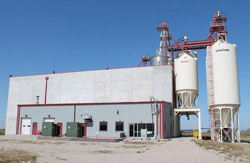
Maas Companies of Rochester, MN will liquidate the former Northwood Mills Oilseed Plant, a state of the art oilseed processing facility located outside of Grand Forks, North Dakota at a Sheriff’s Foreclosure Auction on November 27. The auction will be conducted on-site at the plant, 530 35th Street NE, Northwood, North Dakota. Here is some more information:

Northwood Mills opened its doors in 2007 but struggled with the economic conditions and volatile pricing for its products. The 40 Acre plant operated for approximately two years, the equipment is pristine and ready for a new owner. The auction offers the plant for sale as one lot including all real estate, process and auxiliary equipment, storage and completed furnished office space. Originally the plant was used for soybean crushing but later crushed canola, sunflowers, corn germ and flax with outputs ranging from 200-300/tons per day. The plant offers excellent access to transportation for both raw materials and finished products via highway and rail with expansion availability for a 30 car rail spur on the BNSF line.

Maas Companies Inc, a company specializing in the selling of commercial and industrial assets of Rochester, Minnesota will conduct the auction. Tyler Maas, Sales & Marketing Director states, “the sheriff’s foreclosure sale offers the plant to a new buyer at a significant savings over the approximate $10.2 million dollars that was spent to design and build the facility. In this economy, an auction offers new buyers a great economic opportunity.”

Check open house dates after the break. Read More

Agribusiness, Equipment

Is Whetting Considered Working?

Melissa Sandfort

I had an English teacher tell me one time: “There are two kinds of people in this world. Those that read and those that don’t.” She then went on to explain that people who liked to read would read anything – the ingredients label on a candy bar before they ate it, knowing that it wasn’t good for them in the first place, but curious to read anything and everything. And then there were those who didn’t like to read and she just couldn’t imagine why.

My grandfather falls in the category of “those who like to read.” And I’ve always told him he needs two things on his bucket list:
1. Go on Wheel of Fortune (he claims he’d freeze up!) and,
2. Be an editor of a newspaper.

Not only does he love to read, his vocabulary is incredible and his knowledge of proper grammar is, too. So when he told me this story from the past, I had to assume whet was spelled “whet” and not “wet”. I’m forever expanding my vocabulary just by visiting with grandpa.

Listen to grandpa’s story about whetting as he takes us on another AgWalk.
Listen to Grandpa explain

Now admit it – did you have to look on dictionary.com?

Until we walk again …

Uncategorized