Bread for the World on Elections and Hunger

Cindy Zimmerman

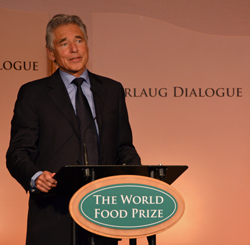
2010 World Food Prize Laureate Rev. David Beckmann says hunger in America is a key issue that should be addressed in the 2012 election.

“About one in five of our children live in households that run out of food,” said Beckmann, who is executive director of Bread for the World. “On the other hand, I think the safety net programs have worked remarkably well in this economy.” Beckmann notes that hunger in the U.S. has not increased since 2008 even though unemployment and poverty did increase, thanks to programs like food stamps, WIC, Medicaid, and tax credits for the working poor.

Bread for the World would like to see those programs continue because they work, which is why they called on President Obama and Governor Romney to state what they will to do to as president for the hungry and poor, and both responded. “Both of them affirmed the idea of a ‘circle of protection’ around hungry and poor people, both stressed jobs, both affirmed charity, both said government programs are important,” said Beckmann who added that the agreement between the two is important on maintaining U.S. safety net programs in the current fiscal situation, “because in the end, we’re going to have to have a bipartisan budget agreement.”

You can see videos of both candidates addressing the topic on the Bread for the World website, www.bread.org.

David also talks about what he calls the “commonality between agriculture and people who are hungry” and has this interesting and quite beautiful perspective. “Farmers feel food, they understand food, and it gets under their skin when they know a lot of people are hungry and it doesn’t need to be,” he said. “So there’s also kind of a spiritual bond between people having a hard time putting food on the table and farmers in the middle of the field where there’s an abundance of food.”

Listen to or download my interview with David here: Rev. David Beckmann at WFP 2012

View the World Food Prize Photo Album here.

AgWired coverage of the World Food Prize is sponsored by Elanco
Audio, Elanco, Food, politics, World Food Prize

Elanco Part of Global Harvest Initiative

Cindy Zimmerman

The Global Harvest Initiative (GHI) is a private-sector voice for productivity growth throughout the agricultural value chain to sustainably meet the demands of a growing world. The initiative, established in 2009, includes agricultural industry stakeholders such as DuPont, John Deere, Monsanto and now Elanco.

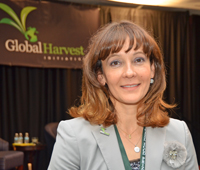
“This is the first time for Elanco joining this effort,” said GHI board member Claudia Garcia, Elanco Senior Director Global Corporate Affairs. “Elanco is very invested in technology. We truly believe that we need to do more to produce more food, not necessarily adding more animals, but becoming more productive because we’re concerned about the environment. But we cannot do it alone.”

GHI released its 3rd annual Global Agricultural Productivity Report (GAP Report) at the World Food Prize in Des Moines Wednesday and Garcia says the report puts the data in perspective and breaks it down to make it more manageable. “This year we decided to put an emphasis on regions, because if you keep talking the world, the world – it’s too big,” she said. “This is also the first year that we’re including the importance of animal production.”

The year 2050 seems like a long time away to have to worry about how we will feed a population of 9-10 billion people, but Claudia says it is not too early to work on it. “2050 is really now and we have to start working now to ensure that all of the production is there so that at the end there is going to be safe, affordable, abundant food on every table, regardless of how much you make or who you are,” she said. Well said!

Listen to or download my interview with Claudia here: Elanco's Claudia Garcia at WFP

View the World Food Prize Photo Album here.

AgWired coverage of the World Food Prize is sponsored by Elanco
Audio, Elanco, Food, Livestock, World Food Prize

Nestle’ Chair Addresses World Food Prize

Cindy Zimmerman

The 2012 World Food Prize Borlaug Dialogue kicked off in Des Moines Wednesday with an address by Peter Brabeck-Letmathe, chairman of the Nestlé Group, who gave his broader view on food security and nutrition.

Brabeck said that as per capita income increases in developing countries, people are no longer satisfied with a bowl of rice a day. “No, they want to have a little bit of meat, whether it’s beef, chicken or perhaps lamb on top of it,” he said, noting that current meat consumption in developing countries is 69 grams per capita per day, which is expected to increase by at least 9 grams per person every ten years.

On the subject of genetically modified crops, Brabeck said the impact of increasing yields is obvious, but food crops can also be modified to provide needed micronutrients, such as vitamin A in rice to help children who suffer blindness from a lack of it. “The introduction of GMO rice however, seems to fail mainly due to opposition to what I call “well-fed” people in some industrialized countries and I just wonder whether these people will ever be held accountable for the damage they are causing to the most vulnerable,” he said to applause.

You can listen to Brabeck’s remarks here: Nestlé's Peter Brabeck-Letmathe at WFP 2012

View the World Food Prize Photo Album here.

AgWired coverage of the World Food Prize is sponsored by Elanco
Audio, Elanco, Farming, Food, World Food Prize

Global Food Security Index Adds New Feature

Joanna Schroeder

During events at the 2012 World Food Prize taking place in Des Moines, DuPont announced an enhancement to the Global Food Security Index that was commissioned by DuPont and developed by the Economist Intelligience Unit (EIU). The tool was designed to capture the impact of changes in global food prices at the national level. In response to the rising cost of food, the Index recorded a slight decline in global food security.

“This tool increases the chances of creating sustainable, science-based innovations that target specific challenges, collaborating with others on solutions and bringing know-how to the people and places that need it most,” said DuPont Executive Vice President James C. Borel. “Knowing where the impact is the greatest can help focus our collective efforts where they are needed most.”

The World Bank estimates that global food price spikes in 2008 pushed 44 million people below the poverty line globally, most of them in poor countries. In the United States, almost 15 percent of households experienced food insecurity in 2011, up 11 percent before recent price jumps. Today, the driver of price increases were the U.S. drought and other global weather issues.

“Many factors affect food prices, from rising demand in emerging markets to abrupt changes in the weather,” said EIU Global Forecasting Director Leo Abruzzese. “The new Price Adjustment Factor tool will assess, quarterly, the impact of price changes on a country’s ability to afford food. High and volatile prices can impact food security by limiting consumers’ purchasing power and calorie consumption.”

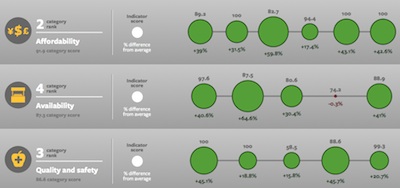
The Global Food Security Index addresses the underlying factors of food insecurity in 105 countries and points to areas for improvement and reforms. Features include:

  • Ability to capture the impact of changing food prices on each country’s ability to afford food.
  • Analysis of key findings.
  • Definition of 25 global indicators that measure specific aspects of food affordability, accessibility, availability, nutritional value and safety.
  • An interactive heat map of overall scores and detail of category results.
  • Adjustable weightings to allow for scenario planning.
  • Ability to compare multiple countries simultaneously and adjust rankings by indicators.
  • A country details page that allows a food-security drill down into individual economies.

View the World Food Prize Photo Album here.

AgWired coverage of the World Food Prize is sponsored by Elanco
Elanco, World Food Prize

Iowa Hunger Directory Unvield at WFP

Joanna Schroeder

To kick of the 2012 World Food Prize in Des Moines, the 6th annual Iowa Hunger Summit took place. The summit brings attention to issues related to hunger, poverty and malnutrition and is the largest gathering of hunger related organizations based in Iowa. During the luncheon portion of the event, Iowa Governor Terry E. Branstad designated October 16 as Dr. Norman E. Borlaug World Food Prize Day.

In addition, a new initiative was announced by Ambassador Kenneth Quin, President of the World Food Prize, called the Iowa Hunger Directory. This program will provide a year-round extension of the Hunger Summit and a vehicle for organizations and individuals to participate in hunger efforts.

“We want to create a comprehensive listing of Iowa organizations combating hunger at home and abroad,”said Quinn during the event. “We know there are dynamic organizations and dedicated people who are working diligently fighting hunger throughout the state and around the world and we want to facilitate their collaboration and connectivity. Also, this will allow us to collect more accurate information on their efforts.”

Between October 2011 and October 2012, over 26 million pounds of food were donated to the fight against hunger in Iowa. The Iowa Hunger Summit is sponsored by Iowa Farm Bureau and FBL Financial Group.

View the World Food Prize Photo Album here.

AgWired coverage of the World Food Prize is sponsored by Elanco
Elanco, World Food Prize

Report on Global Agricultural Productivity

Joanna Schroeder

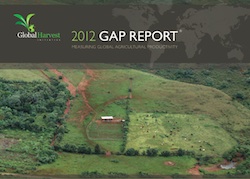
Today the Global Harvest Initiative (GHI) released its 3rd annual Global Agricultural Productivity Report (GAP Report) during the World Food Prize Symposium in Des Moines, Iowa. The GAP Report details efforts to increase global agricultural productivity, and notes that despite gains, it may not be enough especially in Sub-Saharan Africa, East Asia, and other regions to meet demand.

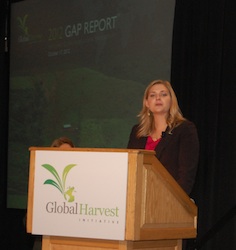
During a presentation to unveil the report, Laura Barringer, who has been on loan to GHI for the past 18 months, gave a brief overview on how regions were doing, opportunities and challenges, and presented strategies that will need to be deployed, to feed the anticipated global population of 9 billion by 2050. Barringer will become the Global Customer Product Support Manager for the Intelligent Solutions Group this November for John Deere.

There were several key areas that Barringer highlighted including the conclusion that we cannot meet future global demand unless agricultural productivity increases are achieved in every region of the world, at par with today’s levels. This was determined, in part, from the GAP Index, that measures global regional agricultural productivity growth against regional growth in food demand.

Barringer highlighted four key strategies that must occur if global food demand is to be met:

  • More investment – the GAP Report estimates that today there is an $80 billion dollar investment gap.
  • Agriculture Research & Development – this is the most important predictor of TFP growth.
  • Need for Science-Based Technologies – these technologies need to rural-based and have a supportive regulatory system to allow the tools to be used.
  • Trade Liberalization – Strong trade strategies will help to further expand market access.

You can listen to Dr. Margaret Zeigler’s, Executive Director of GHI, remarks here: GAP Report Opening Remarks

You can listen to Laura Barringer’s remarks here: GAP Report Overview

Download the full report here.

View the World Food Prize Photo Album here.

AgWired coverage of the World Food Prize is sponsored by Elanco
Audio, Elanco, Farming, Food, World Food Prize

Grazing Lands Conservation Initiative Conference Set

Melissa Sandfort

The Grazing Lands Conservation Initiative (GLCI) will host its 5th national conference in Orlando, Fla., Dec. 9-12, 2012, at the Caribe Royale Hotel and Convention Center. GLCI conference organizers expect over 1000 ranchers, professors, land managers, researchers, public officials, ecologists and students to participate in the exchange of information on ‘cutting edge’ grazing management technologies.

This year, Temple Grandin, noted animal behavior expert, author, speaker and professor will be one of a number of featured presenters. Grandin will conduct a book signing at the conference.

Monday evening will culminate with a special ‘Florida Night’ dinner banquet featuring Florida cowboy poet Stephen Monroe.

The conference will continue its past format of providing information along four tracks that will include Eastern, Central, Western and dairy grazing issues. Some of the issues to be highlighted include the value of rotational grazing and of riparian habitat, carbon sequestration, and the flexibility within grazing systems.

Agribusiness, Events

Are we REALLY educating consumers about ag?

Melissa Sandfort

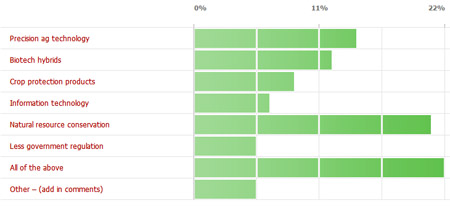
Our latest ZimmPoll asked the question, “What is most important for feeding growing world population? ”

Our poll results: Fifteen percent said Precision ag technology; thirteen percent said Biotech hybrids; nine percent said Crop protection products; seven percent said Information technology; twenty-two percent said Natural resource conservation; six percent said Less government regulation; twenty-three percent said All of the above; and six percent said Other.

There is not a simple answer to this question. We put a number of options up there but through comments others were suggested too. One thing we can all agree on though is that farmers will do all they can to produce the safest, affordable food to feed our growing population that they can!

Some of the suggestions were: Reduce food waste, Reduce post-harvest losses, Unleash the potential of Africa, Develop infrastructure, Improve farmers’ access to market, Give farmers the means to succeed through financing and extension services and Educate consumers to reduce over-consumption. All great ideas!

Our new ZimmPoll is now live and asks the question, “Have our efforts to educate consumers about agriculture been successful?” Agri-marketers continue to try to help educate the growing population of non-ag consumers. Another great example is USFRA, the largest agricultural communications effort of its kind and the goal is to speak with “one voice”. So how are we doing? Let us know here.

ZimmPoll is sponsored by Rhea+Kaiser, a full-service advertising/public relations agency.

Food, ZimmPoll

Zimfo Bytes

Melissa Sandfort

    Zimfo Bytes

  • Alltech recently presented the results of the 2011 Alltech Feed Tonnage Survey along with results from previous surveys, showing a steady increase in feed production year on year.
  • S&W Seed Company announced that Dan Gardner has joined S&W as Vice President of Seed Breeding and Genetics.
  • The American Meat Science Association recently announced winners from the Eastern National Intercollegiate Meat Judging Contest.
  • Woodruff Sweitzer has added two staff members to the talented team, Erin Nash as public relations manager and Shannan Baker as account manager.
Zimfo Bytes

Winterize Farm Equipment With Slip Plate

Chuck Zimmerman

With the fall harvest ending in the near future it’s time to look at winterizing all that equipment. That means you need a good lubricant and that means you might want to check out Slip Plate. You can find out all they ways you can use this product from Superior Graphite on their website. Go ahead. Visit now. Here are a few places where you can use Slip Plate:

SLIP Plate dry film graphite coatings (SLIP Plate No. 1, SLIP Plate No. 3, SLIP Plate No. 4, and SLIP Plate Aerosol) significantly reduce sliding friction on corn picker heads, combine cutter bars, hay elevators, planter plates, hay bailers, gravity wagons, and many more applications around the farm.

Slip Plate is a dry lubricant that is very environmentally friendly unlike petroleum based products. More reasons to use Slip Plate!

I visited with Barry Lee, Superior Graphite, once again to talk about Slip Plate products for the agricultural market. This is part of a periodic series of interviews I’m doing to help the ag industry come to know this company and their products. In our interview Barry not only talks about products for specific farm applications but also one I think you hunters our there should know about and that is Black Ice.

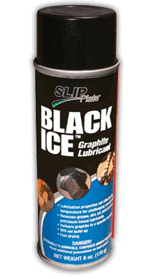
A unique formulation combining a unique solvent cleaner with a friction reducing mineral that first cleans the surface, and then deposits a layer of pure, lubricous graphite powder.

This makes it perfect for gun cleaning!

Our discussion also focused on “What’s inside a can of graphite?” You might think all cans of graphite are the same but they are not. Barry did some research on this subject that finds two things that govern the performance of the graphite product you are using: amount of graphite and the type of graphite. You can find details of his research findings on the Slip Plate website.

Listen to my interview with Barry here: Interview with Barry Lee

Agribusiness, Audio, Farming