Cotton Trade Dispute Update

Cindy Zimmerman

bwcc13-ncc-adamsExtension of the 2008 farm bill raises questions about resolution of the cotton trade dispute with Brazil, according to Dr. Gary Adams, Vice president of economics and policy analysis for the National Cotton Council.

“I think we have to figure out how Brazil reacts to a one year extension (of the farm bill),” Gary said in an interview at the Beltwide Cotton Conferences, noting that the framework agreed to with Brazil in 2010 allowed the United States time to adopt new WTO-compliant cotton policy in a new farm bill. “Is Brazil going to accept a short term extension and see how things play out? We just don’t know the answer to that question.”

Gary says the U-S cotton industry has been facing a slightly different challenge from another country as well recently. “We’ve been dealing with a trade dispute with Peru for the last 6-8 months,” he said. “Countries can initiate their own countervailing duty investigation if they’re concerned that imports into their country are causing harm to their domestic industry. That is what Peru initiated last summer.”

That investigation is proceeding and Adams expects they will know more by the end of March.

Listen to my interview with Gary here: Gary Adams interview

Thanks to Randall Weiseman of Southeast AgNet for providing the photo!

2013 Beltwide Cotton photo album

beltwide-fmc

Audio, Beltwide Cotton, Cotton

Stoneville Offers Two New Cotton Varieties

Cindy Zimmerman

bayer-logoWith weed resistance exploding across America’s farmland, Bayer CropScience has introduced two new Stoneville cotton varieties for 2013 that give cotton growers more tools to fight weed resistance and rotate herbicide chemistries on their farms.

bwcc13-bayer-nicholsSteve Nichols, U.S. Agronomic Services Manager for Bayer CropScience, gave the media an overview of the new varieties during the Beltwide Cotton Conferences last week.

Nichols explained that the ST 4946GLB2 is an early-medium maturing GlyTol LibertyLink Bollgard II variety with exceptional yield potential. “It’s widely adapted across the entire cotton-growing region. That speaks a lot about the stability and the consistency of the performance of it,” adding that it has offers root-knot nematode tolerance. “We’re looking for more varieties with different maturities to give that root-knot nematode tolerance, and this is going to deliver that.” Plus, he said it will have tolerance to the Liberty herbicides.

The other variety, ST 6448GLB2, gives a full-season capability. “It’s the first variety that we’ve really had that meets that full-season market for the South Region. So this variety fits very well in the South Delta, the Georgia market and even into South Carolina,” Nichols said. It also has a dual-herbicide technology that gives growers, especially in Georgia, a tool against resistant weeds.

Nichols added that the development of the Bayer CropScience Agronomic Services, providing hundreds of field trials, helps his company make these kind of developments in cotton varieties to match the right varieties for the right fields.

Listen to Steve tell us about the new Stoneville varieties as well as the role of Bayer CropScience Agronomic Services: Steve Nichols, Bayer CropScience

Audio, Bayer, Beltwide Cotton, Cotton

Keeping the Media in High Cotton

Cindy Zimmerman

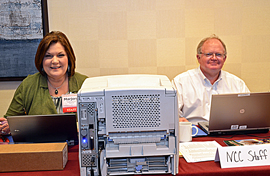
bwcc13-ncc-staffMarjory Lynch Walker and T. Cotton Nelson have staffed the news room at the Beltwide Cotton Conferences for many, many of the event’s 58 year history and while they are not sure what the changes in store will mean for media attendance, they are looking forward to moving ahead.

“Media attendance has always been healthy here. We’ve had as many as 50-60 members here,” Cotton told me, adding that attendance has continued to be strong over the years, even as less growers have been attending. That’s why Cotton says they appreciate Monsanto’s sponsorship of the news room. “Their support has allowed us to have the equipment in here, a big room, food for the media – just to make it a really good working environment for the media.”

Cotton notes that there will still be lots of information to get out to producers with the revamped schedule for Beltwide next year. “We realize the transfer of technology by the news media of the information that’s presented here is great for cotton growers,” he said.

Listen to my interview with Cotton here: Cotton Nelson interview

2013 Beltwide Cotton photo album

beltwide-fmc

Audio, Beltwide Cotton, Cotton, FMC, Media

FMC Committed to Cotton

Cindy Zimmerman

bwcc13-fmc-stuDespite changes planned for Beltwide Cotton Conferences in 2014 that mean no more technical exhibits, FMC Corporation remains committed to involvement in technology transfer within the cotton industry, according to Product Manager Stu Throop.

“Needs are changing just as the industry’s changing,” said Stu, pictured here on the left with some of the FMC team at Beltwide. “The anchor to this is the technology exchange and that’s the part that’s going to be maintained and expanded on in the future.”

Stu says the cotton industry is important to FMC. “We have a history in the cotton industry going back to the beginnings of our company,” he said. “We were able to come in cotton with a series of new brands as the boll weevil eradication program was implemented and cotton acres increased … we just happened to have the right chemistry at the right time.”

With the advent of resistent weed strains, Stu says FMC been able to develop new products to help cotton growers remain competitive. “We’re playing a role in weed pest management in cotton and we’re very excited about some of the chemistries still to come.”

Listen to my interview with Stu here: Stu Throop interview

2013 Beltwide Cotton photo album

beltwide-fmc

Audio, Beltwide Cotton, Cotton, FMC

AFBF President Meets the Press

Chuck Zimmerman

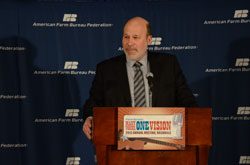
AFBF President Bob Stallman Press ConferenceFollowing the morning opening session of the American Farm Bureau Federation convention, President Bob Stallman held a press conference. Lots of good questions on just about every issue including labor, budget, farm bill, political climate and more. I asked him about measuring the success of the U.S. Farmers and Ranchers Alliance which he chairs and mentioned in his speech today. Bob says that USFRA from the beginning has made it of prime importance to have measurable goals. He says that this past fall a research project showed that USFRA has scored well in terms of how it is influencing the discussion of food and food production. That same study showed ways to improve too.

Post Update: You can download or listen to Bob’s press conference here: Bob Stallman Press Conference

2013 American Farm Bureau Convention Photo Album

AFBF, Ag Groups

AFBF President Opens Annual Meeting

Chuck Zimmerman

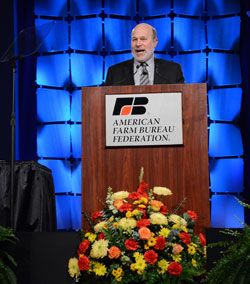
AFBF President Bob StallmanAmerican Farm Bureau Federation President, Bob Stallman, welcomed everyone to the 94th Annual Meeting. I will update this post soon after the opening session for you to listen to if you missed it or need it for a broadcast or report.

Stallman reviewed accomplishments made by AFBF during the last year. He urged members to be in contact with their elected leaders and told them that no matter what they’ve read, they are relevant. In talking about the newly elected leaders he said, “We must let them know that our nation can no longer afford political drama, manufactured crises and self-serving jackass stubbornness.” That drew applause.

Commenting on the farm bill action (or lack of it) he said “Lest anyone wonder why we need a farm bill, we should remember the drought of 2012.” You’d think that would have prompted Congress to have taken action much sooner and more permanently than they did wouldn’t you?

You can find a copy of Bob’s speech here: Stallman Speech 2013 (pdf)

Post Update: You can download or listen to Bob’s speech here: Bob Stallman Speech

I have a photo album started and will be adding to it periodically throughout the meeting: 2013 American Farm Bureau Convention Photo Album

AFBF, Ag Groups

Many Voices One Vision at AFBF Annual Mtg.

Chuck Zimmerman

AFBF Annual MeetingIt’s time for the 2013 American Farm Bureau Annual Meeting and I’m on my way. Cruising above 10,000 feet right now and thank you GoGo InFlight wifi. Listen to AFBF President, Bob Stallman, talk about the importance of this meeting here (.mp3).

There are an estimated 6,000 farmers and ranchers expected to attend AFBF’s 94th annual meeting. Here’s the purpose of the meeting.

The purpose of the annual meeting is for voting delegates to adopt grassroots policies and select leaders to guide the organization throughout the year. After receiving approval from members at the local level, proposed resolutions are forwarded to state Farm Bureaus for consideration. Those policies with national implications that win approval at the state level are sent to AFBF for ultimate consideration during the annual meeting’s business session.

There are two live video feeds of speeches from the event that you can watch. They are:

  • AFBF President Bob Stallman Keynote Address, approximately 9:20 a.m., CST, Sunday, Jan. 13.
  • Agriculture Secretary Tom Vilsack Address, approximately 3:15 p.m. CST, Monday, Jan. 14.

I will be there recording them to post onto AgWired right after they finish too. So, look forward to lots of photos and interviews as I find them during this year’s meeting.

AFBF, Ag Groups

Agriculture Workforce Coalition Announced

Jamie Johansen

awcOrganizations from across the country joined forces to announce today the formation of the Agriculture Workforce Coalition. AWC’s goal is to become a unified voice of agriculture and seek legislation that will ensure America’s farms, ranches and all other agricultural operations have access to a stable and skilled workforce.

AWC is putting a framework together that includes both an earned adjustment in status for current experienced farm workers and a program to ensure that producers continue to have access to a workforce as current agricultural employees move on to other jobs. This will encompass employers with seasonal labor needs, as well as those who provide year-round employment opportunities.

“The continued production of labor-intensive agricultural crops and products in the U.S., ranging from dairy and livestock to fruit, vegetables and tree nuts, cannot be accomplished without vitally important labor provided by skilled and experienced farm workers,” said Chuck Conner, president and CEO of the National Council of Farmer Cooperatives. “Without people to work on America’s farms and ranches, pick the crops or milk the cows, all other issues in agriculture become irrelevant.”

Without the support from 1.5 million hired workers each year, American agriculture would not be possible. Beyond the farm gate, each of these workers supports two to three full-time jobs in the food processing, transportation, farm equipment, marketing, retail and other sectors. Ensuring that farmers, ranchers and growers have access to the workers they need to maintain their productivity and competitiveness will help support continued growth in employment across the economy and in areas far removed from farm country.

“We have an unprecedented opportunity now that Democrats and Republicans are having a serious conversation about the critical need for immigration reform—an opportunity that cannot be wasted,” said Tom Nassif, president and CEO of Western Growers. “Agricultural employers have come together as never before in lock-step and agreement about a workable proposal that will serve the needs of farmers, workers and the American people. The time for immigration reform is now.”

Here are the organizations who have become part of AWC:
American Farm Bureau Federation
American Nursery & Landscape Association
Florida Fruit & Vegetable Association
National Council of Agricultural Employers
National Council of Farmer Cooperatives
National Milk Producers Federation
USA Farmers
U.S. Apple Association
United Fresh Produce Association
Western Growers Association
Western United Dairymen
Agriculture Coalition for Immigration Reform

Additional information on AWC can be found on their website.

Ag Groups, Agribusiness

NAAJ’s Excellence in Reporting on Agriculture Contest

Jamie Johansen

naajNeeding a little pat on the back for your newsroom’s work on issues related to agriculture and rural America? North American Agricultural Journalists are looking for your entires for the Excellence in Reporting on Agriculture.

You can’t give the excuse of your story not finding a home. There are six categories for contestants to choose from: news, spot news, features, columns/analysis, series and special projects. College students don’t have to worry about competing with the big dogs, there is a special category just for you.

The NAAJ is a professional, international group of editors and writers with a membership spanning the United States and Canada. Journalists eligible for membership are those who report or edit agricultural news for newspapers, magazines, wires and syndicated services and are independent of agricultural organizations and businesses. College students interested in a career in agricultural writing also are encouraged to join.

Most categories require you to be a NAAJ member. Those interested in joining can pay a $75 membership fee, but it must be received by January 28. Members may enter two entries per category and submit $10 per entry.

Members winning first-place vie for the Glenn Cunningham Ag Journalist of the Year Award. Winners will be recognized at NAAJ’s annual meeting banquet April 8 at the National Press Club in our nation’s capital.

Stories must be published in the 2012 calendar year and all entries must be received by the contest chair, David Hendee, no later than January 28.

You can find more information, contest rules and entry form here.

Uncategorized

Cooking with Cottonseed Oil

Cindy Zimmerman

bwcc13-cottonseed-1Cotton Incorporated held one of the best press conferences I’ve ever attended at the Beltwide Cotton Conferences this week – featuring a cooking demonstration with flavor-infused cottonseed oils and some kickin’ Texas Tea.

You might remember Chuck doing a post about these great Acala Farms cottonseed oils after World Dairy Expo last year. We got to find out more about them from Tom Wedegaertner, Director of Cottonseed Research and Marketing for Cotton Inc., who says that they are hoping the specialty oils will help increase public awareness of cotton as a food crop.

“Per capita consumption of cottonseed oil is about three pints per person,” Tom explains. “It’s a wonderful frying oil, has a very high smoke point, so a lot of restaurants use it in their deep fat fryers.” Tom says it’s also used in salad dressings because it has a very light, delicate taste that lends itself well to adding other flavors.

Listen to Tom talk about it here: Tom Wedegaertner interview

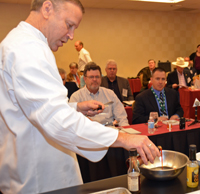
bwcc13-chefSan Antonio Marriott Executive Chef Donald Hoffman provided a demonstration and taste test for the media so we could find out for ourselves just how great these flavor-infused cottonseed oils are. First, he made Salmon Salpicon featuring the Jalapeno Lime and Cilantro flavored oils. He also made a BBQ sauce with Chipotle flavor on chicken breast sauteed in fresh-roasted garlic cottonseed oil.

You can watch Chef Donald demo the salmon recipe in the video below and if you want to find out more about these great tasting cottonseed oils, go to Acala-Farms.com.

2013 Beltwide Cotton photo album

beltwide-fmc

Audio, Beltwide Cotton, Cotton, FMC, Video