FarmLink Offers TrueHarvest Benchmarking Tool

Cindy Zimmerman

farmlinkA new benchmarking tool has been developed by FarmLink that can help farmers get the fullest potential from their operations.

“We’re helping a farmer identify where he should go find yield in a cost effective manner and other areas where he’s doing great,” says company president Scott Robinson about the tool they call TrueHarvest, which uses objective data to show a farm’s full range of performance potential, drilled down to a 150-square-foot area called a micro-field.

“The reason they’re 150 square feet is because our combine collection is done on a fleet of about 200 combines, the combine cutting head is about 30 feet wide, travels about 3.5 miles an hour and we collect data every second,” he said. “That data is used to correlate across the other 67 billion micro fields that we’ve developed across the United States that represents all corn, wheat and soybeans.”

true-harvestAccording to TrueHarvest calculations, American farmers could have produced approximately 1.6 billion more bushels of corn and 250 million more bushels of soybeans in 2013, realizing approximately $11 billion in additional revenue. “If farmers increased their performance up to the 75th percentile on average for corn and soybeans, that’s how much money is on the table,” said Robinson.

FarmLink was at the recent Commodity Classic talking about TrueHarvest and getting good reception from farmers according to Robinson, who said they really appreciated that the service was independent and did not require them to provide the company with private data. “It’s really agronomic benchmarking that we’re doing, but it’s for the individual farmer,” he said.

Find out more in this interview with Robinson and in the video below from the MyTrueHarvest.com website. Interview with Scott Robinson, FarmLink

Audio, Farming, Precision Agriculture, Technology

Grassley and Ag Reject Japan’s TPP Offer

Cindy Zimmerman

grassley-headSenator Chuck Grassley (R-IA) took time between votes today to join with several agricultural organizations and voice strong opposition to Japan’s negotiating position in the 12-nation Trans-Pacific Partnership to exclude a number of agricultural products as part of a final agreement.

“Japan seems to believe that they’re entitled to keep five sacred agriculture products off the table,” said Grassley, who said he just spoke with US Trade Representative Michael Froman this morning about the issue, stressing that when Japan agreed to join the negotiations they knew everything had to be on the table. “We’ve got to hold their feet to the fire.”

“The third largest country in the world can’t make protectionist moves like that without it having a ripple effect,” he added.

The five broad agricultural product categories that Japan wants to exempt from the TPP agreement are pork and beef, wheat and barley, rice and starch, dairy, and sugar. Participating in a conference call with Grassley today were representatives from the National Pork Producers Council,
American Farm Bureau Federation, National Cattlemen’s Beef Association, National Oilseed Processors Association, and the National Association of Wheat Growers Association. All of them and more are strongly urging the administration to reject Japan’s offer.

Listen to the press conference here: Ag Groups Reject Japan's TPP Offer

AFBF, Ag Groups, Audio, Beef, NCBA, Pork, Trade, Wheat

ABM Acquires Assets of BioSolutions

Chuck Zimmerman

178Advanced Biological Marketing (ABM) has purchased the assets of BioSolutions, an importer of innovative technologies for the agricultural sector in Southern Africa. The acquisition was finalized in December of 2013. Included is the office in Litchenburg South Africa, a manufacturing facility and a distributor network. ABM branded products will be produced, formulated and packaged there. This facility will manufacture products for the entire African Continent, South East Asia and Australia.

The previous staff from BioSolutions will now be employed by ABM. As market penetration grows and the distributor network is built, staff will be added. Josey Hendriks will serve as general manager and Dr. Ronel Hendriks will be the lead science officer and oversee testing, quality control and research of new products.

“This is an excellent opportunity for ABM to expand its global reach,” said Dan Custis, President and CEO. “As our market penetration continues to grow both domestically and internationally, we saw the need to expand and diversify our production facilities. With this acquisition and future expansion of the facility, we’ll be able to provide our products and reach additional growers more efficiently than what we are currently doing. In addition, having this facility closer to the actual point of contact with the stakeholders is a plus for the farmers in that part of the world”.

Custis states that equipment purchases are moving forward and manufacturing should be fully operational in time to supply products for the 2015 growing season. In the meantime, goods will be shipped from the Van Wert location to meet the demand for this growing season.

Agribusiness

Manage Your Ground Speed with New Holland

Chuck Zimmerman

Vic ConstableGetting a lesson in Ground Speed Management with New Holland tractors was my second one during Operation Blue Force out on a farm near Bakersfield, CA. Our classroom teacher is Vic Constable. After the lesson I got into a T9 4-wheel drive tractor with track units pulling a massive field “Optimizer” to put that lesson in action. My driver, Ryan, showed how to set up Ground Speed Management as well as Custom Headland Management. After recording his instructions it was my turn to sit in the seat and drive. I did pretty good and learned a few extra lessons that just need to stay in California. 🙂

The 16-speed full powershift transmission with Ground Speed Management (GSM) features both field and road operation settings. GSM Field™ automatically downshifts the tractor and adjusts engine rpm to maintain the best performance, then upshifts and changes engine rpm as load decreases. GSM Road™ selects the proper gears and engine rpm based on speed lever input and load conditions. Even without GSM, get clutch-free, push-button shifting and fingertip control of direction changes.

You can listen to Vic’s lesson here or watch it below: Vic Constable Lesson

If you’d like to see these features in action check out my ZimmGlass video below:

New Holland Operation Blue Force Photo Album

Agribusiness, Audio, New Holland, Tractor, Video

NCGA CEO to Retire

Cindy Zimmerman

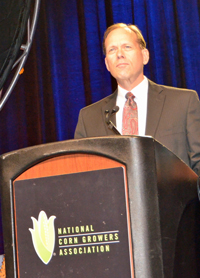
classic14-rickAfter 14 years of leading the National Corn Growers Association (NCGA), CEO Rick Tolman has decided it’s time to retire – so take a good look at this photo here because it was the last Commodity Classic for Rick as CEO.

The announcement was made today from NCGA that Rick told the NCGA Corn Board earlier this week that he would like to step down as chief executive officer at the end of September

“Rick has been a tireless advocate for corn farmers and our organization,” said NCGA president Martin Barbre in a statement. “However, Rick told us – as much as he loves representing our way of life – he is ready to enjoy more time with his wife, Linda, and their five children and eight grandchildren, and other pursuits. As he said it, we all put off things until ‘someday,’ and, for him, ‘someday’ has finally come, after 14 years of service to the organization and a 37-year career in agriculture.”

classic14-martinMartin added that they are sad to see Rick go but that he is “definitely riding into the sunset on a high note.”

“We all want to leave things better than we found them, and Rick can certainly be proud of his legacy at NCGA,” Martin said, adding that it will be a year of transition, not turmoil. Rick will remain as CEO until September 30 and the board will soon begin the somewhat reluctant process of searching for a replacement.

This post was supposed to be about some of the great news that both Rick and Martin had to share at the Commodity Classic, so that is still what it will be. I did interviews with both of them about some of NCGA’s recent success stories and new initiatives.

One brand new news item Rick announced at the NCGA banquet was that the Smithsonian Institution wants to put the Corn Farmers Coalition DC metro campaign ads in a new exhibition called “American Enterprise” scheduled to open next year in the Museum of American History. “It will last for 20 years and we anticipate about 90 million people seeing it,” Rick said.

In this interview on the final day of Classic, Rick also talks about the great corn grower response last year to commenting on the EPA proposal to gut the Renewable Fuel Standard (RFS) and how NCGA plans to keep that momentum going. Interview with Rick Tolman, NCGA CEO

I talked with Martin specifically about a couple of recent NCGA initiatives – the Coalition for Safe Affordable Food, and the Soil Health Partnership. He also discussed two major policy issues facing NCGA this year – implementation of the farm bill and getting the water resources bill across the finish line. Interview with Martin Barbre, NCGA president
2014 Commodity Classic Photos

Ag Groups, Audio, Commodity Classic, Corn, NCGA

Opinion About Open Ag Data Alliance?

Jamie Johansen

New Holland ZimmPollOur latest ZimmPoll asked the question, “What’s your favorite fish?”

Looks like grilled is a favorite by a landslide. Personally, I agree. I didn’t learn to like fish until later in life and still don’t cook it often, but love when someone makes it for me. It is interesting to see all the fast-food chains adding a fish sandwich to their menu this time of year. Maybe we should have added fish sticks to the list.

Our poll results:

  • Pan Fried – 11%
  • Deep Fried – 19%
  • Poached – 3%
  • Baked – 9%
  • Grilled – 35%
  • Smoked – 9%
  • Soup – 0%
  • Don’t eat fish – 11%
  • Other – 3%

Our new ZimmPoll is now live and asks the question, “What do you think of the Open Ag Data Alliance?”

The Open Ag Data Alliance (OADA), an open standards software project to ensure farmers have full data access, security and privacy, has officially been launched with the goal of enabling farmers to have flexibility and control over data-driven decisions on their farm. What do you think about it? Do you think there is a need for this – or do you even understand it at all? Let us know!

ZimmPoll

Bayer’s Investment in Seeds Innovation

John Davis

bayer-aif14-kneenBayer CropScience is showing its dedication to innovation several ways, starting with moving the company’s global seeds headquarters to the Research Triangle Park (RTP) in North Carolina.

“This is something that reflects our presence in the market and desire to be close to the market,” explained Geoff Kneen, Bayer CropScience’s vice president, head of strategic initiatives and RTP operations, during an interview with Cindy at the Ag Issues Forum in San Antonio. “The Americas are really the biggest market for the genetically modified seeds that we produce.”

Globally, he said they have opened several breeding stations, and recently bought a soybean breeding station in Argentina. They’re also working on developing new varieties of wheat, a crop he admits has not gotten as much technology attention as its corn and soybean cousins.

In addition to these innovations in seed technology, Geoff said they are working on educating the public about the safety and benefits of the GMO seeds they produce.

“A lot of people don’t understand the technology, and if they don’t understand it, they naturally fear it as bad, and we have to put that right,” pointing out that GMOs help growers, as well as putting more and a higher quality level of food on tables. His company has also joined a coalition of ag interests and set up a website, GMOAnswers.com, to have an open dialogue on the hardest questions and provide the truth. “We encourage really difficult questions, and you can read all those answers. They’re there for peer review.”

Listen to Cindy’s interview with Geoff here: Interview with Geoff Kneen, Bayer CropScience

bayer-issues-button2014 Bayer CropScience Ag Issues Forum Photos

Agribusiness, Audio, Bayer, Seed

My Favorite Things

Melissa Sandfort

Today Aunt Jeanette writes:

Flowers on houseplants and robins in the yard,
Bald eagles flying overhead, the time change – so hard!
Days working outside, and loving the sun,
These signs of spring are the cause for some fun!

imageWhen the temperature reached 75 degrees a couple days ago, I had an urge to go outside and look for those first signs of new life under the mulch. I am glad the opportunity did not arise, because the next day the temperature dipped to 27 degrees and we had a mixture of snow and rain. I guess it’s best to leave that tender, beginning life protected a while longer. Ah, March in Nebraska!

I know spring can’t be too far away because this particular houseplant always blooms about the same time we set our clocks ahead an hour. It is my personal signal that warmer days will be coming soon.

The plant is one that I started from one grown by my paternal grandmother. I can still picture in my head exactly where it sat in Grandpa and Grandma’s house. I thought it was the most fascinating plant. However, I had never seen it bloom so I was very excited when I saw that first unusual flower (tiny and white on a long stem).

Both sets of my grandparents were avid gardeners and had green thumbs. My parents still enjoy their garden and share their abundance of produce with family and friends. Me – I am not such a great vegetable gardener, but my houseplants and outside flowers and plants are among my favorite things!

Until we walk again …

Uncategorized

What’s in the Bayer CropScience Trait Pipeline

John Davis

bayer-aif14-gentOur friends at Bayer are working hard to get the next generation of soybean traits in growers’ hands in the next couple of years. At the recent Ag Issues Forum, Chuck caught up with Allen Gent, who is Bayer CropScience’s U.S. soybean product manager for soybean seed and trade. He said they’re working on weed resistant traits, such as their LibertyLink seed that allows growers to spray Liberty herbicide in crop for non-selective postemergence control of the toughest weeds, and a couple of new traits in the form of what they’re calling Balance Bean and Balance GT soybeans. He says since these are GMO products, the approval process is quite long.

“The regulatory process has gotten a lot more lengthy for all companies involved,” which he admits is really a testament to how careful regulators and the industry are in putting out any new technology. He added that there has been a shift in the 10-12 year process that it takes from concept to product on the shelf, where most of that time used to be in the early development stages and is now taken up by the regulatory approval process at the end of development. Allen expects these latest traits to be approved and ready to use in the next couple of years.

Further down the road, he said they’ll be focusing on fighting more weed and disease resistance traits.

You can check out Chuck’s interview with Allen here: Interview with Allen Gent, Bayer CropScience

bayer-issues-button2014 Bayer CropScience Ag Issues Forum Photos

Agribusiness, Audio, Bayer, Soybean

Fresh Produce Sales Up in 2013

Jamie Johansen

unitedfresh-logoUnited Fresh Produce Association released the 2013 Year in Review edition of the FreshFacts® on Retail report, which examines overall retail trends in produce for the past year. The report shows that during 2013, the produce department averaged more than $47,000 per week per store, which was up 4.8 percent over the previous year.

The FreshFacts® on Retail report, produced in partnership with the Nielsen Perishables Group and sponsored by Del Monte Fresh Produce, measures retail price and sales trends for the top 10 fruit and vegetable commodities, as well as value-added, organic and other produce categories.

Highlights of this “Year in Review” report include:
Over the past year, all of the top 10 fruits posted volume increases
– Fruits average weekly dollar sales increased 4.5 percent versus 2012
– All of the top 10 vegetables posted increases in weekly dollar sales
– Among value-added fruit categories, value-added fruit and fresh-cut fruit both posted increases in weekly dollar sales
– Snacking value-added vegetables posted an increase of 15 percent in weekly dollar sales
– Avocados posted the highest growth in the fruit category, with dollar sales increasing 11.7 percent and volume increasing10.3 percent
– Packaged salad and tomatoes, the two top-selling vegetable categories in 2013, increased dollar sales 6.7 percent and 3.4 percent

This quarters’ FreshFacts® report also features a spotlight on organic produce. Recent trends show that even with increases in retail prices, volume sales continue to grow in all organic fruit and vegetable categories. The growing demand for organic produce resulted in dollar and volume increase, roughly 20 percent for both organic fruits and vegetables overall.

Ag Groups, Food, Produce, Vegetables