
Learn More About Plant Sap Analysis

Jamie Johansen

Michelle Gregg is the Executive Director for Crop Health Laboratories (CHL) and Leah spoke with her about the new company’s upcoming event and opportunities they have for growers across the country. Part of CHL’s business model is using an existing technology that is new to North America. This new technology is called plant sap analysis which offers a different management option for growers.

The Power Growers Seminar will take place Nov. 7 & 8 in Santa Clara, CA. The educational event will introduce plant sap analysis to growers. Along with data that have been collected through the first year’s trials across North America is various crops.

“The results are really promising especially for greenhouse producers and those who have year-round production models. The purpose of the seminar is to provide connectivity to university researchers, specialty growers and consultants. Allowing them to come together at the same table, have limited and exclusive access to our pilot data, comment and ask questions on the system and give us feedback so we can make the best program possible.”

The Netherlands-based company, NovaCropControl, has been utilizing this technology for 10 years. Michelle says they deserve the credit for creating the technology. There has been significant response to this technology in Europe and Netherlands, which has a high population of greenhouse production.

Michelle said the seminar will truly introduce growers to the concept of having ultimate control of your crops nutrient management program. CHL really wants to gather the perspectives from producers on the East and West coasts, from Canada and everywhere in between.

“We are humbled by some of the responses we are getting. Granted this is our first year in North America, the main responses we are getting is ‘this program really allows me to critically evaluate my nutrient management and verify that what I am putting on my soil is really reaching the target tissue.’ That is one of the benefits of analyzing the sap verses analyzing the tissue itself. You can collect the nutrient information prior to metabolism by the plant.”

Stay tuned for our full coverage of the Power Growers Seminar in just a few weeks. For more information on the event visit www.crophealthlabs.com/sap-analysis-seminar/. Listen to Leah’s complete interview with Michelle here: Interview with Michelle Gregg, Crop Health Laboratories

Agribusiness, Audio, Events, Precision Agriculture, Technology

Zimfo Bytes

Talia Goes

Zimfo Bytes

  • The National Corn Growers Association and BASF Corporation will again award five $1,000 scholarships to undergraduate and graduate students pursuing a degree in an agriculture-related field during the 2015-16 school year.
  • On Nov. 7, Agriculture Future of America will honor two men who have demonstrated this spirit of innovation throughout their careers and have actively given back to benefit the next generation of agriculture leaders.
  • Zoetis welcomes Megan DeRose to its U.S. Cattle and Equine Marketing Team as marketing manager, responsible for the U.S. Dairy Anti-Infective and HOOF-TEC™product portfolios.
  • Michael Cavallero, retired President of North American Tropical Fresh Fruit for Dole Fresh Fruit Company, will be the 2015 honoree at the Produce Legends Dinner during the United Fresh Midwinter Leadership Forum January 13-15, at the La Quinta Resort and Club, in La Quinta, CA.
Zimfo Bytes

Corn Growers in the Sunbelt

Cindy Zimmerman

ncga-sunbeltThe National Corn Growers Association had a presence last week at the Sunbelt Ag Expo in Moultrie, Georgia for the first time.

NCGA president Chip Bowling of Maryland visited with attendees at the event, including USDA Deputy Secretary Krysta Harden who grew up on a Georgia peanut farm, and got to see some crops he doesn’t normally see. “I got to see some cotton and a few peanuts,” Bowling told Randall Weiseman with Southeast AgNet during an interview at Sunbelt.

Bowling noted that corn acreage has been increasing in the southeast. “In the last couple years, when corn prices shot up there for awhile, we started seeing more corn acres in the south,” he said. “We are growing a fair amount now – about a billion and a half bushels – which is way up from what it used to be.”

Listen to Randall’s interview with Chip here: Southeast AgNet interview with NCGA president Chip Bowling

Audio, Corn, NCGA, Sunbelt Ag Expo

2014 World Food Prize Honors Dr. Sanjaya Rajaram

Joanna Schroeder

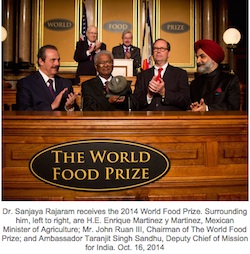
The 2014 World Food Prize was awarded on World Food Day, October 16, 2014 to Dr. Sanjaya Rajaram, a wheat breeder who has developed more than 400 varieties of the crop. Born in a small village in India and now citizen of Mexico, Dr. Rajaram conducted the majority of his research in Mexico at the International Maize and Wheat Improvement Center (CIMMYT).

World Food PrizeDr. Rajaram’s scientific research led to a prodigious increase in world wheat production – by more than 200 million tons. His crossing of winter and spring wheat varieties, which were distinct gene pools that had been isolated from one another for hundreds of years, led to his development of plants that have higher yields and dependability under a wide range of environments around the world. He also developed wheat varieties resistant to the rust disease that can wipe out entire fields, thus protecting the world’s food supply.

“This award honors the resilience and innovative spirit of farmers in the developing world and the national agricultural systems,” Dr. Rajaram said as he accepted the award. “Without their contributions my research would not have been possible. The mission was – and the mission remains – to serve them.”

As the World Food Prize culminates the centennial year of its founder and Dr. Rajaram’s mentor, Dr. Norman Borlaug, it is especially fitting to recognize the impact of Dr. Rajaram’s achievements.

“Dr. Rajaram worked closely with Dr. Borlaug, succeeding him as head of the wheat breeding program at CIMMYT in Mexico, and then carried forward and expanded upon his work, breaking new ground with his own invaluable achievements. His breakthrough breeding technologies have had a far-reaching and significant impact in providing more food around the globe and alleviating world hunger,” said Amb. Kenneth M. Quinn, President of The World Food Prize. “Dr. Borlaug himself called Dr. Rajaram ‘the greatest present-day wheat scientist in the world’ and ‘a scientist of great vision.’ It is an honor to recognize Dr. Rajaram today for his development of an astounding 480 varieties of wheat, bred to offer higher yields, resistance to the catastrophic rust disease, and that thrive in a wide array of climates.”

Food, Wheat, World Food Prize

NCGA Staffer on CTIC Tour

Cindy Zimmerman

2014 CTIC Conservation in Action Tour Photo Album

Many of the participants at last week’s CTIC Conservation in Action tour of the Florida Everglades Agricultural area were from the Midwest and they were very interested in some of the very different crop production they saw in the Sunshine State.

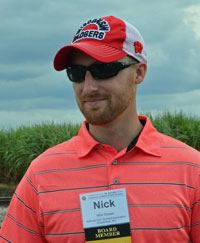
ctic-14-ncgaCTIC board member and National Corn Growers Association (NCGA) Soil Health and Sustainability Manager Nick Goeser was amazed by the sugarcane planting and harvesting he saw. “It’s incredible,” he said. “It’s different (compared to corn) but the level of mechanization is very similar, the level of farm management, the precision involved – it’s amazing.”

Farmers in the Everglades Agricultural Area (EAA) have implemented some very successful best management practices to protect the important ecosystem that provides the water supply for much of the state. “A lot of the management issues are similar,” said Goeser. “We learned they had about a 55% reduction in phosphorus, which is huge.”

Goeser says what farmers have been able to accomplish in the EAA can serve as a conservation case study for farmers in other parts of the country.

Listen to my interview with Nick here and watch some of the sugarcane harvest in the video below: Interview with Nick Goeser, NCGA


Audio, Conservation, Corn, CTIC, Harvest, NCGA, Video

Raising Cane in the Everglades

Cindy Zimmerman


2014 CTIC Conservation in Action Tour Photo Album

ctic-14-cane-plantingPlanting at U.S. Sugar Corporation is done with precision, as we found out on the 2014 CTIC Conservation in Action tour last week in the Everglades Agricultural Area.

Steven Stiles, U.S. Sugar farm manager, says cane is a “ratoonable crop” which refers to the stalks that are called ratoons and normally one planting lasts about four years. “The production goes on a linear decline,” he said, with each successive year producing a little less than the year before. Instead of seeds, they plant 2-3 foot cuttings of cane stalk called billets from which the plants sprout.

Stiles explained how they “laser level” and “table top” the fields before planting which helps them in the event of excessive rainfall and flooding. “And when it’s dry…if it’s flat you get a more consistent irrigation job,” he said.

U.S. Sugar’s precision ag manager Scott Berden says they use GPS and auto steer on their planters, as well as rear-mounted cameras so the operator can see how the planting is going behind him. The whole system is monitored by computer through a private on-farm wireless network. “We’re looking at engine health, telematics data on the field, as well as all the field data,” said Berden.

Listen to Steve and Scott explain here or below in the video: Steve Stiles and Scott Berden with U.S. Sugar


Audio, Conservation, CTIC, Sustainability, Video

Top 100 Ag Cooperatives

Cindy Zimmerman

2014-coop-monthIt’s still National Cooperative Month, which is when USDA traditionally releases its top 100 list of agricultural cooperatives.

According to USDA, Iowa has the most agricultural cooperatives of any state at 16, up from 11 a decade ago. Minnesota ranks second among the states, with 13. It is followed by Nebraska with nine, Illinois and Wisconsin with five each, then California, Indiana, Kansas, Missouri and Ohio, which are all tied with four.

Looking at business volume where a cooperative has its headquarters, Minnesota ranks first among the states, with $68.8 billion. Missouri is second at $16.2 billion and Illinois is third at $13.2 billion.

The top two cooperatives are Minnesota-based – CHS Inc. and Land O’ Lakes, both of St. Paul. Dairy Farmers Incorporated, based in Kansas City, Missouri, is ranked third and GROWMARK of Illinois comes in fourth. Rounding out the top five is Ag Processing Inc. of Omaha, Nebraska.

Like the nation’s ag co-op sector as a whole, the top 100 cooperatives also enjoyed a third consecutive year of record sales. They reported revenue of $174 billion in 2013, an increase of almost 9 percent over the $166 billion reported in 2012.

See the full list here.

Cooperatives, GROWMARK, USDA

ZimmComm Partner Authors Organic Report

Cindy Zimmerman

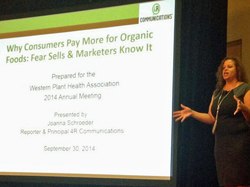
jms-californiaOur own Joanna Schroeder was the principal researcher for a recent research report published in Academics Review, “Organic Marketing Report,” findings of which she presented at the Western Plant Health Association annual meeting in Palm Desert, California.

Joanna’s research found no scientific consensus to prove the organic marketing industry’s claims that organic food is more nutritious and safer than traditional food. The report reviewed more than 200 published studies from 1990-2014 as well as sales trends and report, NGO, government and marketing group reports, presentation, websites and more.

The article found three two reasons why consumers purchased organic foods: personal health and food safety concerns and absence claims (i.e. pesticide free, no GMOs, hormone and antibiotic-free). It was also found that organic labels do not compel consumers to purchase organic products unless the label contains absence claims or related packing callouts that imply health or safety related concerns.

“In other words, fear sells,” says Joanna.

Fear-based campaigns only sell when they effectively utilize several key components:

1) The portrayed consequence of not taking action is severe but not exaggerated.
2) The audience feels that the problem is relevant to them.
3) They are told why they should care and how the issue relates to their lives.
4) When they believe the proposed solution is effective in preventing the consequence.
5) The solution is easy.Read More

Food, Organic

Global Yield Gap Unveiled at Water for Food Conference

Cindy Zimmerman

Water for food logoFinding of the Global Yield Gap and Water Productivity Atlas were unveiled this week at the sixth annual Water for Food Global Conference. The outcome of a six-year international collaborative research effort led by the Daugherty Water for Food Institute at the University of Nebraska and Wageningen University in the Netherlands, the Atlas is the first transparent, interactive and map-based web platform to estimate exploitable gaps in yield and water productivity for major food crops worldwide.

According to the Atlas, sub-Saharan Africa has the world’s largest gap in farm yields at 70-90 percent below their potential. The data show that Sub-Saharan Africa – primarily smallholder farmers practicing subsistence agriculture in Burkina Faso, Ethiopia, Kenya, Mali, Niger, Nigeria, Tanzania and Uganda – can potentially increase yields of existing farms by more than twofold. Other studies show that Ethiopia’s surface water and groundwater supplies could irrigate 10 times as much land than they are right now.

yield-gapThe Atlas can help farmers, policy makers, foundations and private sector organizations identify regions with the greatest potential to sustainably produce more food with strategic use of resources. The Atlas also provides a digital platform for analyzing location-specific crop production and land-use changes, as well as the potential impact of certain crops or new agriculture technologies on specific areas.

“Producing enough food to meet the demands of more than 9 billion people in 2050, while conserving natural resources and ecosystems, depends on improving crop yields on existing farm land around the world,” said Roberto Lenton, founding executive director of the Robert B. Daugherty Water for Food Institute at the University of Nebraska. “The foremost use for the Atlas is to leverage data to identify opportunities to strategically increase yield and water productivity of existing cropland, rather than tilling more land that may not be ideal for sustainable crop production.”

Find out more at YieldGap.org.

Food, International, Research, Water

USDA Announces New Farm Bill Program

Cindy Zimmerman

usda-logoUSDA is making plans to launch new Farm Bill program to help provide relief to farmers impacted by severe weather, including drought.

Agriculture Secretary Tom Vilsack today announced the Actual Production History (APH) Yield Exclusion, available nationwide for farmers of select crops starting next spring, allows eligible producers who have been hit with severe weather to receive a higher approved yield on their insurance policies through the federal crop insurance program.

Spring crops eligible for APH Yield Exclusion include corn, soybeans, wheat, cotton, grain sorghum, rice, barley, canola, sunflowers, peanuts, and popcorn. Nearly three-fourths of all acres and liability in the federal crop insurance program will be covered under APH Yield Exclusion, which allows farmers to exclude yields in exceptionally bad years (such as a year in which a natural disaster or other extreme weather occurs) from their production history when calculating yields used to establish their crop insurance coverage.

Secretary Vilsack and USDA Risk Management Agency administrator Brandon Willis announced the details in a call with reporters: USDA APH announcement with Vilsack and Willis

Audio, USDA