CIRB Annual Meeting Underway

Chuck Zimmerman

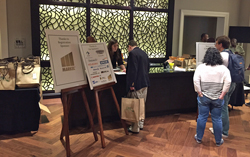
CIRB RegistrationThe 2015 Crop Insurance & Reinsurance Bureau Annual Meeting is underway in Bonita Springs, FL. That’s where you hold a meeting this time of year! I grew up about 2 hours north of here.

So, registration is underway, the board is meeting and we have the opening reception is coming up soon. This is my first time attending and we’re going to be learning a lot together.

I’d like to thank Rural Community Insurance Service for sponsoring my coverage of this year’s meeting. We’ll have lots of photos and interviews in the next few days!

Follow the hashtag #CIRB2015 for those who will be tweeting!

Coverage of the Crop Insurance & Reinsurance Bureau Annual Meeting is sponsored by
Coverage of the Crop Insurance & Reinsurance Bureau Annual Meeting is sponsored by RCIS
Ag Groups, CIRB, Insurance

Agri-Pulse Open Mic with Phillip Seng

Leah Guffey

Agri-Pulse interviewed Philip Seng, President and CEO USMEF on Open Mic this week:

open-micInternational trade can be a “gold mine” for beef and pork producers as well as the grain growers they rely on for feed. However, U.S. red meat exports are challenged from lower domestic production and the rising value of the U.S. dollar. In this week’s Open Mic in-depth interview, Philip Seng, President and CEO of the US Meat Export Federation, says the value, quality and consistency of the US product has helped the industry maintain and expand its place in the globe – despite tough competition from places like Australia and the European Union. Seng says over the next decade Asia will be home to 65 percent of the world’s middle class and that’s another reason to concentrate on global trade deals like the Trans Pacific Partnership.

Click here to listen to Agri-Pulse Open Mic with Phillip Seng, President and CEO USMEF.

Agri-Pulse, Audio, Exports, Food, Markets, Meat

20 Best College Farms in America

Jamie Johansen

Screen Shot 2015-02-04 at 10.39.45 AMBest College Reviews has published a ranking of the 20 Best College Farms in America. Best College Reviews is an editorially independent college review website focusing on college rankings, reviews of college features, and thought leadership on helping students find their place in the higher education landscape. I am excited to see a Missouri school on the list that is right in my back yard.

From small student-run organic farms, to large agribusiness training centers and entrepreneurial programs, farming plays a central role in many American higher ed institutions. Best College Reviews realizes that a university farm can mean a number of things, so as they reviewed 50 universities from across the country, they kept the following criteria in mind: Farm Size, Integration with the Main Campus, Sustainability, Are courses taught at the farm?, Do students use the farm?, and Integration with the Community.

Here are the top 5 on their list:
1. Warren Wilson College – Asheville, North Carolina
2. College of the Ozarks – Point Lookout, Missouri
3. Deep Spring College – Big Pine, California
4. Hampshire College – Amherst, Massachusetts
5. Butte College – Oroville, California

Ag Groups, Education, Farming

Zimfo Bytes

Talia Goes

Zimfo Bytes

  • Valent U.S.A. Corporation announced that Presidio® Fungicide has been registered by the Environmental Protection Agency (EPA) for use on tobacco.
  • CropLife America announces that it has joined the North American Climate Smart Agriculture Alliance, an alliance with the mission to generate dialogue and greater understanding within the agriculture and forestry sectors of the impacts of climate change and the steps they can take to meet the challenges.
  • Purina Animal Nutrition announces the hiring of Dr. Kevin Herrick, Ph.D., as the senior manager to the dairy and livestock technical support team.
  • GROWMARK employees were recognized at the Region IV Best of NAMA awards ceremony, a communications contest sponsored by the National Agri-Marketing Association (NAMA).
Zimfo Bytes

Soil Health Partners Work Together

Cindy Zimmerman

The Soil Health Partnership (SHP) was launched just shy of a year ago with seed funding in part from Monsanto and technical support from The Nature Conservancy (TNC). That may seem like a case of strange bedfellows, but everyone has the same goal of healthier soils.

shps15-monsantoAt the first Soil Health Summit last week in St. Louis, Monsanto Sustainability Business Development Lead Kevin Coffman said having partners in the environmental community is very helpful to the effort. “They’ve certainly thought about this a very long time,” said Coffman about the role of TNC and the Environmental Defense Fund in the partnership. “So, it was a natural partnership to bring them together.”

Coffman was pleased with the summit and the progress of the SHP to date. “This was really our first chance to get the cooperating farmers face to face to share more about they’re doing,” he said. Interview with Kevin Coffman, Monsanto

tnc-carrieCarrie Vollmer-Sanders, who is Director of the Western Lake Erie Basin Project for The Nature Conservancy, is also a farmer and she says the partnership is helping her learn a lot about her own farm. “(We’re) taking a closer look at the management of what we’re doing with cover crops versus no cover crops,” she said, adding that they ultimately hope to learn what the benefits are for the soil. “Really that can change the game for agriculture…it’s not just yield that we’re talking about.” Interview with Carrie Vollmer-Sanders, The Nature Conservancy


2015 Soil Health Summit Photo Album

Audio, Conservation, Environment, Soil

Iteris and BASF Join in Precision Ag Weather Agreement

Cindy Zimmerman

iteris-1Iteris and BASF have entered into an agreement to leverage Iteris’ ClearAg high-resolution field level weather information.

Under this agreement, Iteris’ ClearAg™ high-resolution, precision hail information will be integrated into BASF’s suite of precision agronomy sales and customer support tools. BASF sales and customer support staff will have access to Iteris’ field-level hail information, including descriptions of hail events by state, county, township, or zip code; hail amounts; and graphic maps of hail events in most U.S. states with the goal of being able to quickly notify U.S. corn and soybean growers in time for precise crop protection response to potential crop damage or other hail-related issues.

basf-new-logo“It’s important for corn and soybean growers to quickly assess and respond to hail-related crop damage before fungus or other diseases have time to set in and cause further damage,” said Gary Fellows, Ph.D., BASF Tech Service Fungicide and Seed Treatment Manager. “By leveraging Iteris’ ClearAg hail data, we can send a notification to growers on how to treat or respond to hail-damaged crops for improved execution in the field.”

“By delivering our high-resolution ClearAg hail data to BASF, we are empowering their sales and support staff, as well as their U.S. Crop Protection customers, with actionable information for more proactive field response,” said Abbas Mohaddes, President and CEO of Iteris. “We look forward to working with the world’s largest chemical company and their efforts to bring high-value, decision-support services to their grower customer base in the U.S.”

Read more here.

Agronomy, BASF, Precision Agriculture, Weather

U.S. Wheat Associates Elects 2015/16 Officers

Jamie Johansen

mimeU.S. Wheat Associates (USW) farmer directors elected officers for the 2015/16 fiscal year at their board meeting in Washington, DC, Jan. 31, 2015. Mike Miller of Ritzville, WA, was elected to serve as Secretary-Treasurer. Current Vice Chairman Brian O’Toole of Crystal, ND, was elected Chairman and current Secretary-Treasurer Jason Scott of Stevensville, MD, was elected Vice Chairman. Current Chairman Roy Motter of Brawley, CA, will become Past Chairman. The new USW officers begin their one-year terms in July 2015 at the organization’s annual meeting in San Diego, CA.

Mike Miller is a fourth generation farmer who operates a dryland wheat farm and grows multiple crops on a separate, irrigated farm in east central Washington. He has served on many local, state and national boards, and is in his second term on the Washington Grain Commission and his fourth year as a USW director representing Washington.

Brian O’Toole is an experienced agricultural and community leader. He serves on the North Dakota Wheat Commission, on the board of the Wheat Marketing Center in Portland, OR, and is Chairman of SBARE Wheat Granting Committee. He is also past president of the North Dakota Crop Improvement and Seed Association and past president of Crystal Farmers Elevator Co-op.

Jason Scott is at least a sixth-generation wheat farmer from the Eastern Shore of Maryland, where he manages his family’s soft red winter wheat, row crop and vegetable operation. He also owns and operates a Pioneer Hi-Bred® seed dealership with his father. Scott has been a member of the Maryland Grain Producers Utilization Board since 2003 and served as president from 2005 to 2007.

Roy Motter is managing partner of Spruce Farms, LLC, a diverse operation in California’s Imperial Valley that produces Desert Durum®, lettuce, cabbage, onions, sugar beets, sugar cane, alfalfa seed and hay, sudan grass, melons and tomatoes. He has been a member of the California Wheat Commission since 1998.

Ag Groups, Wheat

AgNerd Giveaway

Chuck Zimmerman

QiPackIt’s time for an AgNerd Giveaway. This one is for a QiPack, wireless charger for your gadget.

I purchased it via the initial Kickstarter campaign to fund the project. Mine includes an iPhone 5/5S case and Qi coil. This allows your iPhone 5/5S to wirelessly charge just by placing it on top of the QiPack. Qi enabled gadgets don’t need the extra coil. So, basically you charge the QiPack and then don’t need to connect your device to it to charge it!

I’ll pick a winner for this AgNerd Giveaway this Friday at noon central. All you need to do is let me know you’re interested via comment here, or on my Twitter or Facebook page. Good luck.

Uncategorized

AgChat’s Agvocacy Conference Heads Back to Northwest

Jamie Johansen

AgChat FoundationDo to popular demand, the AgChat Foundation will host the 2nd Annual Pacific Northwest Regional Agvocacy Conference in Spokane, WA. The training for farmers and ranchers will take place April 27-28, 2015 and registration will open February 9 with an early bird discount.

Since the inception of the Foundation in 2010, the mission has been to provide training to as many U.S. regions as possible. Therefore, no two trainings have been repeated in a region. However, due to positive feedback and requests received following the success of last year’s event, farmers and ranchers from the pacific northwest will again have the opportunity to learn from top agvocacy experts.

In 2014, DataEssentials and Bayer CropScience conducted a study which concluded that 94% of American consumers would like to speak with a farmer or rancher. The same study indicated that 36% of the population trusts farmers and ranchers more than scientists, nutritionists, government agencies, companies engaged in farming or agriculture, even social media contacts outside agriculture. As the number of farmers and ranchers sharing their story grows, so will the success connections from field to fork.

“Farmers and ranchers, in the pacific northwest and all across the U.S., have a unique story to tell and we are the only ones who can tell it accurately and authentically,” says AgChat Foundation Vice-President, Marie Bowers of Harrisburg, OR.

Ag Groups, Education

Research to Quantify Cover Crop Benefits

Cindy Zimmerman

A common theme at last week’s 2015 Soil Health Summit in St. Louis was the need to quantify the benefits for farmers of using cover crops.

shps15-tynerPurdue University economics professor Dr. Wally Tyner is trying to do just that. “I’ve worked in a lot of different areas in economics and this is the hardest nut to crack,” he said. “Because it’s long term, it involves risk issues, it’s hard to quantify, it’s hard to control … but we’ve got to start to try!”

Tyner was doing a study on the economics of harvesting corn stover for biofuels or animal feed, when the question of using cover crops to be able to harvest more stover sustainably. “The answer is yes,” he said. “Cover crops will do more environmental protection than the stover actually does.”

Tyner’s current research is a cost-benefit analysis on using cover crops in different farming operations and soil types. “We have two students working on this now, we’re trying to get five fields and five years of data from every farm,” comparing farms using cover crop against those not using them.

“Cover crops today are where no-till was 30 years ago,” says Tyner. “If we want to get a significant portion of the farm acres doing cover crops, we’re going to have to show some economic benefits, or at least show that the costs are low and the soil health benefits are huge.”

Listen to my interview with Dr. Tyner here: Interview with Dr. Wally Tyner, Purdue University


2015 Soil Health Summit Photo Album

Audio, Corn, NCGA, Soil