
Toledo Food Dialogues Tackles Water Issues

Cindy Zimmerman

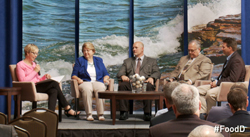
FD Toledo Panel 1

From left to right: Gail Hogan, retired Emmy award winning broadcast journalist; Sandy Bihn, president, Toledo Lighthouse Society and executive director, Lake Erie Waterkeeper Inc.; Chuck Campbell, acting commissioner of water treatment, city of Toledo; Rich Nachazel, president, Destination Toledo, Inc,; and Adam Sharp, vice president of public policy, Ohio Farm Bureau Federation

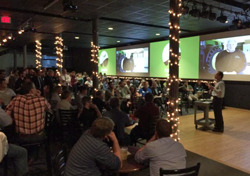
All things water were discussed this morning during the Food Dialogues: Toledo event. On August 2, 2014 a toxic algal bloom caused nearly 500,000 people to be without water. The event led to discussions around how to balance the need for clean water with the need for food. The conversation was continued through two panel discussions with the first panel, “Lessons from Toledo Water Crisis,” moderated by Gail Hogan and featuring Sandy Bihn, president, Toledo Lighthouse Society and executive director, Lake Erie Waterkeeper Inc.; Chuck Campbell, acting commissioner of water treatment, city of Toledo; Rich Nachazel, president, Destination Toledo, Inc,; and Adam Sharp, vice president of public policy, Ohio Farm Bureau Federation.

The panelists noted that the event brought water issues to the forefront of consumers’ minds while Nachazel noted it brought a black eye to the state and efforts are being made to counter the issue with positive images and information. And its working. Interestingly, he noted that $12.9 billion dollars come in to the state via tourism and 28 percent of these funds raised by eight counties surrounding Lake Erie so it is imperative they keep the lake healthy.

While water emergency plans were in place prior to the issue, it brought to light some areas that could be better addressed. Today Campbell said his organization has updated preparedness plans, and revised operating procedures along with implementing other measures. While Biln noted that they learned testing needed to be improved, she believes this has largely been solved through collaborative efforts among all industries that play a role in water quality.

But all panelists noted that more work needs to be done and there needs to be more funding to conduct extensive, ongoing research.

An important user of water is the agricultural industry and as Jack Fisher, executive vice president of the Ohio Farm Bureau Federation pointed out, the Ag industry is often accused of causing water quality issues. While he acknowledged that agriculture plays a role, there are other factors including those noted by John Knights, executive director for the Nature Conservancy, septic systems and water treatment facilities.

FD Toledo Panel 2 -2

From Left to Right: Gail Hogan, retired Emmy award winning broadcast journalist; Jack Fisher, executive vice president, Ohio Farm Bureau Federation; Josh Knights, executive director, The Nature Conservancy in Ohio; Jay Martin, lead faculty for the Global Water Initiative and the Field to Faucet Program, Ohio State University; and Terry McClure, vice chairman, Ohio Soybean Council Board

The two were joined by Jay Martin, lead faculty for the Global Water Initiative and the Field to Faucet Program, Ohio State University; and Terry McClure, vice chairman, Ohio Soybean Council Board in the second panel, “Balancing the Food and Water Question”.

The panel agreed that everyone was working together and the process was going well but that it must be an ongoing effort- there is still much to learn. For example, Martin said their research is looking at ways to improve processes and much of this is being done directly with the help of farmers. Today, said McClure, there are 32 sites doing field testing. “As we make adjustments, we will better understand how we can improve,” said McClure.

In the efforts among the Ag industry, money has not been a barrier. Fisher said they have received federal and state funding and the state’s Ag industry has allocated $2 million for water quality research because the industry knows that research is a major component of solutions.

You can watch a replay of both panels here.

Agribusiness, Environment, Food, USFRA, Water

Growing the Farmers Business Network

Chuck Zimmerman

ZimmCast 476In a very short amount of time the Farmers Business Network (FBN) has not only registered a lot of farmers as members but also millions of acres. This means there is a big and growing amount of data in the system.

fbnIn this week’s ZimmCast you can listen to Charles Baron, co-founder, talk about what the Farmers Business Network has been created to do. He also talks about the recent $15 million in funding the company has received, led by Google Ventures. The company has caught the eye of some serious Silicon Valley investment! Charles is pictured below.

FBN Farmer Launch Party in Davenport, IA.

FBN Farmer Launch Party, Davenport, IA.

FBN intends to use the new funding to grow its platform nationally and work with more farmers. “Farmers have been advising each other for thousands of years. FBN gives them a platform to do so with real information on a massive scale, so they can make the most informed decisions,” said FBN Co-Founder Charles Baron. “This funding will allow us to reach even more farmers in more crops, so they can make the best decisions for their land.” Charles says they’re holding a series of launch parties across the corn belt right now to introduce themselves to more farmers.

Charles BaronA unique element of FBN is the independent nature of their network which provides data from real farmers solely for member use and their advisors. Right now the network has been focused on the midwest but with expansion plans it will soon be coast to coast and perhaps in the future, worldwide.

One FBN member says:

“FBN is exactly what I was looking for,” said Steve Pitstick, a farmer in Maple Park, IL. “It gives me the ability to see information from top producers on so many more acres so I can learn quicker and make decisions with more confidence.”

Here’s what FBN members get:

  • advanced analytics
  • comprehensive yield benchmarking
  • real world seed performance
  • matching on over 490 varieties
  • practice analytics and more

FBN can integrate over 35 different formats of farm data. They will clean and standardize it and then network thousands of fields together. In just six months, FBN has analyzed 7 million acres of data in the United States, and has been growing at 30% per month.

Farmers can become a member of FBN by registering online for a simple $500 annual fee.

Learn more about Farmers Business Network in this week’s program: Farmers Business Network

Subscribe to the ZimmCast podcast here.

The ZimmCast

sponsored by
The ZimmCast podcast is sponsored by GROWMARK
Locally owned, globally strong.
Agribusiness, Audio, data, Farming, Precision Agriculture, ZimmCast

Antimicrobials in Livestock – A Thing of the Past?

Jamie Johansen

rebelation15-172Dr. Karl Dawson, Chief Scientific Officer and VP at Alltech, talked antibiotics at the recent REBELation in the beef breakout session. Companies like McDonald’s and Costco have said no to antibiotics. Is it time for the industry to be a REBEL and say no too?

“The term antibiotic is somewhat controversial. I prefer to talk about antimicrobials. The use of antimicrobials has been around in livestock since the 1940’s. It is something we have used to address diseases, cure bacterial infections, but the most controversial part of that has been to use them as materials to enhance growth in livestock.”

“The big concern about using those right now has been the progressive change or selection of bacteria that resist the antimicrobial.” Dr. Dawson said that the thought process behind this is we are propitiating it by continuing to use antimicrobials in livestock. He added that we should have known this we going to happen years ago and the banning of antimicrobials will change the industry because they have been relied upon for so long.

There are alternatives. But there isn’t a one-size fits all package to replace them. “It is going to be a thought process; a management process that will need to take place.” Dr. Dawson also stated that a simple ban may not be the answer to our problems. “The antibiotic resistance bacteria that are out there have been selected for and we will not eliminate those by simply stopping the use today.”

In the long-term, he said the industry needs to look at strategies that not only limit the development, but also depress antibiotic resistant bacteria and select against them.

Listen to my complete interview with Dr. Dawson to learn more about antimicrobials here: Interview with Dr. Karl Dawson, Alltech

Don’t forget to check out photos from the event here: 2015 Alltech REBELation Photo Album

Agribusiness, Alltech, Audio, Livestock

Toledo Food Dialogues Focused on Water

Cindy Zimmerman

toledo-food-dialoguesAre you watching Food Dialogues: Toledo?

EPA Administrator Gina McCarthy mentioned the Toledo water crisis last year in her announcement yesterday on the final Waters of the United States (WOTUS) rule to point out the importance of clean water to industry. The question being addressed during today’s U.S. Farmers and Ranchers Alliance Food Dialogues is “How do we balance our need for clean water with our need for abundant food?”

The first panel is on now, the next one will start at 11:00 am Eastern, and both include representatives from Ohio agriculture talking about what farmers are doing to address nutrient management and water quality.

Tune in now with live stream from Ohio Farm Bureau.

USFRA, Water

Pharmacist is New Holland ‘Next Gen’ Finalist

John Davis

New Holland Voice of the Next GenA pharmacist from Canada might not know a lot about blue tractors, but she knew enough about the song to be a New Holland Voice of the Next Gen Contest winner. Melinda Lee is from Moose Jaw, Saskatchewan, and was turned on to the contest by a Facebook friend.

melinda1“They didn’t want to sing themselves, so they sent it to me,” she laughed, admitting she knew the song quite well. “I’ve heard it on the radio quite a few times.”

Good thing her friend did, because after Melinda made her video on her iPhone, she was one of the five finalists in the contest and traveled to Hershey, Pennsylvania, to meet Tyler Hubbard and enjoy a Florida Georgia Line concert.

As a pharmacist, she admitted she might not have a lot of use for a big blue tractor, but she said she could always use one.

You can listen to Chuck’s interview with Melinda here: Interview with Melinda Lee

New Holland Voice of the Next Gen Photo Album

Agribusiness, Audio, New Holland

Agriculture Reacts to WOTUS Final Rule

Cindy Zimmerman

Agricultural organizations are analyzing the final Clean Water Act Waters of the U.S. (WOTUS) rule released today to determine whether it answers the concerns they have raised about the impact the regulation would have on farmers and ranchers, but most express reservations.

afbf-logo“We are undertaking a thorough analysis of the final WOTUS rule to determine whether the Environmental Protection Agency listened to the substantive comments farmers and ranchers submitted during the comment period,” said American Farm Bureau president Bob Stallman. “Based on EPA’s aggressive advocacy campaign in support of its original proposed rule—and the agency’s numerous misstatements about the content and impact of that proposal—we find little comfort in the agency’s assurances that our concerns have been addressed in any meaningful way.”

nfu-smallNational Farmers Union president Roger Johnson believes the final rule is an improvement over the proposed rule. “The final rule puts bright-line limits on jurisdiction over neighboring waters, offering farmers increased regulatory certainty and mitigating the risk of enforcement or litigation,” said Johnson, adding that it also “provides more clarity on which ditches fall under the Clean Water Act jurisdiction.” However, Johnson says they “remain concerned about waters that cannot impact the quality of jurisdictional waters will fall under jurisdiction, or that farmers will not have the regulatory certainty they need to address these waters appropriately.”

NCGA-LogoNational Corn Growers Association president Chip Bowling of Maryland says they will be fully review the final rule. “We especially want to ensure that the broad promises made in the EPA press release are carried out in the text of this comprehensive rule,” said Bowling. “We especially will look closely at how on-farm ditches, ponds and puddles are treated in the rule.”

The American Soybean Association will also be reviewing the rule for the same reasons but the National Cattlemen’s Beef Association strongly condemned the final rule, saying it “unilaterally strips private property rights” and is a “flawed rule … from a flawed process.”

AFBF, EPA, NCBA, NCGA, Water

Lights! Camera! YouFarm!

Cindy Zimmerman

youfarmYouFarm International wants to make you and your farm a star!

You’re already wearing many hats – why not become a movie director, too? You can show the world how you and your family live and work on your farm. Be creative – there are no rules about what or how you film true to this year’s motto of YouFarm: Farm ’n’ Family. Submit your video to our competition and, if you win, you’ll be off on an inspiring trip to Asia. So get yourself organized – and …action!

The international video competition for farmers is calling for entries until June 15 for a chance to win the grand prize – the Farmers around the Continent Tour! “You and your companion will travel through Asia and visit farms and other great sites. The prize will cover flights, visas, transfer services, accommodation, and much more! Broaden your horizons and become inspired by fellow farmers from around Asia!” They have other cool prizes too.

What do you have to lose?? It is an international competition, so let’s see if we can get the most entries from the USA!

Farming, International

Administration Finalizes WOTUS with Few Changes

Cindy Zimmerman

epa-army-corpsThe U.S. Environmental Protection Agency and the U.S. Army finalized the Clean Water Rule that has become known as the Waters of the United States or WOTUS.

According to EPA, the rule “ensures that waters protected under the Clean Water Act are more precisely defined and predictably determined, making permitting less costly, easier, and faster for businesses and industry.”

The rule is grounded in law and the latest science, and is shaped by public input. The rule does not create any new permitting requirements for agriculture and maintains all previous exemptions and exclusions.

Outlining specifics, the press release on the action addresses several areas of concern to the agriculture community, including the regulation of ditches. “The rule limits protection to ditches that are constructed out of streams or function like streams and can carry pollution downstream. So ditches that are not constructed in streams and that flow only when it rains are not covered.”

In addition, EPA states that: The rule protects clean water necessary for farming, ranching, and forestry and provides greater clarity and certainty to farmers about coverage of the Clean Water Act. Farms across America depend on clean and reliable water for livestock, crops, and irrigation. The final rule specifically recognizes the vital role that U.S. agriculture serves in providing food, fuel, and fiber at home and around the world. The rule does not create any new permitting requirements for America’s farmers. Activities like planting, harvesting, and moving livestock have long been exempt from Clean Water Act regulation, and the Clean Water Rule preserves those exemptions.

Listen to EPA administrator Gina McCarthy and Assistant Secretary of the Army for Civil Works Jo-Ellen Darcy announced the final rule here: Final WOTUS rule announcement

Response from agricultural organizations so far has been mainly that they need to review the final rule before making comments.

Audio, EPA, Water

Alltech Answers Fish Oil Shortage Dilemma

Jamie Johansen

rebelation15-98-editedIt is hard to find a more diverse company than Alltech. At their recent REBELation, breakout sessions covered topics from digital media to aquaculture. Headlining discussion on algae was, Becky Timmons, Director for Applications Research and Quality Assurance for Alltech Algae. She started with Alltech 30 years ago and also has a very diversified background. She has been everything from a lab technician to head of the flavor and now into the world algae.

rebelation15-5-editedBecky quoted Rick Barrows, USDA, who said finding a replacement for fish oil would be like the ‘holy grail’ for the aquaculture industry. “In our bid to feed more people a high quality protein and as we have a growing population, everyone is expecting the aquaculture industry to really grow.”

She explained that there is a stagnant amount of fish oil available, about 1 million tons. Consumption is right at the amount as well. If aquaculture needs to grew, so does the production of fish oil. The human population is also consuming more fish oil than every before.

Alltech has the answer. “We are producing an algae that is about 70% fat and very high in DHA. We have done work in both trials and commercial to show that we can successfully replace the fish oil. The fish eat it very well and you actually see nutritional benefits to the fish. And that fillet quality is still just as good, preferred in sensory testing and has the healthy fatty acid profile that we need.”

Trials have shown that this method is cost-effective for producer and consumer and Becky believes we are going to see a great shift of algae use soon. Listen to my complete interview with Becky to learn more about Alltech’s algae production here: Interview with Becky Timmons, Alltech Algae

Don’t forget to check out photos from the event here: 2015 Alltech REBELation Photo Album

Agribusiness, Alltech, Aquaculture

Meet Another Voice of the Next Gen Contest Winner

Jamie Johansen

New Holland Voice of the Next GenIt’s time to meet another of the New Holland Voice of the Next Gen Contest winners. Shawna Starbird hails from Nashville, TN and found out about the contest from Facebook, but almost missed the deadline to enter. With three hours to spare she got her video uploaded and it paid off. Shawna said the New Holland peeps went all out for her and the other winners and was thrilled to have this once in a life-time experience.

shawna“I love singing. I love music. It’s something that has pretty much been my whole life. It’s my one love I will never be able to shake.”

She is a huge fan of Florida Georgia Line and swears she saw Tyler Hubbard in Nashville traffic recently. Along with be a country music fan, Shawna has played in a few bands over the years, has served as a worship leader intern and is in the middle of co-writing a few songs. “I am looking to meet as many people as possible and see what type of opportunities there are for me in Nashville.”

You can listen to Chuck’s interview with Shawna here: Interview with Shawna Starbird

New Holland Voice of the Next Gen Photo Album

Agribusiness, New Holland