FFA State Officers Return from South Africa

John Davis

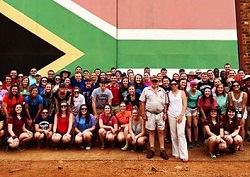
ffa-ilsso1Seventy-five FFA members from 23 states have returned from a 12-day educational and cultural experience in South Africa. This news release from the group says they participated in the 2016 International Leadership Seminar for State Officers, an experience that allows FFA members to experience foreign culture, learn about international agriculture and become more knowledgeable of the global marketplace.

The group traveled throughout five of the country’s nine provinces while surveying the agricultural landscape. FFA officers met with government and U.S. Embassy officials to learn about U.S.- South African trade relations, toured crop and livestock operations, met with business and industry leaders and explored a private game reserve, which is home to lions, leopards, elephants, rhinos and buffalo. The group also met with fruit exporters and olive oil producers and much more.

“This seminar exposes students to culture and food production practices beyond what they are accustomed to in the United States,” said Shane Jacques, education specialist with the National FFA Organization. “Our hope is that through a structured experience like ILSSO, these students will see that study abroad opportunities or global internships and careers are not only attainable, but essential to providing a sustainable talent pipeline for agriculture and feeding the world.” Jacques added that, on average, nine out of ten students who participate in the program admit that they would be receptive to living and working abroad as a result of this experience.

Prior to departing the United States, the students completed ten weeks of online coursework related to cross-cultural adaptability. The program was made possible by corporate sponsors Bunge North America and John Deere.
Ag Groups, FFA, John Deere

#SHPSummit16 Hears From Indiana Farmers

Taylor Truckey

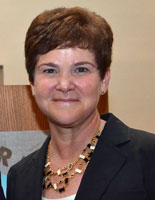
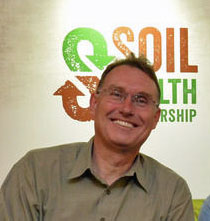
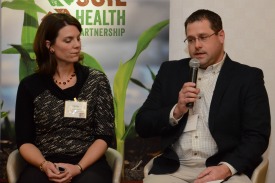
Carrie Sanders, left, shown with her husband, right

Carrie Sanders, left, shown with her husband, right

Carrie Volmer-Sanders farms with her husband and parents in Northeast Indiana/Northwest Ohio, and they have implemented cover crops on their farm for about 5 years now. Sanders works for The Nature Conservancy which is where she first heard about the project.

“There are a couple of goals being a part of this. Some include sharing the information with local farmers about the Soil Health Partnership and using cover crops; having them touch, feel, and see what they can do for the soil and what they can do for farms.” The Sanders’ family farm was one of the first involved and got started with SHP in 2014. A sentiment echoed between many of the demo farmers is the excitement for what they’re going to see take place in their fields over the next few years and how they can share that insight with other growers.

“We can share the data with other farmers about look, this is what it’s done for the microbes, this is what it’s done for the yields, it’s done this for our investment.” The Sanders’ farm has shared yield data the last few years to help show the potential of implementing cover crops. Carrie is excited about working with AgSolver to aggregate the data collected through the project to really understand it and to be able to share that information with interested growers.

Mike Buis

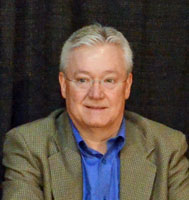
Mike Buis

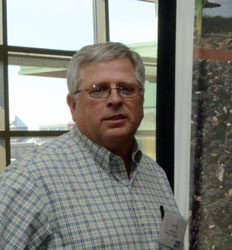
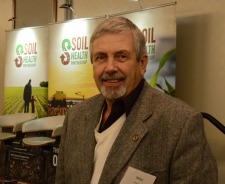
Mike Buis is looking forward to what the next few years will bring as he learns from the members of the Soil Health Partnership and fellow demo farmers. “Listening to a lot of the speakers today, we’re looking at the economic value, we’re looking at saving the soil, and we’re looking at different cover crop variations.”

Buis hasn’t had a lot of experience with cover crops as of yet, but has been researching and reading about the possibilities with implementing cover crops. “I’ve been reading about it and have other friends who have tried it, liked it, and have improved their yields on a lot of their marginal ground. We have real good ground, we have some marginal ground, and we have overflow ground. We’re trying to improve our soil.”

Buis’ farm in Central Indiana had 8 inches of rain in June and 8 inches of rain in July so they experienced a loss of nitrogen and soil. Buis elaborated, “If we want to hand this ground to our younger generations, then we need to protect it.”

Mike signed up in 2015 and is excited to hit the ground running in 2016 as they start planning.

Listen to the rest of Carrie’s interview: Interview with Carrie Sanders, The Nature Conservancy

Listen to the rest of Mike’s interview: Interview with Mike Buis, Indiana Farmer

2016 Soil Health Summit Photo Album

Conservation, cover crops, Farming, Research, Soil, Soil Health Partnership, Sustainability

Soil Health Stewardship Program Benefits Growers

Taylor Truckey

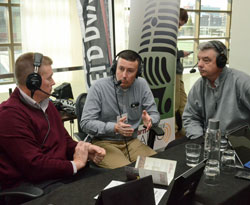
Illinois farmer David Brown (R) and another SHS participant on AgriTalk

Illinois farmer David Brown (R) and another SHS participant on AgriTalk

While at the Soil Health Summit, David Brown, a farmer from Illinois, spoke with AgWired about his involvement in the Soil Health Partnership Stewardship Program.

“We’re learning so much from it,” said Brown. “When the opportunity presented itself, I thought ‘we have to do this’. It’s a learning opportunity for us and if you don’t learn, you’re standing still.”

Brown is involved in the Conservation Stewardship Program with the USDA in addition to the Soil Stewardship Program and says the stewardship program is a true partner in the research and data collection that comes out of the field trials.

When asked about what he looked to gain from the program, Brown said, “I hope to find out that we should have been doing this all along. This is not new.” As a young child he asked his father why there were drilling alfalfa seed on a certain field. Even then, he was hearing words like fertility, soil health, and other benefits like getting a crop off as well with cover crops. “I hope we find out that this is what we should have been doing all along; improving our assets.”

Central Illinois land values have climbed over $13K/acre and Brown offered a unique look at why farmers should place value on soil health in their operations. “Where the farmstead sits, that 80 acres is worth over $1M. When you get your envelope from the stockbroker every month you open that to see how your stocks and assets did. Every day we on television we hear how NASDAQ and Dow Jones are doing, yet we walk across that farm and we don’t think about what is underneath our feet and the asset that is there. How am I taking care of that? Am I improving it? Am I making it worth that 13K/acre? It’s an asset, and I’m here to learn if this is what we need to be doing,” he explained.

Brown emphasized that the partners in the Soil Stewardship Program are knowledgeable and more than willing to share their experiences and information. David encouraged growers to try a few acres if they were unsure. “Just see what you can do. It’s kind of fun to watch things green at a time of year when things shouldn’t be green.”

Learn more in this interview: Interview with David Brown, Illinois Farmer

2016 Soil Health Summit Photo Album

Farming, Soil, Soil Health Partnership, Sustainability

Deputy Secretary Harden to Leave USDA

Cindy Zimmerman

hardenUSDA Deputy Secretary Krysta Harden today announced plans to depart the agency at the end of next month.

“Today is bittersweet for me as I announce my decision to step down as Deputy Secretary at the end of February,” said Harden in a statement. “I am proud of what our Department has accomplished since 2009 to bring economic opportunity that will help rural America thrive for generations to come. And although I will not be part of the many great and transformational things USDA will accomplish over the next year, I am more committed than ever to USDA’s mission. We have worked hard over the past seven years to make USDA truly the People’s Department, as demonstrated by this Administration’s commitment to bring young people, women, veterans and equal access to the forefront of food and agriculture policy.”

Harden thanked President Obama and Secretary Vilsack “for the opportunity to be part of their team” but made no mention of what she intends to do when she leaves the post. Since 2009, Harden has held USDA leadership positions as Assistant Secretary for Congressional Relations and Chief of Staff to the Secretary and was was sworn in as the Deputy Secretary on August 12, 2013. “My work at USDA on behalf of our farmers, ranchers, producers and rural communities has been the greatest honor of my professional life,” Harden concluded in her statement.

Agriculture Secretary Tom Vilsack announced today that Michael Scuse, the current Under Secretary for Farm and Foreign Agricultural Services (FFAS), will serve as Acting Deputy Secretary of Agriculture upon Harden’s departure. ” I speak for thousands of colleagues across the USDA, the federal family, and our nation’s food and agriculture sector, when I say she will be missed. I appreciate her service and wish her well in her future endeavors,” said Vilsack.

USDA

#SHPSummit16 Focuses On Field Research

Taylor Truckey

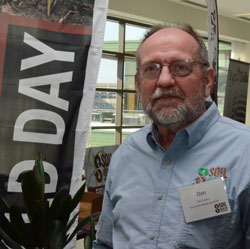
shs16-toweryThe Soil Health Partnership knows that further research is needed to show farmers the benefits of soil health. Dan Towery, Field Manager with the Soil Health Partnership in Indiana, spoke with Chuck Zimmerman at the Soil Health Summit this week in Indianapolis about the purpose of the Summit as well as the field research trials they are currently conducting.

“We’re going to discuss with growers, university folks, and folks from the private sector, this whole idea of soil health,” said Towery. “We’re looking at the whole gamut; the agronomic, the economic, and the environmental pieces and how they all fit together. The whole idea is to give growers the assistance that they need to make some of these changes in their production.”

With commodity prices being low, growers are looking at how to best manage costs while keeping inputs low, and Towery acknowledged that there can be added expenses when focused on improving soil health, but there is also opportunity and money to be made.

The Soil Health Partnership has multiple demo farms where they have replicated strip plots in partnership with local growers. The growers decide what they want to compare. Typically, most are looking at a conventional tillage system compared to no-till with cover crops. Over a 5 year effort, SHP will track inputs and management decisions and by the end, SHP hopes to be able to show that farmers increased their profit margins and relate it back to what happened in the soil. An example of factors they will be monitoring are increasing the active organic matter portion and improving filtration.

Field-size strip plots and weather inconsistencies allow for error in a given year; devoting five years to the replicated research projects will allow for a better synopsis of the impact of soil health. The demo fields are from 20 to 80 acres in size with 8 strips total, 4 control and 4 adaptive management.

Learn more in this interview: Interview with Dan Towery, Soil Health Partnership

2016 Soil Health Summit Photo Album

Audio, Soil, Soil Health Partnership

The Nature Conservancy Supports Soil Health

Cindy Zimmerman

shs16-clemensThe Nature Conservancy (TNC) provides technical support for the Soil Health Partnership (SHP), and it’s something that fits in well with the organization’s mission “to conserve the lands and waters on which all life depends.”

“The Nature Conservancy has been working in agriculture for several decades,” says Larry Clemens, TNC North American Agriculture Program Director. “We’ve been wanted to scale up our partnerships and our collaborations, so when the Soil Health Partnership was forming it was a great opportunity … to get good information and good science out to growers in the Midwest about soil health practices.”

Clemens adds that soil health is a global priority for TNC. “We really see in the future that soil health is going to be key to increasing our production and feeding the world,” he said during an interview at the second Soil Health Summit this week in Indianapolis.

The SHP is a true partnership between environmental interests like TNC, farmers through the National Corn Growers Association, and industry with funding from Monsanto and The Walton Family Foundation, and Clemens says it has long term implications for the future. “As we think about feeding our world, soil is truly the foundation and when it’s not healthy, the rest of our ecosystem is likely not going to be healthy,” he said.

Listen to Chuck’s interview with Larry here: Interview with Larry Clemens, The Nature Conservancy

2016 Soil Health Summit Photo Album

Audio, Corn, Environment, NCGA, Soil, Soil Health Partnership

Soil Health From the Ground Up #SHPsummit16

Cindy Zimmerman

The Soil Health Partnership (SHP) is not even two years old yet, but already the group has made some great strides in learning more about soil health to share with farmers.

shs16-kokHans Kok is a field manager for SHP in Indiana, where the second Soil Health Summit is being held this week. “We’re setting up a network of demonstration farms across the Midwest,” Kok says. “We are challenging farmers to change their soil management practices.”

Kok says the goal is to get soils back to where they should be to use less inputs and get higher yields. “We’re finding farmers who are farming in a fairly conventional way and we challenge them to take one field of 50 or 80 acres and put four replicated strips in there with a new practice,” he said. “For the next five or more years, we’ll keep track of what’s happening in those strips compared to what the farmer is doing currently.”

SHP is collecting both economic and field data, with extensive soil sampling and aerial photography. “We’re putting all this together for farmers as a management tool for the future,” Kok explained.

At the summit in Indianapolis, Kok says they are talking about some of the results they have collected so far, hearing from experts, providing soil demonstrations, and having small group discussions.

Learn more in this interview: Interview with Hans Kok, Soil Health Partnership

2016 Soil Health Summit Photo Album

Audio, Corn, Farming, NCGA, Soil, Soil Health Partnership

Planting Predictions for 2016?

Jamie Johansen

New Holland ZimmPollOur latest ZimmPoll asked the question, “What do you think of new dietary guidelines?”

Referring to the new Dietary Guidelines for Americans, many of those who took our recent poll feel nothing has really changed from past dietary guidelines and even more simply don’t care.

Here are the poll results:

  • Fair – 0%
  • Nothing new – 37%
  • Good news – 0%
  • Disappointed- 0%
  • Who cares? – 63%

Our new ZimmPoll is now live and asks the question, What’s your planting intentions prediction for 2016?

Planting season is getting closer and with lower prices and farm income down, the question is what will be planted this year? We’ll just focus on corn and soybeans and ask, what do you think?

ZimmPoll

Soil Health Summit Starts Today

Chuck Zimmerman

Soil Health PartnershipMy current home is the Alexander in Indianapolis where the Soil Health Partnership is about to kick off the 2016 Soil Health Summit. Cindy attended the first one last year. It’s my turn this year.

I’ll be sharing interviews with staff, supporters and farmer who are participating in the organization’s work. Here’s what the SHP 5 year initiative says:

Over the next five years, we plan to identify, test and measure management practices that improve soil health and benefit farmers’ operations. Right now, many farmers across the country are implementing innovative management practices that result in economic and environmental benefits. We plan to build upon the work of these farmers to provide connections between on-farm practices and improving soil health.

We believe the results of this farmer-led project will provide a platform for sharing information from farmers to farmers, with the support and resources to benefit farmers’ bottom lines and agricultural sustainability. We want to help provide the spark for greater understanding and more broadly implementing agricultural practices that work best.

Photos from the event can be found here: 2016 Soil Health Summit Photo Album

The Soil Health Partnership is a National Corn Growers Association Initiative, with Initial Support From Monsanto and The Walton Family Foundation and With Technical Support From The Nature Conservancy

Ag Groups, Conservation, Environment, NCGA, Soil, Soil Health Partnership

New Sustainability Initiative by @GROWMARK

Cindy Zimmerman

growmark-worldOne of the definitions of sustainable is “able to endure or continue for a long time” and that is the main characteristic that GROWMARK has chosen to focus on with a new system sustainability initiative.

GROWMARK Executive Director of Agronomy Marketing Ron Milby says the initiative fits in with the cooperative’s overall goals. “Our mission statement is ‘To improve the long-term profitability of our member-owners’ and I think with sustainability we can actually get there,” said Milby. “That’s why we’ve created a program called ‘ENDURE’ – what are the enduring management practices that keep our farmers profitable long term.”

growmark-milbyOne aspect of the new initiative is ENDURE Advocates for GROWMARK FS crop specialists. “What we’re trying to do with this advocate program is recognize and award those crop specialists that are doing a good job promoting sustainable business practices,” Milby explained.

Promoting pollinator health is also part of the ENDURE initiative, which has already been very successful, and they are working on other ways the concept of enduring sustainability will be promoted within the GROWMARK FS system and beyond. Sustainability is even the theme for GROWMARK’s 2016 Essay Contest for high school FFA members in Illinois, Iowa, Missouri and Wisconsin.

Learn more about GROWMARK’s sustainability initiative in this interview: Interview with Ron Milby, GROWMARK Agronomy

Agronomy, Audio, GROWMARK, Sustainability