
BASF Hosts Panel on Risk Management

Lizzy Schultz

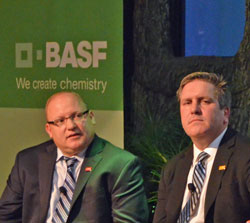
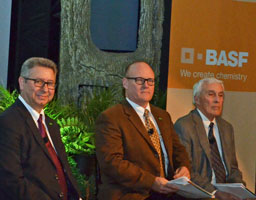
classic-16-basf-earlyriser BASF hosted an educational session at the 2016 Commodity Classic on the importance of managing risk in the current economy. Four panelists, all farmers and industry professionals, gave their perspective and offered producers advice on ways to make the best of the market.

“It’s really about how we can build partnerships in our operations that reduce risk,” said BASF’s Niel Bentley in an interview following the session. “When you’re thinking about who you’re doing business with, you need to attract the right people around your business, and find the partners that help you build the best possible plan.”

Listen to my full interview with Niel here:
Interview with Niel Bentley, BASF

One panelist, Ohio farmer Walker Gottfried, discussed the value of developing strong networks while managing risk on an operation.

“Developing networks is paramount to managing risk because it gives farmers control in this economy where this is no control,” said Gottfried. “In my opinion, the most important qualities to include in your network are trust, people that will challenge your thinking, and people that are knowledgable in areas that you may not be.”

Listen to my full interview with Walker here:
Interview with Walker Gottfried, Ohio Farmer

Travis Harrison, a corn, soybean and wheat farmer from Northwest Ohio, spoke about the four ways he works to manage risk, and how he has managed to incorporate all four factors through the creation of Green Field Ag, a precision ag company with several lines of precision equipment for sale, as well as custom strip-till services.

“We try to surround ourselves with people who know more than us about certain issues,” said Harrison. “It’s always helpful to have manufacturers to listen to you, to be able to help them potentially develop new products, and I really feel that everyone needs to have a GPS guru on their farm, so its nice to have a company at our farm to help with that.”

Listen to my full interview with Travis here:
Interview with Travis Harrison, Green Field Ag

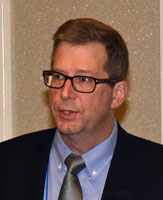
Brent Gloy, farmer, economist, and professor at Purdue University, spoke on the importance of cutting fixed costs as part of a successful risk management program, as well as his perspective on the current state of the economy.

“Its not the economic environment of 5-7 years ago, so risk management is really critical.” said Gloy. “The current mood in the industry is as negative as I’ve seen it in the past ten years, and i think it’s important to remember that this isn’t the end of the world, and we just need to go about it in a way that ensures that we’re in it for the long term future of agriculture, which, I think, remains really really bright.”

Listen to my full interview with Brent here:
Interview with Brent Gloy, Purdue University

2016 Commodity Classic Photo Album

BASF Science Behind Living Acres Photo Album

Coverage of Commodity Classic sponsored by
Coverage of Commodity Classic sponsored by BASF Coverage of Commodity Classic sponsored by New Holland
Ag Groups, Audio, BASF, Commodity Classic

“Thank a Consumer” At #Classic16

Lizzy Schultz

classic-16-usfra-2 The US Farmers and Ranchers Alliance (USFRA) has a strong presence at the 2016 Commodity Classic, using the event as an opportunity to talk to farmers and ranchers about their consumer programs, all of which are working to bridge the trust gap that exists between farmers and consumers.

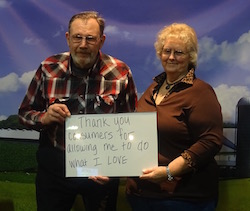
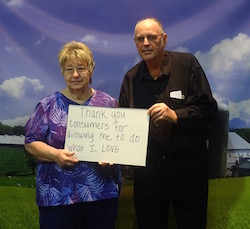
Farmers are encouraged to stop by the USFRA booth during the event to ‘Thank a Consumer,’ and express appreciation for the consuming public that helps to sustain farmers and ranchers’ livelihood and contribute to their overall profitability.

“Farmers as a whole have seen a lot of ‘thank a farmer’ programs, and I think they recognize that there is some value in that, but sometimes it has also felt a little self-serving,” said Randy Krotz, CEO of USFRA, at an interview during the 2016 Commodity Classic, “We thought it was very appropriate that we recognize consumers and thank them for their partnership in food, and farmers have been welcoming the campaign with open arms.”

classic-16-usfra-3 The campaign intends to showcase the partnership that exists between consumers and producers, though it may not always be visible at the surface. It also serves as an opportunity to create valuable dialogue about the topics that matter to consumers while allowing farmers to have a more active role in the social spaces that agriculture has become so disconnected from.

“We want to activate farmers and get them more active in social spaces,” said Krotz. “When folks like the Humane Society of the United States (HSUS) want to activate the public, they can turn on ten thousand people very quickly, but agriculture has trouble doing that, which is why we need to keep the focus on growing the digital audience for agriculture.”

Listen to my full interview with Randy here:
Interview with Randy Krotz, USFRA

2016 Commodity Classic Photo Album

Coverage of Commodity Classic sponsored by
Coverage of Commodity Classic sponsored by BASF Coverage of Commodity Classic sponsored by New Holland
Ag Groups, Audio, Commodity Classic, USFRA

Ribbon Cutting for #Classic16

Chuck Zimmerman

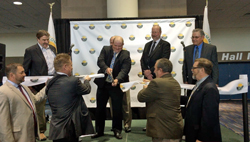
Commodity Classic Ribbon CuttingIt’s official. The ribbon has been cut and Commodity Classic is underway in the Big Easy.

Just before noon today, leaders of the groups that make up Commodity Classic made welcoming remarks before cutting the ribbon. According to the most current statistics another record crowd is on hand at 9,509. More will probably walk in.


2016 Commodity Classic Photo Album

Coverage of Commodity Classic sponsored by
Coverage of Commodity Classic sponsored by BASF Coverage of Commodity Classic sponsored by New Holland
Ag Groups, Commodity Classic, Video

Record Setting #Classic16 Underway

Lizzy Schultz

classic16The AgWired team is in New Orleans this week (again) for the 2016 Commodity Classic.

2016 is set to be the biggest and best year for the farmer-led event established in 1996, with a record number of registered attendees and the biggest trade show in the event’s history. From the trade show booths to breakout sessions, virtually every part of Commodity Classic is setting new standards this year.

“I really don’t know where to start. Everything from the educational sessions to the Evening of Entertainment to the trade show is bigger and better,” said Commodity Classic Co-Chair Sam Butler, a soybean farmer from Alabama. “This is also the first time Commodity Classic has been in New Orleans, and that takes the excitement level up a few notches as well.”

The Association of Equipment Manufacturers is also participating in this year’s Commodity Classic, adding considerable excitement and participation from leading equipment companies, including a number of short line manufacturers. “In the past we’ve had about 250,000 to 300,000 square feet of trade show space. We have 600,000-plus square feet for the trade show this year,” said Commodity Classic Co-Chair Wesley Spurlock, a corn farmer from Texas. “With the addition of the Association of Equipment Manufacturers this year, we’ve seen many big equipment companies triple the size of their footprint for 2016.”

Spurlock is especially excited about the Classic charity partnerships this year with Second Harvest and Roots of Music and he urges all attendees – or those unable to attend – to make a contribution this week. Just click here.

Learn more in this interview: Interview with Wesley Spurlock, NCGA First Vice President

2016 Commodity Classic Photo Album

Coverage of Commodity Classic sponsored by
Coverage of Commodity Classic sponsored by BASF Coverage of Commodity Classic sponsored by New Holland
Ag Groups, Agribusiness, Audio, Commodity Classic

UNL and AgIsAmerica Host Twitter Town Hall

Kelly Marshall

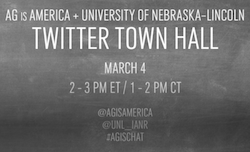
Twitter town hallThe University of Nebraska-Lincoln’s Institute of Agriculture and Natural Resources (UNL-IANR) and  Agriculture is America (AgIsAmerica) are partnering together to host a Twitter Town Hall on Friday, March 4th from 2 pm – 3 pm ET/ 1pm – 2pm CT.

Scientists, researchers, and Extension educators will answer questions regarding UNL-IANR’s role in the advancement of agricultural science and agricultural technological innovation. Specifically, experts will discuss the role of unmanned aerial systems in agriculture, water management, and nutrient management; how technology can be used to track foodborne illnesses; how consumers can reduce food waste; and groundwater availability and quality. UNL-IANR, a land-grant institution, is dedicated to the three-fold mission of researching, teaching, and Extension as well as “growing a healthy future through food, fuel, water, landscapes and people.”

Like a traditional town hall meeting, the Twitter Town hall will allow participants to ask questions.  To submit a question or follow the conversation, include the hashtag #agischat in your tweet.  All areas of agriculture, including friends and supporters, are invited to attend.  Participating Twitter handles are: @agisamerica and @UNL_IANR

Ag Groups, Education, Water

BASF Kicks Off #Classic16 with #LivingAcres

Cindy Zimmerman

Scott Kay and Paul Rea with BASF Crop Protection

Scott Kay and Paul Rea with BASF Crop Protection

Agricultural media heard from BASF Crop Protection executives Wednesday at the 10th annual Science Behind event, held prior to the start of the 2016 Commodity Classic in New Orleans. The event was held appropriately for the topic at the Audubon Butterfly Garden and Insecterium which helped showcase findings from a BASF biodiversity research initiative called Living Acres.

“Living Acres is our next step in sustainability to help farmers increase our ecosystem by helping the monarch butterfly flourish in the United States,” said BASF Crop Protection Vice President Scott Kay. “We see a real need for sustainability and how we live within the world that we’re trying to feed.”

Listen to Kay talk about BASF’s sustainability commitment here: Interview with Scott Kay, BASF

“Monarch butterflies are really iconic insects across North America,” said Paul Rea, Senior Vice President BASF Crop Protection North America. “What we’ve found through our research is that milkweed is critical as a habitat for them to make their migration each year… And we’ve identified ways that farmers could develop small areas to establish milkweed to provide that environment for monarch butterflies.”

This research is part of the $2 million BASF spends on research and development every day, not just on new products, but also on ways to improve the sustainability of agriculture. “We have a very long commitment to agricultural research to help farmers farm successfully today and in the future,” said Rea. That does include a strong crop protection pipeline which is expected to achieve peak sales of €3 billion for products launched between 2015 and 2025. “In North America that translates into about 50 new products between now and 2020,” said Rea.

Rea talks about some of the new BASF crop protection products expected to hit the market just this year in this interview: Interview with Paul Rea, BASF

BASF Science Behind Living Acres Photo Album

Coverage of Commodity Classic sponsored by
Coverage of Commodity Classic sponsored by BASF Coverage of Commodity Classic sponsored by New Holland
Audio, BASF, Commodity Classic, Crop Protection, pollinators, Research

BIVI Research Focuses on Evolution of PCV2

Joanna Schroeder

brian-paynePorcine circovirus Type 2 (PCV2) continues to evolve and was a hot topic during the American Association of Swine Veterinarians (AASV) that took place in New Orleans. There were several presentations on the virus and one was delivered by Dr. Brian Payne that focused on his PCV2 cross-production research. This is an important topic to producers, said Payne, because Boehringer Ingelheim Vetmedica (BIVI) has been hearing a lot in the industry that there have been changes to the virus including slight mutations.

“Our goal was to be sure these new strains are being cross protected with the vaccines. But we also needed to show that just in general, strains are changing in the industry,” Payne explained. “You can be reassured that even with those strains that there is still cross protection with CircoFLEX.”

During his presentation he also discussed how they are using surveillance programs to keep up with the emergence and discovery of new strains. Learn more in Chuck Zimmerman’s interview with Brian: Interview with Dr. Brian Payne, BIVI

eduardo-fanoBIVI’s Eduardo Fano was also at the AASV conference and he is the Technical Manager for the Flex family. He is an expert on the topics microplasma and PCV2. He explained that cross protection means the vaccine is not only able to prevent against the original virus strain, but also all the mutations of the strain.

“PCV2 is a hot topic right now because it’s not just the original virus moving around,” said Fano. “We have PCV2A and PCV2B’s and now we have PCV2D’s.” He added that BIVI is conducting studies not only in their R&D labs but also with universities such as University of Minnesota where they are identifying successful vaccination cases including those animals who have been exposed to other variations of the virus.

You can learn more about this research and PCV2 in Chuck Zimmerman’s interview with Eduardo: Interview with Eduardo Fano, BIVI

BIVI 2016 AASV Meeting Photo Album

Coverage of American Association of Swine Veterinarians annual meeting sponsored by Coverage of American Association of Swine Veterinarians annual meeting sponsored by Boehringer Ingelheim Vetmedica Inc.
Agribusiness, Audio, Boehringer Ingelheim, Swine

BASF Science Behind #LivingAcres

Jamie Johansen

The 10th annual BASF Science Behind media event prior to Commodity Classic this year was all about butterflies and research into establishing new habitat for these iconic insects and important pollinators.

basf-classic16-scienceDuring the Science Behind Living Acres, BASF announced first-year findings from a biodiversity research initiative focused on helping increase the iconic monarch butterfly population through establishing milkweed in non-crop areas. The research, conducted last year on the BASF Research Farm in North Carolina, provides best practices for establishing and maintaining the plants in non-production areas.

“Sustainability and biodiversity are two important areas of focus for BASF,” said Max Safarpour, Department Head, Director of Global Regulatory & Government Affairs, BASF. “Living Acres puts years of research and development experience to work to find a way for biodiversity to exist alongside modern agriculture.”

Listen to Safarpour explain more in this interview: Interview with Max Safarpour, BASF

LtoR - Max Safarpour and Luke Bozeman of BASF, NC State Professor Harold Coble

LtoR – Max Safarpour and Luke Bozeman of BASF, NC State Professor Harold Coble

BASF Field Biology Group Leader Luke Bozeman says they found that creating milkweed refuges will take an upfront investment of time, but once established it should support itself year after year with minimal effort.

“The solution will not happen overnight,” said Bozeman. “But the effort taken to improve monarch butterfly habitats will quickly make an impact.”

Bozeman talks about how farmers can plant milkweed on non-crop acreage: Interview with Luke Bozeman, BASF

BASF research found milkweed plants are most successful when established through a planting process using root sections. Though it is common to plant milkweed by seeding, only a small number of common seeds germinate. Planting root stock or buds results in the most successful establishment.

“Plants from root sections are much more vigorous than seedlings and will grow rapidly,” said Dr. Harold Coble, professor emeritus of the faculty of North Carolina State University. “They can easily reach up to six feet in height under good growing conditions.”

Under a grant from BASF, Dr. Coble identified seven steps for successfully establishing milkweed in non-production areas: seed/root, pot, plant, spread, water, grow and mow. While some areas of a farm may better support milkweed stands than others, this work focuses on non-cropland areas such as ditches, roadsides, alleyways and other border areas.

Dr. Coble explains more in this interview: Interview with Dr. Harold Coble, NC State

BASF Science Behind Living Acres Photo Album
Coverage of Commodity Classic sponsored by
Coverage of Commodity Classic sponsored by BASF Coverage of Commodity Classic sponsored by New Holland
Agribusiness, Audio, BASF, pollinators

PRRS Update at #AASV2016

Cindy Zimmerman

aasv-bivi-phillipsDr. Reid Philips is in an expert on Porcine Reproductive and Respiratory Syndrome (PRRS) who shared his knowledge in a presentation during the American Association of Swine Veterinarians conference in New Orleans. Phillips is a swine veterinarian in the Swine Health Division of Boehringer Ingelheim Vetmedica (BIVI) who serves as the Technical Manager for the PRRS virus. One of BIVI’s key products is its Ingelvac PRRS MLV, a modified-live PRRS vaccine that helps to protect the pigs against respiratory and reproductive symptoms of PRRS.

During his conference presentation, Phillips focused on a recent PRRS challenge dose study. It looked to evaluate the effect of challenged dose vaccinated pigs. He explained that challenge dose looks at vaccinates and non-vaccinates and then challenges them with an infectious dose of the PRRS virus and then measures the outcome. “So what this study compared is vaccinated pigs to non vaccinated pigs and then challenging those different groups with different levels of virus,” said Phillips.

Phillips said they learned that vaccinated pigs perform better than non vaccinated pigs. “The vaccine helps pigs mitigate the consequences of infection,” he said. For example average daily weight gain, saw the same performance as pigs that were not challenged.

More interestingly, pigs challenged with two logs or less performed equal to pigs that were not challenged. This is important for producers in that immunity matters. Pigs vaccinated who are challenged with the virus are performing as well as pigs who have never been exposed to the virus. “This is cool stuff,” added Phillips.

Learn more in this interview: Interview with Dr. Reid Phillips, BIVI

BIVI 2016 AASV Meeting Photo Album

Coverage of American Association of Swine Veterinarians annual meeting sponsored by Coverage of American Association of Swine Veterinarians annual meeting sponsored by Boehringer Ingelheim Vetmedica Inc.
Animal Health, Audio, Boehringer Ingelheim, Swine, Veterinary

Bayer All About the #AgVocate

Cindy Zimmerman

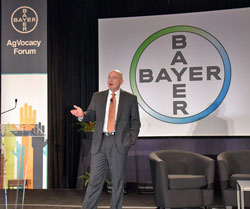
bayer-agvocate-davidThe name of the traditional pre-Commodity Classic Bayer event is different this year – it’s called the AgVocacy Forum and that’s the big focus – advocating for agriculture.

“We don’t have a choice and we’ve got to activate our voice and we’ve got to do it now,” said David Hollinrake, Bayer VP Marketing and Portfolio Management, starting off the main part of the program on Wednesday morning.

Hollinrake noted that there are several major drivers of change that will reshape agriculture, including issues such as population growth, automation of labor, growth in life sciences, reducing food waste, and shifting social values. “I’m confident you’re going to see a different agriculture in the future,” said Hollinrake.

Listen to David’s presentation here: David Hollinrake, Bayer AgVocacy Forum

Hear my interview with David here: Interview with David Hollinrake, Bayer

Bayer AgVocacy Forum Photos

Agribusiness, Audio, Bayer