Wyant Honored with Fellowship
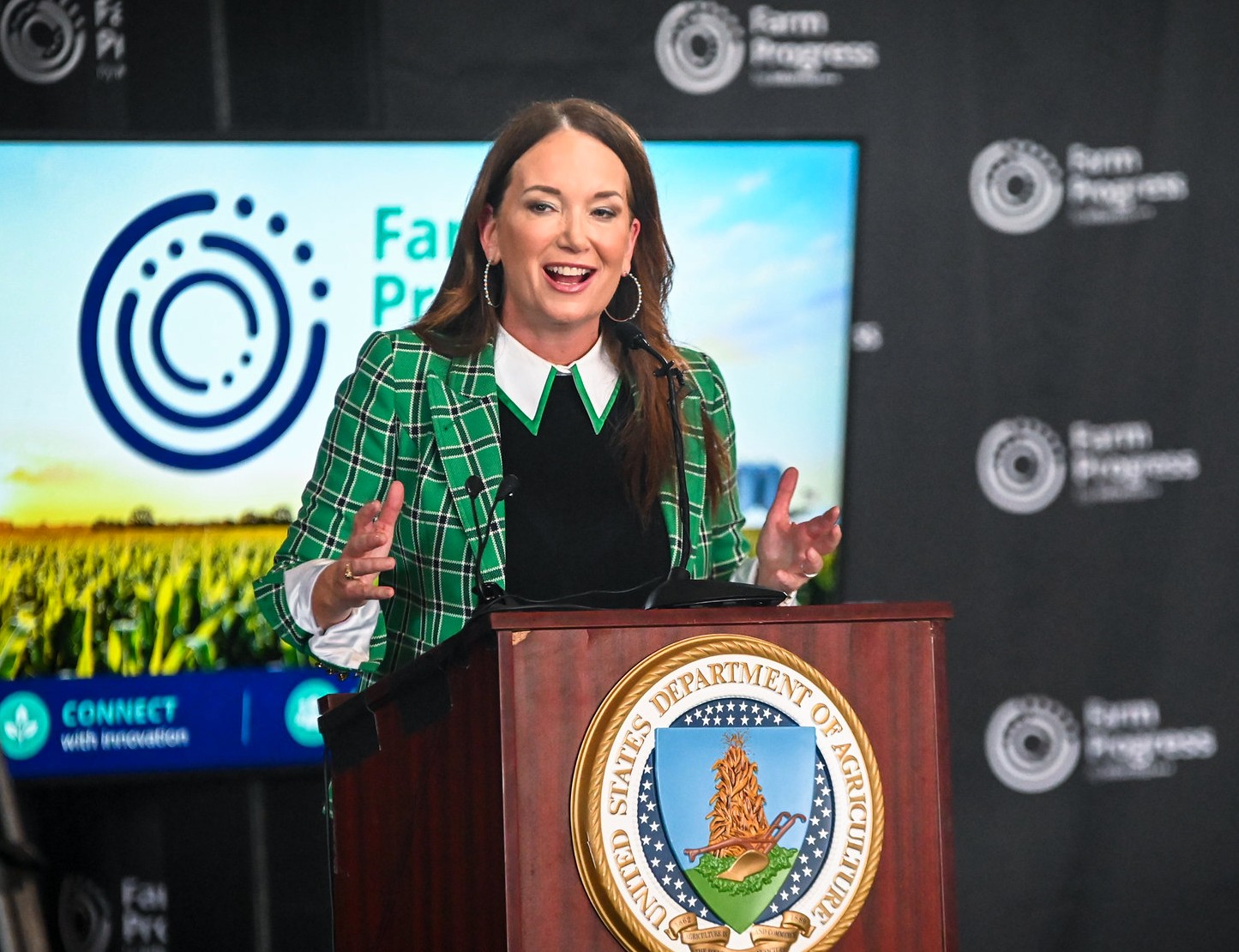
Agri-Pulse Founder and CEO Sara Wyant has been named The McAllister Top Management Fellow by the Software Information Industry Association (SIIA) and will spend three days talking to students and faculty at Northwestern University’s Medill School of Journalism this fall.
“For more than 40 years, The McAllister Top Management Fellow has imparted B2B journalism and information services wisdom to students at Medill/Northwestern,” said Abe Peck, director of business-to-business communications and professor emeritus in service in the Medill School.
He noted that Wyant is an award-winning agricultural journalist, entrepreneur and founder of Agri-Pulse Communications Inc., a unique digital media firm she launched in 2004 to focus on farm, food and rural policy issues.
The honor was announced during the recent Business Information and Media Summit in New Orleans.
The fellowship is endowed by Mr. and Mrs. Donald McAllister, Jr., and Ms. Liane McAllister Romaine, in honor of the late Donald McAllister, Sr., who was active in specialized business media for more 70 years.
RFA CEO Calls for Unleashing U.S. Ethanol
In a rousing address at the 2026 National Ethanol Conference this morning, Renewable Fuels Association (RFA) President and CEO Geoff Cooper drew parallels between the ethanol industry’s untapped potential and the inspiring underdog story of college football quarterback Fernando Mendoza. Cooper likened the sector to the overlooked athlete who, given the chance, achieved extraordinary success – a metaphor for ethanol’s readiness to “be let off the leash” amid regulatory hurdles.
Reflecting on 2025 achievements, Cooper highlighted record-breaking production of 16.4 billion gallons of ethanol, up 200 million from the prior year. The industry also produced 35 million metric tons of high-protein animal feed and 4.7 billion pounds of distillers corn oil, supporting 13 billion pounds of red meat and 575 million gallons of bio-based diesel. Carbon capture reached a new high of 3.3 million tons, with growing sequestration efforts. Demand surged, with domestic consumption at 14.3 billion gallons – the highest in six years – and an average gasoline inclusion rate of 10.5%. Exports hit a record 2.2 billion gallons, shipped to over 80 countries, representing one in eight gallons produced.
“We saw glimpses of our industry’s potential last year, and 2025 was another good year for the U.S. ethanol industry,” Cooper said. “But we could have done so much more, if simply given the opportunity. More to lower fuel prices for consumers. More to reduce reliance on imported petroleum. More to clean up the air and reduce emissions. And more to create jobs and boost the farm economy.”
That opportunity, RFA emphasized, begins with eliminating outdated federal regulations that restrict E15 sales during the summer driving season. Despite bipartisan support and a broad coalition agreement that included the American Petroleum Institute, legislative efforts to secure permanent, nationwide year-round E15 sales narrowly failed in late 2024 and again in early 2026. And instead of adopting year-round E15, the House formed the E15 Rural Domestic Energy Council” to continue working on the issue.
House lawmakers serving on the council had pledged legislative action on year-round E15 by today, but as of this morning, no bill had been introduced. Cooper called on members of Congress to act swiftly, stressing that year-round E15 would lower fuel costs, strengthen U.S. energy security, and provide critical economic relief to farmers and working families. Cooper noted that a small handful of mid-sized refining companies is holding up progress on E15 and reform of the RFS program’s small refinery exemption (SRE) program. He said lawmakers are finding out “that there is simply no way to appease mid-sized refiners who continue to game the RFS system with SREs. Those refiners either want to maintain the status quo, or they want to blow up the RFS entirely—neither of those options is acceptable to the majority of liquid fuel and agriculture stakeholders.”
“Our message to the Council—and to every member of Congress—is clear: Year-round, nationwide E15 is an urgent priority for America’s farmers, energy sector, and working families—and it can’t wait any longer. Unleash E15! Let’s get it done,” Cooper said.
He encouraged all members of the RFA and the ethanol industry in general to contact their members of Congress and urge them to pass E15 legislation.
Read Cooper’s remarks here and listen to the entire address below:
NEC26 State of the Industry (37:37)
Precision Ag News 2/23
Since 2021, Syngenta and BSI have worked together with growers in Peru and Chile to protect grapes, tomatoes, berries, cherries, and other crops from diseases such as Botrytis, Sour Rot, Powdery Mildew, and Alternaria alternata with remarkable results in terms of higher yields and better quality. The sustainable technology behind Quillibrium® delivers consistent, high‑quality extracts without the need to harvest protected trees, thus preserving biodiversity while ensuring a reliable supply.
Animal Ag News 2/20
U.S. Beef Export Picture Changing
In an interview from the recent 2026 Cattle Industry Convention and Trade Show in Nashville, Dan Halstrom, President and CEO of the U.S. Meat Export Federation (USMEF), provided an optimistic outlook on U.S. beef exports despite recent hurdles.
Halstrom reports that exports declined by 18-19% in volume last year, largely due to ongoing issues with China. Excluding China, the drop was minimal at 2-3%, underscoring robust performance in other regions. Halstrom highlighted record-breaking demand worldwide, emphasizing a shift toward premium U.S. beef. For instance, Central American markets like Guatemala and Panama have evolved from opportunistic buyers of lower-grade cuts to consistent purchasers of choice and higher-quality products, even amid record-high prices exceeding $370 per choice cutout.
Looking ahead, Halstrom sees significant growth through new trade frameworks such as Indonesia. “Our estimate is if you got rid of all the non-tariff trade barriers, you’d be looking at $200 million a year just for Indonesia. It’s a huge market with a lot of spending power,” said Halstrom. In addition, the UK’s 13,000-ton duty-free quota now being allocated could add $100-150 million. “So there’s a lot of these smaller regions of the world where framework agreements have been talked about with the Trump administration…And that could be really powerful.
Halstrom stressed that future exports will tie closely to U.S. production levels, but demand remains unwavering amid a global beef shortage. He noted the economic edge: U.S. exports high-value cuts while importing lean grinding beef, yielding over $1.15 per pound in value differential. With a growing global middle class craving quality protein, Halstrom views 2026 as a pivotal year for expansion, calling it “new land we’re plowing.”
DWFI Podcast 50 – Nebraska Master Irrigator
In this episode, host Frances Hayes dives into the Nebraska Master Irrigator Program, a new approach to advanced water stewardship. Joining Frances is Crystal Powers, DWFI Water and Cropping Systems Extension Educator and a co-collaborator on the new initiative.
Through the Nebraska Master Irrigator Program, organizers invite participants to dig deeper and “talk shop” about the critical issues facing agricultural producers in Nebraska and throughout the U.S. The podcast discussion focuses on how this program helps farmers grow more with less, maximize existing farm investments, improve margins, and ultimately strengthen the long-term future of Nebraska’s soil and water resources.
DWFI podcast episode 50 18:48The Robert B. Daugherty Water for Food Global Institute (DWFI) at the University of Nebraska was founded with the mission to have a lasting and significant impact on achieving more food security with less pressure on scarce water resources by conducting scientific and policy research, using the research results to inform policy makers, and sharing knowledge through education and communication.
How to subscribe:
Ag Economic Update at CIRB Annual Meeting
At the recent 2026 Crop Insurance and Reinsurance Bureau (CIRB) annual meeting, Jim Wiesemeyer of Informa Economics painted a stark picture of the U.S. farm economy, highlighting a severe cash flow squeeze driven by low commodity prices and persistent high input costs.
Wiesemeyer compares the current situation to the 1980s farm crisis, but noted mitigating factors like lower interest rates and improved crop insurance programs. “Ag is in a cash flow bind right now,” Wiesemeyer said. “That means a load of relatively low prices versus still high input prices… I haven’t seen it this bad, if you will, since the 1980s. It’s not as bad as the 1980s. We have much lower interest rates now. And we have a far better crop insurance, revenue assurance program.”
To bridge the gap, Wiesemeyer pointed to recent government aid efforts. The Trump administration’s initial $12 billion farmer assistance program for row crops is set for payout by February 28, with potential for an additional $15 billion package from Congress in the coming months. However, he stressed the urgency for farmers to reduce debt amid consecutive years of depressed prices.The lack of a comprehensive farm bill exacerbates these challenges.
Wiesemeyer discussed House Ag Committee Chairman GT Thompson’s push for “Farm Bill 2.0” – dubbed the “Skinny Farm Bill” by some – targeting Title I provisions left out of prior legislation. Markup is eyed for the week of February 23, but passage hinges on bipartisan support, particularly from Democrats like Rep. Angie Craig (D-MN), who is eyeing a Senate run. “It depends on one person, Representative Angie Craig,” Wiesemeyer explained. “Does she want a bill… or does she want an issue to campaign on?”
Despite the gloom, Wiesemeyer remains optimistic, citing boosts from domestic utilization like year-round E15 ethanol, the 45Z sustainable aviation fuel program, and potential economic growth. He urged farmers to embrace volatility as a trading opportunity and learn from Brazil’s ag prowess by focusing on value-added products. With elections looming, he warned that political shifts could influence stability, but aid and policy tweaks could temper negatives by harvest time.
Jim Wiesemeyer, Informa Economics (18:29)Industry Ag News 2/18
Industry Awards at 2026 CattleCon

Burt Rutherford (R) receives Greg Henderson Excellence in Agricultural Journalism Award (NCBA photo)
The Greg Henderson Excellence in Agricultural Journalism Award was presented this year to Burt Rutherford, a freelance writer and former senior editor of BEEF magazine who has spent his career helping producers become better and more efficient at what they do through his effective writing. This new award recognizes agricultural journalists who exemplify the values Greg Henderson championed throughout his career as Editorial Director for Drovers at Farm Journal Media. Henderson passed away in 2024 at the age of 67.
Jon Mollhagen, founder of Moly Manufacturing, LLC., received the inaugural Legacy Award for his innovation and dedication to the beef cattle industry. A fifth-generation Kansas cow-calf producer, Mollhagen founded Moly Manufacturing in 1987 and its SILENCER® chute has become the industry standard in livestock handling equipment.Another award presented was the Beef Checkoff Visionary Award which recognizes an individual in the beef industry who has demonstrated exemplary support of and commitment to the Checkoff’s goals and vision. The 2025 honoree is Anne Ilse Anderson of Austin, Texas. Anderson and her husband Jim own a cow-calf operation in the Texas Hill Country, combining a deep passion for agriculture with a global business perspective.
2026 American National CattleWomen Awards were also presented, including:
Outstanding Cattlewoman of the Year Leanna Spratling, Spring Creek, Nevada
Outstanding Educator Laurie Munns, Hansel Valley, Utah
Outstanding Promoter Connie Tabor, Agra, Oklahoma