
 I already clued you in to what Tad Whitten is doing right now at the Missouri and Iowa State Fairs. Now, I’ve got the scoop on what Tad will be doing for this year’s Farm Progress Show coming up at the end of August. Tad says he will be debuting a new filling station replica:
Zimfo Bites
- Mediacom of Springfield announces Wednesday the launch of RFD-TV in Springfield, Columbia, Jefferson City, Jasper, Cassville, Carl Junction and other surrounding areas. RFD-TV is a cable channel that targets the general interests of rural North America, South America, Europe, and the rural world. RFD-TV services the business and personal needs of rural America, which includes small acreage owners, farmers, ranchers, horse owners, small town residents and those who just enjoy the rural way of life. RFD-TV’s programming has a variety of well-balanced, high-quality, original programs including rural “lifestyle” features, rural news, commodity and financial market reports, equine training & features, consumer programming, rural event coverage, and traditional country/ethnic music-themed entertainment including programming from RFD-TV The Theatre in Branson, MO.
- For the 2008 growing season, Pioneer Hi-Bred will offer a new system to help growers target their soybean product selections based on high-yielding genetics and traits to maximize their profit potential – not seed count. The Pioneer Soybean Seed Size Value Guarantee minimizes seed size cost variations per acre by using a price adjustment starting at 2,800 seeds per pound across all varieties and lot numbers. Customers purchasing Pioneer® brand soybean varieties will receive a graduated discount on varieties or lots with fewer than 2,800 seeds per pound. This program will be available to customers served by Pioneer sales representatives in the United States and Canada; some Southern and Western areas of the United States are excluded.
- Pennsylvania FFA and 4-H organizations may enhance their programs thanks to more than $300,000 in funds awarded today by the Pennsylvania Department of Agriculture. The FFA and 4-H received the funds from Agriculture Secretary Dennis Wolff during Ag Progress Days in Rock Springs, Centre County. “Our youth are the future leaders of Pennsylvania agriculture, our state’s number one industry,” said Wolff. “The FFA and 4-H encourage youth to explore the many opportunities in agriculture that are available to them. By supporting these programs, we can keep Pennsylvania agriculture growing for generations to come.” State FFA officers accepted $71,000 in fair funds, which will be divided among 139 chapters that are home to nearly 8,000 students. State 4-H officers received $236,000 to provide local program support to more than 90,000 members in Pennsylvania.
Pfizer VMRD Leader
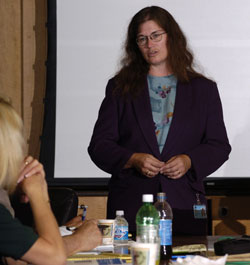 The head of Pfizer Animal Health’s Veterinary Medicine Research and Development facility (called the Farm) is Dr. Cathy Knupp. She was on our program at their media event titled “Delivering Solutions Through Research and Innovation.” I’m really learning a lot attending these type of R&D programs!
Dr. Knupp supervises global research and development activities for the company. Sounds like a big job to me. She welcomed us to their facilities and I interviewed her to learn more about the Farm. She says that it can take a decade for the whole discovery and development process to work to bring a new product to market.
The research headquarters in Kalamazoo is 2,100 acres and they’ve got 170 different programs in research right now.
You can listen to my interview with Dr. Knupp here: pfizer-vmrd-07-knupp.mp3
Or if you’d like you can download it here:  Dr. Cathy Knupp Interview
Sunset on Lake Okoboji
 Unlike a lot of the midwest temperatures here in northern Iowa have been fairly moderate. We also got some nice rain overnight.
The clouds made for a nice sunset on the lake just before our Syngenta Learning Centers group went out to supper. Like my trip to Pfizer Animal Health last week, this event is really helping not only build relationships but providing media representatives with story material and a better understanding of what the company is doing and what products they are working on.
I would encourage more companies to follow their lead.
Soybean Management Strategies
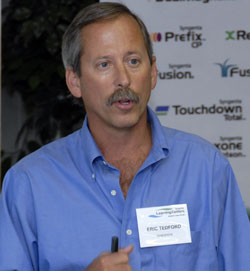 Eric Tedford is Technical Brand Manager, Fungicides for Syngenta. He was on our program here at the Syngenta Learning Centers media briefing to talk about soybean management strategies.
He gave us some specifics about some of their products and also talked about some that will be coming out in the next season. In particular he points to their herbicide options. One that’s coming out once it receives registration is an insecticide product called Endigo.
You can listen to my interview with Eric here: learning-centers-tedford.mp3
Or you can download the interview using this link: Eric Tedford Interview (4 min MP3)
Improving Ethanol Production Process
 One of our presenters here at the Syngenta Learning Centers media briefing is Brad Wiersum, Head, Renewable Fuels Strategy, Syngenta Seeds. His topic was their biofuels strategy.
As you’ll hear in my interview with him they’re really looking forward to the introduction of some new corn varieties with high levels of corn amylase. By using high amylase corn, they estimate that it will improve the process efficiency of ethanol production which would lead to substantial savings in the cost of production of ethanol.
You can listen to my interview with Brad here: learning-centers-wiersum.mp3
Or you can download the interview using this link: Brad Wiersum Interview (4 min MP3)
Blast From The Past
 Most people don’t know it, but Tad Whitten – owner of Motorsports Management – says ethanol has been used as fuel for more than 100 years. That’s why Tad is operating exhibits at the 2007 Missouri State Fair and the 2007 Iowa State Fair. He wants to educate people on the history of ethanol as a fuel source in the U.S. I stopped by Tad’s exhibit at the Missouri State Fair where he has a replica of 1933 Ethanol filling station. The old-time exhibit features skits throughout the day, which creates a conversation between a filling station attendant and a customer who is filling up his tank with ethanol. An audience can then “eavesdrop” at the scene and learn about the corn-based fuel. At the filling station, Tad filled me in on some ethanol history. You can listen to the interview here:
Syngenta Learning Centers Photo Album
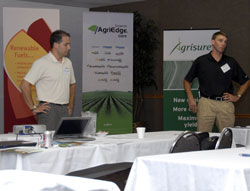 We’re getting ready to finish up here in the Syngenta Learning Centers media briefing. Right now we’re hearing from a couple of growers who work with Syngenta. It’s nice to get their perspective on things.
The internet access here is a little challenging so I’ll probably be posting interviews later. In the meantime I have started a photo album from the event here which you’re welcome to visit: Syngenta Learning Centers Photo Album
Dr. Mike Boehlje Talks New Agriculture
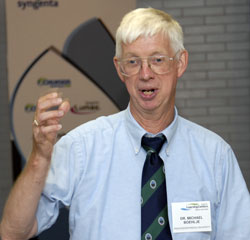 If you’ve never heard Dr. Mike Boehlje, Center for Food & Agricultural Business, Purdue University, speak then you’re missing a good performance. He is passionate about his work. He just completed his presentation on “Farming in the 21st Century” here at the Syngenta Learning Centers media briefing.
He started out with the “e” word which is of course, ethanol. However most of his talk really was on this thing called “new agriculture.” Kind of sounds like new media doesn’t it? Dr. Boehlje had to fly home right after his talk but I talked him into a short interview on his way out the door.
He says there are a lot of things that make up new agriculture but some key areas include new marketing opportunities, a lot of which is being driven by the bioeconomy and in particular, biofuels. Then there’s new tehnology and new business models. He sees a generational shift whereby younger farmers are saying, “bring it on” when it comes to these new ways of farming. The number one question he says growers are asking him this year is “How do I solve this corn on corn thing, especially yield drag?”
You can listen to my interview with Dr. Boehlje here: learning-centers-boehlje.mp3
Or you can download the interview using this link: Dr. Boehlje Interview (7 min MP3)
Learning Centers Overview
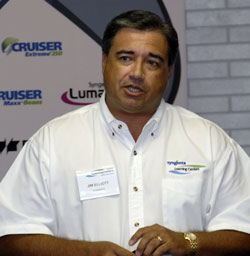 The first speaker on the program is Jim Elliott, AgriEdge, Agronomy Services Manager, Syngenta Seeds.
Jim really gave us an overview of the whole Learning Centers program. This is the 4th year now that Syngenta has been doing these programs and they expect over 5,000 attendees this season. He says that 90% of the people who attend say they gained knowledge that impacted their management practices. Attendees are growers, retailers and industry leaders.
These Centers are run from Pennsylvania to Colorado.
You can listen to my interview with Jim here: learning-centers-elliott.mp3
Or you can download the interview using this link: Jim Elliott Interview (7 min MP3)