
 The Corporate Council on Africa wants U.S. investors to realize their potential in African agribusiness opportunities. That’s why the CCA is showcasing the African food value-chain at the 2008 U.S. Africa Agribusiness Forum. The CCA wants public and private sectors alike to cross borders and bring “farm to fork.” I’ll be covering the forum here at the Hyatt Regency in Chicago throughout the day Thursday and Friday.
Highlights of the Forum will include industry-specific sessions, panels to address cross-cutting issues, such as finance product innovation, pharmaceutical and biofuel industry growth, carbon trading, production technology, and certification; as well as networking opportunities. Industry experts will share best practices and the latest trends in the field.
These are a few examples of how the 2008 U.S.-Africa Agribusiness Forum will help companies gain the competitive edge on investing in Africa by becoming more knowledgeable about the African agribusiness marketplace.
2008 U.S. Africa Agribusiness Photo Album
AgWired coverage of the 2008 U.S. Africa Agribusiness Forum is sponsored by:

 Okay, so you can get your markets, make phone calls, take video and pictures, email, text, browse the web, edit documents, listen to music and podcasts and now you can control your irrigation equipment. All from your phone.
 So another conference is over and tomorrow I’ll be moving on to Jackson, MS for the Appaloosa Horse Club National Show. This will be the first time it’s being held there and from what I’ve heard already, things are going well.
 Here’s my wrap up post from the Farm Foundation Transition To A Bio Economy conference. I learned a lot from the presentations here and hope the interviews have helped you too.
 What we know and what we need to know was Peggy Caswell’s, USDA-ERS, topic here at the Farm Foundation Transition To A Bio Economy conference. She says we need to know things about how farmers or the providers of biofuels and feed stocks are going to have to change the way they do business. She used the example of having to look at different types of contracts and financing.
 The issue of investment and financing for ethanol plants and bio refineries in general was addressed today by Chris Groobey, Baker & McKenzie, LLP. He works on project financing with investors and lenders and mostly in renewable fuels. He painted a pretty bleak picture.
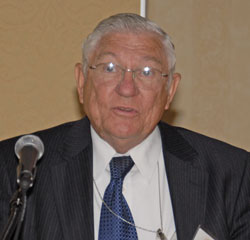 We had two Under Secretaries talk to us here today. It was my first time to meet our USDA Under Secretary for Research, Education and Economics, Gale Buchanan. He was here at the Transition To A Bio Economy conference to talk about the need for research in a growing bio economy. In fact, he sees a need for a tremendous amount of research to address the opportunities presented by the whole energy picture.
 When it comes to infrastructure needs for a bio economy our rural road system is a key component. To speak about it here at the Transition To A Bio Economy conference we heard from Frank Dooley, Purdue University. He sees a big increase in grain production, primarily in the midwest. With that comes a growing demand for transportation. He thinks we should be concerned because most of the corn will be moved by truck and that’s going to impact rural roads. He also sees an increase in rail transportation but not significantly.
 We hear a lot about the growth in ethanol production but do you know how it gets from the plant to where it needs to be to enter our fuel supply? How about rail car? During our discussion on the infrastructure needs of a Transition To A Bio Economy, we heard from Paul Hammes, Union Pacific Railroad. Of course his focus was on rail infrastructure and as it relates to biofuels. Specifically, he spoke to the different pieces of that supply chain like rail cars, the rail network and unload/load capacity.