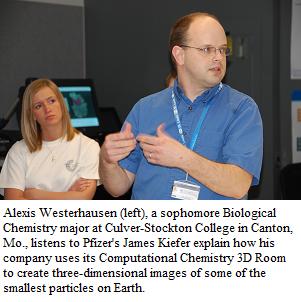
 OK, you go to school, you get your degree and you’re locked into that career choice for the rest of your life, right? Well, today’s students don’t want to be locked into just one job. It’s not a matter of attention deficit. I think it has to do with their quest to keep learning. Well, during the recent Novus International Undergraduate Networking Day, the Missouri Colleges Fund scholars got the chance to see just what their options might be.
One such student was Alexis Westerhausen, a sophomore studying biological chemistry at Culver-Stockton College in Canton, Mo., who said she was impressed by how interested the companies’ were in the students, considering they were undergrads and many of them hadn’t even made definite career plans yet. And she said the tour gave her an education she didn’t get at school.
“Colleges don’t portray to us all the opportunities we have in the science field. So it’s kind of neat to see these local businesses that are interested in us.”
Westerhausen said she was also surprised how many other jobs you could move to within a company like Novus. As you might remember from earlier posts, many of the Novus staff either started out in a different part of the company or in a different career with another company altogether. That gave Westerhausen some solace that she doesn’t have to be locked into only one job her entire career.
“That does kind of comfort me, because, right now, I’m really interested in chemistry. But it’s nice to know that I’m not stuck there for the rest of my life.” She’s glad there are companies that are willing to help her expand into other areas… if that’s where her life carries her.
Listen to my whole conversation with Alexis here: Westerhausen.mp3
2009 Novus International Undergraduate Networking Day Photo Set

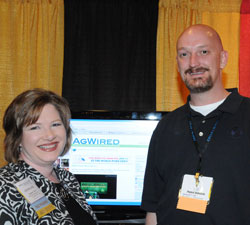
 Are you a woman working in agriculture? There’s a new social networking site created by Rhonda Werner called
  Doing a story on farming or tractors? Need a good quality photo? John Deere has help in the mail.
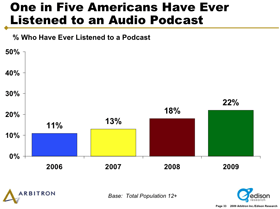 Edison Research and Arbitron have produced some very
  Although I can’t say Earth Day gets me very excited the idea that a lot of people may be wearing some soybean underpants, well, you decide. These are
  The definition of the word “Novus” is new – and that describes

 It is time for another edition of “Guess Whose Boots.”
 Cindy and I are in post-NAMA recovery. However, we may be physically tired but we’re emotionally charged. Those of you in agricultural marketing and communications will be too once you hear this week’s program which features an interview with Curt Blades,
  As you would expect, farmer use of the internet as a source of news and information has skyrocketed and this study provides further documentation of that fact. Curt says the study is projectable and provides breakouts for age and income demographics. Once again it shows that the higher the farm income level, the higher the use of the internet. He says they also found that high speed internet access is much more widespread than many think. I think you’ll enjoy hearing about this new study of farmer media use habits.