
 The next Farm Foundation event is less than a week away and will feature U.S. Secretary of Agriculture Tom Vilsack as the keynote speaker.
The one-day workshop on April 28th, entitled Agricultural Research and Productivity for the Future, will look at the impact of research on the growth in agricultural productivity, the challenges facing the food system over the next decade, public- and private-sector funding options, and strategies for moving forward:
Targeted to policy makers, agribusiness leaders, academics and government agency representatives, the workshop is a collaboration of Farm Foundation and the National Agriculture Research Extension, Education and Economics Advisory Board.
Historically U.S. agriculture’s competitiveness in global markets has been driven by a combination of public- and private-sector investments in research, education and technology transfer. Recent research indicates the growth in U.S. agricultural productivity is slowing, in part because of reduced investments in agricultural research. Funding for agricultural productivity enhancing research has slowed, and in some cases declined, in the United States. At the same time, other nations have increased their public investments in agricultural research.
At the April 28 workshop, participants will examine the relationship between public- and private-sector research and agricultural productivity growth, both in the United States and worldwide. Participants will identify specific challenges for agricultural research and develop the implications for research funding strategies in the United States.
If you’re going to make it to the workshop, you need to hurry up and register by tomorrow (April 23rd) through the Farm Foundation Web site. Check it out!
 As sustainability initiatives move from fringe to mainstream many companies are wondering how to “go green” beyond Earth Day celebrations and recycling paper and cans.
  going green actually means from a business standpoint. He noted that a sustainable business plan not only helps a business practice what they preach, per se, but is also created and executed in a way that helps companies save money. The agency’s CO2 Management Initiative helps a business focus on five key areas: water, energy, materials, waste, and transportation. Similar to how the Fieldpoint Calculator, designed by the
  Slip on your cowboy boots and slap on that cowboy hat. When May rolls around, there is only one place you’re going to want to be: the inaugural
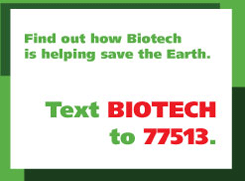 You can find out what biotech is doing to help the Earth today by texting biotech to 77513. It’s an Earth Day think being produced by the Biotechnology Industry Organization. You can find out a lot more on their website.
 I think I heard something about today being Earth Day. I can’t say that it really excites me. Maybe it’s because farmers tend the land every day and view care of their property as an integral part of their life. So why do we need a special day? Maybe it’s because this day has been used by so many people and organizations who are antagonistic to modern day agriculture and even to human existence. The Earth Day website says it, “marks the anniversary of the birth of the modern environmental movement in 1970.”
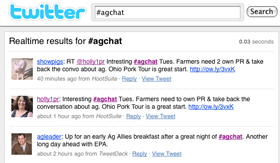 We had another great
  Make plans to attend the next Farm Foundation Forum Tuesday May 5th from 9 to 11 am at the National Press Club, 529 14th Street NW, Washington D.C. when the group takes a look at animal welfare as it relates to production agriculture:
 Thank you to Greg Lamp for pointing out that you can attend post IFAJ/AMS tours this year even if you’re not a member of AAEA, LPC or IFAJ. So how about some NAFB’ers joining in the fun?