
 If you’re going to the Farm Progress Show and you have never participated in AgChat, the weekly Twitter conversation/community for agriculture, then you’re going to have several chances to learn more about it. AgChat will be on display along with all the latest products and services. AgChat is for farmers, in fact for anyone involved in providing food, fuel, feed and fiber as well as consumers. The audience is growing and it’s providing some good interaction with people who want and need to understand agriculture today.
“AgChat gives farmers a stronger voice and leverages the power of the agricultural community,” notes Michele Payn-Knoper, Certified Speaking Professional and founder of #AgChat. “We see upwards of 1,000 “tweets” during our two hour discussion every Tuesday night, cementing this tool as an important venue for sharing views and ideas on current food and farm topics, from antibiotic use to mainstream media misinformation about agriculture.”
On Tuesday, September 1, Farm Progress attendees can learn more about this social media tool at two #AgChat events:
• Tweetup: A networking and #AgChat demonstration for those in agriculture who are a part of Twitter, or want to see it in action. From 3-5 p.m., in the Country Financial tent, booth 749 on 7th Street, join Payn-Knoper and others in the #AgChat community, who will answer any questions you have. Refreshments will be served.
• #AgChat live: Join other farmers and agribusiness to participate in this fast-paced streaming “convo” on Twitter. Tweet and talk with several of the chat regulars, or just watch the community in action. Payn-Knoper will be moderating live from Farm Progress, 7-9 p.m., in the Decatur Conference Center & Hotel Illini Room. Bioenergy is the topic for the Sept. 1 chat. Other #AgChat participants will be joining in the streaming conversation from locations around the world.
“Our goal is to pull back the curtain for the next wave of adopters of these tools, and to reveal both the simplicity and power of social media in communicating about agriculture. We want farmers to experience that special act of reaching out across the virtual fence to communicate not only with other farmers, but with moms, journalists and others who are interested in gaining a broader perspective on food and agriculture. It also gives us an opportunity to ‘listen louder’ to thought leaders and consumers about their food interests.”
 That was my take away from a meeting I attended this week in Washington, IA to gather some audio, photos and video for our friends at
 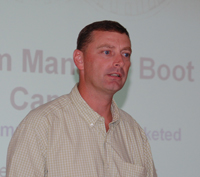 But genetics can only do so much and the rest is up to the producer. Cliff Jones with PIC’s tech services says they work with producers to help them achieve the maximum genetic potential from their animals with the proper care and he gave the producers in Washington an abbreviated version of PIC’s Farm Managers Boot Camp that they sponsor. “The key focus point is just to pay attention to the pigs,” Cliff says.
  More of the BASF ag divisions are entering the social media world. Now BASF Plant Sciences has unveiled a
  Our
Our  • Create a backup of your spring information.
 We’re making a major change to our
 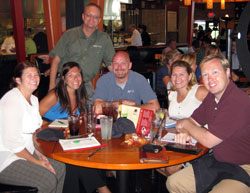 The Gateway NAMA board met yesterday for some program/membership planning. I’m waiting on a summary of what we accomplished to help with member communications. I can tell you that we’ve been pretty inactive but with some fresh talent in leadership hopefully we’ll change that around this coming year. We’re looking at a mix of fun and educational sessions that will be of interest to all members.
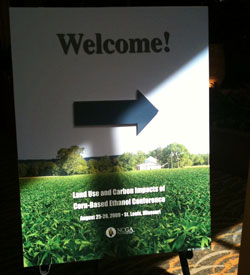 Do you understand things like indirect land use when it comes to regulations via departments like the EPA due to the RFS? Me either. And I’ve sat in on conferences and discussions and interviews on the subject for a while now. That’s because an issue like indirect land use involves predicting the future based on certain assumptions that may or may not be valid, especially if they’re based on out of date data and information. So that’s part of what the NCGA is dealing with at their
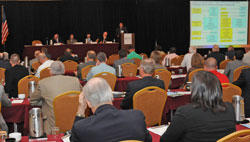 The NCGA Land Use and Carbon Impacts of Corn-Based Ethanol Conference is underway here at the Renaissance hotel by the St. Louis airport. This is our first panel discussion on “Emission Factors and Land Use Change Modeling” which is being moderated by Geoff Cooper, Renewable Fuels Association. We’re talking some very involved talks on things like Lifecycle Greenhouse Gas Analysis, Measuring Indirect Land Use from Biofuels, Analysis of the RFS and more.