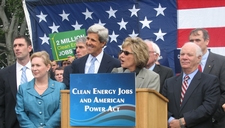
 This week, Senators Barbara Boxer (D-Calif.) and John Kerry (D-Mass.) debuted the “Clean Energy Jobs and American Power Act,” an 821-page bill designed to “create clean energy jobs, reduce pollution, and protect American security by enhancing domestic energy production and combating global climate change,” as well as creating millions of green energy jobs. Part of that includes reducing carbon emissions by 20 percent by the year 2020 and 80 percent by 2050 compared to 2005 levels.
The American Farm Bureau Federation isn’t buying it.
 “America’s farmers and ranchers did not fare that well in the House-passed climate change bill and they fare even worse in the Senate bill,” said American Farm Bureau Federation President Bob Stallman. “There are few benefits and even greater costs to agriculture and the American public.”
Stallman says the 20 percent target, which is higher than the House bill by three percent, is unrealistic and will lead to higher energy bills for all consumers. “The Waxman-Markey bill, passed narrowly by the House this summer, did at least include credits to farmers for carbon-storing or carbon management practices. The Senate bill does not guarantee any benefits to agriculture for carbon sequestration,” Stallman said.
Another major concern for Farm Bureau is that the Boxer-Kerry bill would not prevent the Environmental Protection Agency (EPA) from continuing to move forward to fully regulate all greenhouse gases under the Clean Air Act. The bill also does nothing to provide alternative sources of energy to fill the energy deficit left by the reduction in fossil fuels, nor does it prevent the EPA from using controversial indirect land use principles that penalize ethanol, according to Stallman.
“Both the Senate and House bills would bring higher fuel and fertilizer costs to American farmers and ranchers, which puts us at a competitive disadvantage in international markets with other countries that do not have similar carbon emission restrictions,” Stallman said. “For the future prosperity of the U.S. economy and American agriculture, climate change legislation must be defeated by Congress.”

 The Got Milk folks and milk loving rock star White Gold are about to introduce “The Battle for Milkquarious” which debuts on October 5.
 The
The  Tractor restoration is a competitive sport and the “Super Bowl” of the competition is the
 You never know what you’re going to see traveling away from home.
 Here’s a look at a
  I talked to Lyle, the Orwig of Charleston Orwig, in the agency’s suite overlooking the expo arena about their commitment to agriculture and the dairy industry. “When we began with Charleston Orwig, agriculture was a focus for us, we didn’t just happen to get a couple of ag accounts and say – oh, let’s be an ag agency,” Lyle said. “Having grown up on a central Illinois dairy farm, it’s important for me personally, as well as the agency to maintain that connection to agriculture and so we have focused on that as we’ve grown the agency.” Lyle says about 85 percent of the agency staff have an agricultural background, either in agribusiness communications or growing up on a farm, or both.
  The theme of of
  I just signed up for