IFAJ Congress 2011

Chuck Zimmerman

Mark your calendars now for the IFAJ Congress 2011.

In 2011, we’re inviting you to come and experience New World agriculture for yourself. Be there as the world’s leading agricultural journalists assemble for the first IFAJ congress in Canada in more than 40 years.

* Experience agriculture in the Great Lakes region – one of the most fertile and productive farming regions on Earth
* Learn how immigrant farmers – many from the Netherlands, Switzerland and Germany – have found prosperity in Canada
* See research-driven innovations and cutting-edge agricultural practices and theories in action
* Enhance your journalism and communication skills and get access to opinion leaders and decision makers at professional development sessions


IFAJ

Karen McMahon Receives Ruth White Media Award

Chuck Zimmerman

When she’s not working as editor for Farm Industry News she may be collecting for the Lutheran Ladies. She’s Karen McMahon, pictured on right at Ag Media Summit.

Well Karen has just received a big award. She was presented with the Ruth White Media Award from the Mid American CropLife Association (MACA).

The award is given to members of the media for their distinguished service to agricultural chemicals and MACA activities. It was presented during MACA’s annual meeting held September 7-9 in Des Moines, IA.

McMahon has been editor of Farm Industry News (FIN), a Penton Media publication, for 10 years. She first worked on FIN in 1998 as senior editor, and prior to that, she was managing editor of Penton’s National Hog Farmer for five years.

Media

Elanco Animal Health Gives You Plenty To Think About

Chuck Zimmerman

There’s plenty to think about when you “launch” in today’s new media world. How about a blog, Facebook, Twitter, LinkedIn and YouTube account? That’s what Elanco Animal Health has done with their Plenty To Think About blog, etc.

. . . the thinking person’s guide to feeding a hungry planet, sponsored by Elanco Animal Health.

The Plenty to Think About blog was inspired by global response to a 2009 white paper, “Food Economics and Consumer Choice,” authored by Elanco Animal Health President Jeff Simmons. The paper focused on the United Nations Food and Agriculture Organization’s statement that the world needs to produce 100% more food by the year 2050 and that 70% of that food must come from efficiency-enhancing technologies. “Response to the white paper from producers, retailers and the business press indicated that hunger, food prices and agricultural sustainability are high priorities for individuals, farmers and businesses across the global food supply chain,” Simmons said.

Plenty to Think About also recently launched on Facebook, Twitter, LinkedIn and YouTube.

Agribusiness, Elanco

National Farm Safety & Health Week

Chuck Zimmerman

We’re coming up on National Farm Safety & Health Week. With the 2010 harvest upon us it’s a good time to think safe. The folks at the National Education Center for Agricultural Safety have a farm first aid kit you can purchase.

To hear some reasons why you should think safe you might enjoy a video clip from Cattlemen to Cattlemen featuring an interview with Mike Deering, NCBA. Mike also wrote about the subject on the NCBA Blog, Beltway Beef. You can participate in an online discussion on the subject of farm safety tomorrow evening. It’s the topic for this week’s AgChat, which I’ll be guest moderating. Please join us from 8-10pm ET. There are many mechanisms to participate with but a good one is Twubs.

Ag Groups, Audio

Soybean Growers Can Expect Plenish From Pioneer Hi-Bred

Chuck Zimmerman

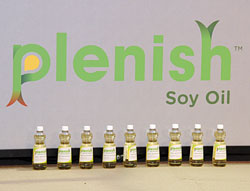
You may not find a bottle of Plenish high oleic soy oil on your local supermarket shelf just yet but that doesn’t mean there isn’t some taste testing going on. At the Farm Progress Show Pioneer Hi-Bred conducted a cooking demonstration and had samples of food cooked with the product outside their exhibit.

Farmers want a soybean with strong agronomics and increased demand. Enter Plenish™ a Pioneer® brand soybean with an enhanced oil profile and increased oil stability. Plenish™ high oleic soybean oil will have 0g trans fat and 20 percent less saturated fats than commodity soybean oil and 75 percent less saturated fat than tropical palm oil.

There are currently more soybean acres cultivated in North America than any other oilseed crop, making Plenish™ high oleic soybean oil a cost-effective and sustainable trans fat solution.

I learned more about it from Russ Sanders, Marketing Director. He says Plenish represents a significant re-making of soybean oil. They’re making it “like olive oil” from the standpoint of taste and health benefits. It will begin appearing in fast food and snack food products in coming years. It will allow labels to carry the no trans fats label. For farmers, Plenish, will come in Pioneer Y Series genetics.

You can listen to my interview with Russ here: Interview With Russ Sanders

Farm Progress Photo Album

Agribusiness, Audio, Farm Progress Show, Pioneer, Soybean

Concerns With Proposed GIPSA Rule

Chuck Zimmerman

During the recent USDA/DOJ public workshop on competition in the livestock industry I spoke with Dr. Stephen Koontz, Associate Professor, Colorado State University. He has a degree in agricultural economics from University of Illinois.

Proposed new rules from the Grain Inspection, Packers and Stockyards Administration (GIPSA) was the main topic of conversation and Dr. Koontz has some concerns. He says these rules are an attempt to clarify vague language in the law that has been troubling, especially from a legal standpoint. However, when you look at the proposal he says it not only covers production contracts for the poultry and pork sectors but beef as well. It was disappointing to him to see the cattle industry “lumped in with everybody else.” This is because the cattle industry is very different than the other industries and in fact, so is the pork industry. To just treat them all as one is very troubling he says. Another thing that bothers him is how the proposed rules treat production contracts. He says that there is good research showing the benefit of these contracts to producers and consumers and the proposed rules “treat them in a very heavy handed way.” The rule basically says that if there is any preferential pricing in a contract that it has to be documented and justified. He says that opens the packing industry to the potential of having to explain every premium and discount and then it opens them up to legal action. It adds costs and risk which ultimately will be passed along to the cow/calf producer and then the consumer.

His take on the proposed rule is summed up by a friend of his at Oklahoma State University who says, “If you look closely at the rule it’s the simple, easy to understand, wrong answer.” He says it’s being pitched as “big vs. little” but he sees it more as targeting the good producer who is innovative, who is trying to do something different and now whatever they are trying to do has to become public knowledge and that “stomps pretty hard on creativity and innovation.” Interview With Dr. Stephen Koontz

Audio, GIPSA, University

Chicken Whisperer Promotes Healthy Flocks

Cindy Zimmerman

If you want to raise chickens in your backyard, the Chicken Whisperer is the man for you!

chickenKind of reminds me of the old radio spoof Chickenman – “He’s everywhere, he’s everywhere!” Mild mannered Andy Schneider has made himself into the go-to expert on raising backyard poultry. He is host of an Internet radio show and is also a contributor for Mother Earth News Magazine, Grit Magazine, and Farmers Almanac. He’s been featured on CNN, HLN, FOX, ABC, CBS, NBC, NPR, as well as in The Wall Street Journal, TIME Magazine, The Economist, USA Today, Atlanta Journal-Constitution, New Life Journal, and countless other local and national publications and has recently signed a book deal. Schneider broadcasts his radio show at noon every weekday online from his home office, and occasionally on Saturday takes the show on the road. He claims regular listeners from the Netherlands and Australia, among other far-flung destinations. A recent guest to his chat room was from Taiwan. “It’s become, which is really cool, a worldwide show!” he said. He’s also on Facebook, Twitter and is founder of the 1,200-member Meetup group for backyard chicken fans in the Atlanta area.

To top it all off, he is the official spokesperson for USDA’s Biosecurity For Birds program, an outreach campaign geared toward educating backyard poultry owners about keeping their birds safe from infectious poultry diseases. He really is everywhere!

Watch it here:

Poultry, USDA, Video

New Registrations for BASF Products

Cindy Zimmerman

BASF Crop Protection recently received a couple of new registrations.

basfStamina® F3 HL fungicide seed treatment has received EPA registration for commercial seed treatment use on wheat and barley. Stamina F3 HL is applied at the rate of 1 oz. per 100 lbs. of seed and contains no color, allowing seed-treating companies the ability to add their own color. Available for sale this fall on winter wheat, Stamina F3 HL can be mixed with Axcess® insecticide seed treatment for protection against wire worms, aphids, Hessian flies, grasshoppers and other insects.

basfAlso, Kixor® powered Treevix™ herbicide, has received approval from the California Department of Pesticide Regulation for use in California, to control broadleaf weeds for tree nut, pome fruit and citrus growers.

Treevix offers a unique chemistry that complements glyphosate for fast, complete burndown of more than 60 of the toughest broadleaf weeds including difficult species, such as common groundsel, hairy fleabane, cheeseweed and pigweed.

BASF

The Fields Are Aglow With Fire

Melissa Sandfort

About a month ago, we were on our way to Lincoln when I looked out the car window to see the skies filled with smoke and the fields aglow with fire. It’s a farming practice I see every once-in-a-while…controlled burning.

Controlled burning is used in agriculture as a part of field preparation for planting or as a management practice used to improve native grasslands.

Often called field burning, this technique is used to clear the land of any existing crop residue as well as kill weeds and weed seeds. Field burning is less expensive than most other methods such as herbicides or tillage and, when done properly, control burning produces a “cool” fire that suppresses many undesirable plants through proper timing and intensity of the burn. It also suppresses certain undesirable plants, and improves the environment for the better plants.

While herbicides and tillage certainly play a role in proper field management, controlled burning is also a method used by farmers to “refresh” the land and prepare it for next year’s crop.

(Photo courtesy of USDA NRCS, Bob Dayton, Iowa)

Until we walk again…

Uncategorized

SFMid Brings Together Successful Farming and Farm Market iD

Chuck Zimmerman

SFMiD Data Solutions is a partnership between Successful Farming and Farm Market iD and was announced this morning. Between the two companies they are now offering the “most comprehensive agricultural and rural lifestyle database in the industry.”

The combined data solution will offer unsurpassed options for multi‐sourced farm and rural lifestyle data. In addition, SFMiDTM will offer customized solutions to help agrimarketers better understand owner/operator relationships, establish electronic communication data points, and know the farmer as an individual person.

“Farm Market iD has the most current data available – built from multiple federal, state, county and proprietary sources – combined with satellite imagery and common land unit data,” says John Montandon, President of Farm Market iD. “We are thrilled to expand on this offering to generate new data and insights for marketers through the trusted relationship Successful Farming has with farmers.”

For more than 108 years, Successful Farming has worked to forge a strong relationship with farmers and farm families. This relationship allows Successful Farming to collect exclusive data on brand and product use.

“The combined efforts of Farm Market iD and Successful Farming will offer a unique compilation of farm, farmer, and consumer data, enabling agrimarketers the opportunity to learn even more about their customers,” says Scott Mortimer, Publisher of Successful Farming. “This will add value to any marketing campaign.”

Media