
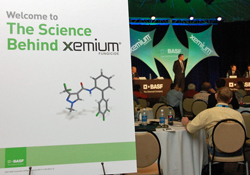
 BASF Crop Protection presented educational information and research results on a new active ingredient, Xemium® fungicide, during the fifth annual “Science Behind” media symposium Wednesday in Tampa, just prior to the kickoff of the 2011 Commodity Classic. This new chemistry demonstrates strong field test results in disease control in a variety of crops being researched. BASF hopes to introduce products containing this new active ingredient in the United States in 2012.
Xemium, a next-generation fungicide in the carboxamide family, was discovered by researchers at BASF headquarters in Limburgerhof, Germany. Xemium is a result of BASF experience in research and development, specifically in the carboxamide class of chemistry.
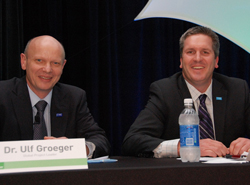 “Our history and experience with carboxamides led us to the discovery of Xemium, which will be a strong addition to our existing global fungicide portfolio,” said Dr. Ulf Groeger, BASF Global Project Leader for Xemium. “The unique mobility in the plant ensures a long-lasting preventative and curative effect to protect the crop from damaging fungal pathogens.”
I interviewed Dr Groeger to get a brief explanation of the science behind Xemium. Listen to or download that interview here: BASF Ulf Groeger Interview
The development of Xemium marks a continuation of BASF’s strong fungicide portfolio, which includes the popular Headline. “BASF is committed to developing new chemistries and innovative products to advance the industry,” said Paul Rea, Vice President, U.S. Crop Protection, BASF. “We are rooted in research and development, and the discovery of the Xemium molecule is yet another testament to our promise to help growers get the most out of every acre.”
Xemium fungicide was submitted for registration through a workshare joint review between the U.S. EPA, Canada PMRA and Australia APVMA in early 2010. U.S. registration of Xemium is anticipated in 2012.
I also interviewed Paul about the new ingredient and BASF’s commitment here. Listen to or download that interview here: BASF Paul Rea Interview
BASF Commodity Classic Photos
2011 Commodity Classic Photo Album
AgWired coverage of the 2011 Commodity Classic
is sponsored by: 
 and


 Just to give you a contrasting look at Tampa, here’s one from last night of the convention center. I call it picture perfect and hope it stays that way!
 Let me introduce you to
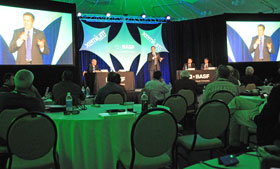
 We’ll have lots more details on Xemium, but here’s the bottom line. According to the research, Xemium has high intrinsic activity, long-lasting residual control, consistent distribution in the plant for preventative and curative effects, and broad spectrum control. Like Kixor herbicide, Xemium is a technology that will be used in a number of new fungicide products for a variety of different crops. BASF is hoping for approval by early 2012.
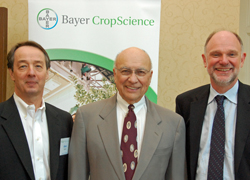 One of those experts was an old friend, former Secretary of Agriculture and U.S. Trade Representative Clayton Yeutter, who is pictured here with Bayer CropScience executives Mike Deall and Alan Ayers. It’s been a couple of decades since I had the opportunity to interview Clayton, so it was a real treat to spend a few minutes with him to get his thoughts on agriculture and trade policy, 2011 and beyond.

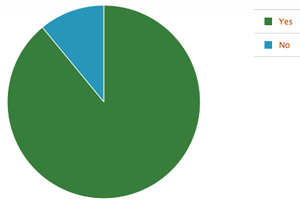

 Measuring the effectiveness of social media really is possible – if know what you want to measure and what tools to use.
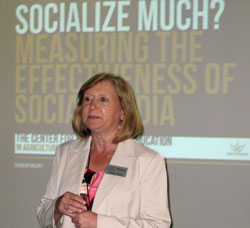 Dr. Tracy Irani (pictured) is Development Director for the PIE Center and she talked about the rapid adoption of social media and how agriculture has become part of the conversation, like it or not. She notes that social media actually has an advantage over traditional media when it comes to measurement. “We know that most of the traditional media metrics are based on the number of eyeballs or number of listeners,” she explains. “That’s where social media has an advantage because the return can be looked at on the basis of who’s in the network, who’s actively using, viewing, posting in a social media environment.” In other words, traditional media can tell you how many potential viewers or readers you might have, where social media can show how actively involved they are by retweets, comments, messages, etc.
 Our
 Active Command Steering was one of the new things getting a lot of attention at the National Farm Machinery Show. These young guys were working on one of the simulators that were set up so attendees could get a real sense of how it works.