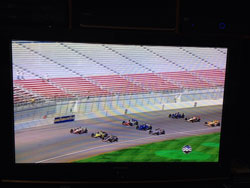
 It was with great sadness that I tuned in to today’s Indy Car race and saw the 13th lap multi car wreck and learned that Dan Wheldon was killed. Wow. I’ve had the opportunity to get to know a number of these Indy Car racers over the years. You can say all you want about the wisdom of driving a “car” at 220 MPH but they are still people. This brought back memories of Paul Dana in 2006. I liked Dan and certainly took a number of photos of him in the winner’s circle. He was the winner of this year’s Indy 500.
Today’s race was cancelled after this happened. Then the drivers all rode 3 abreast for five laps to honor Dan. This is just a photo of my tv while they were circling the track.
 Here’s a photo of Dan in the winner’s circle in at the 2007 Kansas Lottery Indy 300.
At the time I was working with our sponsor known at that time as the Ethanol Promotion & Information Council (now Growth Energy). Dan won the first race of that season in Homestead, FL. I asked him about racing on ethanol in his post race press conference.
Here’s what he said: Dan Wheldon Ethanol Comment
My prayers go out to Dan and his family. It is a shock when something like this happens. I also hope all the other drivers involved in the accident are okay.




 Each October since 1964, cooperatives across the United States have been celebrating the cooperative difference, business model and the contributions of cooperatives to their communities, during
  “Cooperatives have a long history going back to England in the mid-1800s when producers would get together to help market their products and that has resulted in the cooperative system here in the United States,” he said. “If you think of products like Welch’s grape juice, Florida’s Natural, SunMaid Raisins – those are cooperatives that have a national brand and market in some cases world wide.”
 Dan says cooperatives in general are important to not only the economy of the United States, but the entire global economy, which is why they are looking forward to being a part of the
 The
The  Many farmers rely on GPS for precision agriculture. This includes using GPS for accurate mapping of field boundaries, roads and irrigation systems; for precision planting; and for targeting the application of fertilizer and chemicals that combat weeds and crop diseases. GPS also allows farmers to work in their fields despite low-visibility conditions such as rain, dust, fog and darkness.
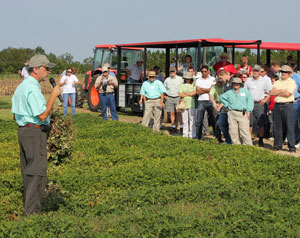 The event, held at the end of September in the Southwest area of Georgia, allowed many first time attendees to actually walk through a peanut field and see peanuts plowed up with a digger at harvest. The tour included stops in some of the top ten peanut producing counties in Georgia including Decatur, Seminole, Miller and Early counties.