BASF Supports Scholars with ASA, NCGA and Now NAWG

Cindy Zimmerman

BASF Crop Protection is expanding its support of young people pursuing careers in agriculture by joining with the National Association of Wheat Growers (NAWG) Foundation to establish a memorial scholarship to honor longtime wheat industry friend and BASF employee Jerry Minore. As a BASF Senior Market Manager, Minore was a liaison to the wheat industry, including NAWG and the Foundation, and an advocate for wheat growers.

Paul Rea, Vice President of U.S. Crop Protection for BASF, says Jerry passed away suddenly just a few weeks ago. “It was a real loss and everyone was looking for a way we could remember his service so what better way than to award a memorial scholarship in his name,” said Paul.

Listen to or download Paul talking about BASF’s commitment to the future of agriculture and the new scholarship: BASF VP U.S. Crop Protection Paul Rea

BASF has funded the Jerry Minore Memorial Scholarship for up to $5,000 per year the next three years. Applications for the scholarship program will be accepted through the end of 2012, with the first recipients to be announced at next year’s Commodity Classic.
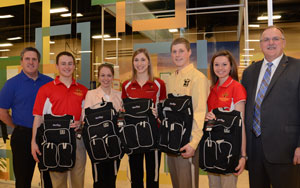
This year, for the fifth consecutive year, BASF partnered with the American Soybean Association (ASA) and the National Corn Growers Association (NCGA) to present another six students with scholarships.

Recipients of the $1,000 NCGA scholarships, pictured here with Paul Rea and NCGA Chairman Bart Schott, are (left to right): Andy Chamra, a junior at Iowa State University pursuing agricultural business; Denise Beam, a sophomore at Pennsylvania State University pursuing a degree in animal sciences with an agricultural business management minor; Gracie Weinzierl, a sophomore at Illinois State University majoring in agricultural education in addition to crop and soil science; Andrew Perry, a sophomore at the University of Missouri-Columbia, studying agricultural economics and plant science; and Bethany Olson, a junior at Iowa State University specializing in agricultural business and international agriculture.
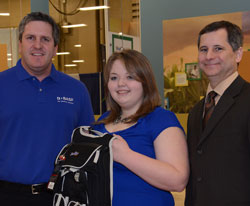
Melissa Schenck of Boston, Kentucky – pictured here with Paul and ASA president Steve Wellman – was chosen as the 2012-2013 ASA SOY scholarship recipient. Schenck, a senior at Nelson County High School, will pursue a degree in agriculture communications at Murray State University in Murray, Kentucky, beginning this fall.

Melissa says she plans to go to Murray State University and major in ag communications or ag business. “Getting a scholarship from ASA and BASF means that college is going to be easier to pay for,” she said. “This scholarship has taken a load off my shoulders” and her parents too! She’s never been to Commodity Classic before and is really enjoying it.

Listen to or download an interview with Melissa here: ASA-BASF Scholarship Winner Melissa Schenck

See video of all scholarship winners here:

2012 BASF Science Behind Photo Album

Coverage of the 2012 Commodity Classic Show is sponsored by BASF and New Holland
ASA, Audio, BASF, Commodity Classic, Corn, NCGA, Video, Wheat

Commodity Classic Trade Show Ribbon Cutting

Chuck Zimmerman

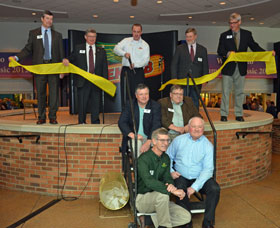
The trade show at the 2012 Commodity Classic is officially underway here in Nashville, TN. Of course things got started with a ribbon cutting where representatives from each of the four participating commodity groups made brief welcoming comments. We’ll hear more from them at tomorrow’s general session that also includes a speech from U.S. Secretary of Agriculture, Tom Vilsack. There’s a lot going on here as this annual event just keeps getting bigger and bigger.

We’ve started uploading photos which you can find at the link below and will be adding to them periodically. Please feel free to use and share.

2012 Commodity Classic Photo Album

Coverage of the 2012 Commodity Classic Show is sponsored by BASF and New Holland
Commodity Classic, Video

Ready For Record Commodity Classic

Chuck Zimmerman

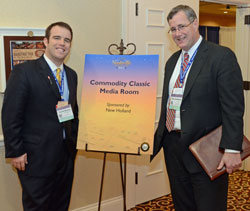
ZimmCast 340I’d like to thank New Holland for sponsoring the media room at Commodity Classic once again this year. And I’d especially like to thank them for being one of our sponsors for AgWired coverage of the event again this year. New Holland was one of the first companies to support our unique brand of “live” event blogging. This is the 7th year the company has been our sponsor for Commodity Classic. Thank you to Gene Hemphill and to Abe Hughes. I’m looking forward to seeing Abe this afternoon in the New Holland exhibit at the trade show. Now back to our program.

Here are (l-r) Patrick Delaney, Communications Director, American Soybean Association and Ken Colombini, Communications Director, National Corn Growers Association. These two organizations coordinate the media room that we have the privilege to work out of. Cindy caught up with both of them yesterday to find out how attendance at this year’s Classic is looking as well as what some of the important issues are facing each farm group.

Listen to this week’s ZimmCast here: A Look At 2012 Commodity Classic

Thanks to our ZimmCast sponsor, GROWMARK, locally owned, globally strong, for their support.

The ZimmCast is the official weekly podcast of AgWired. Subscribe so you can listen when and where you want. Just go to our Subscribe page.

Coverage of the 2012 Commodity Classic Show is sponsored by BASF and New Holland
Ag Groups, ASA, Audio, Commodity Classic, NCGA, ZimmCast

How Tall?

Melissa Sandfort

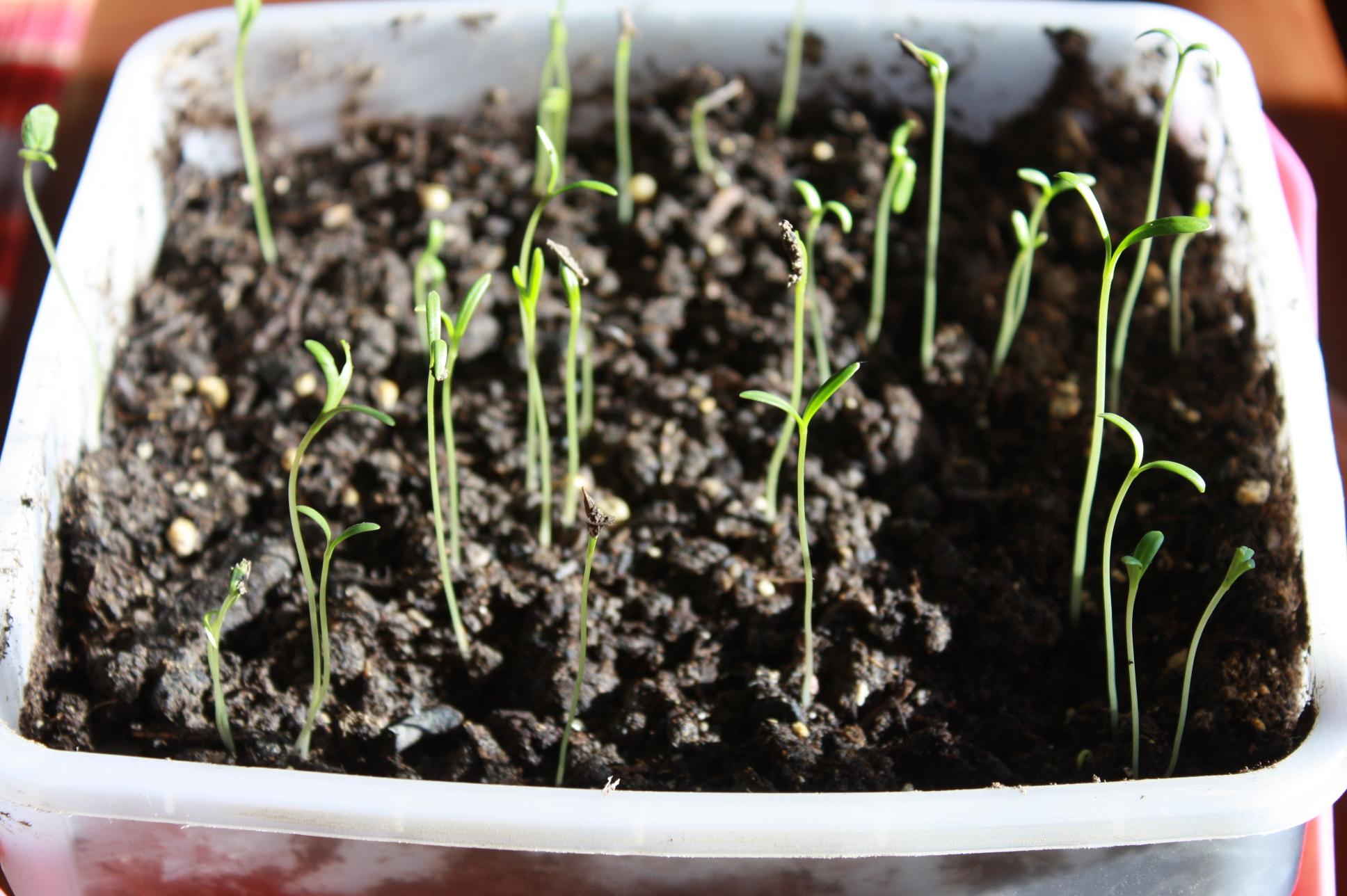
Four feet tall. Do you think my flowers will grow to be 4-feet tall in this old ice cream pail? It was the only package of flower seeds I had around when I found myself in need of an activity to entertain four children under the age of 10 and three of them were girls. So we dug in the dirt (a favorite activity for my son) and planted flowers.

They’re cosmos flowers and really supposed to be outside, but it was the middle of February and 60 degrees so we couldn’t resist. Actually, I think I tricked the four kids into an activity just to fulfill my desire to start doing outside gardening activities just a bit early.

That said, if these flowers grow to be 4-feet tall in an old ice cream bucket inside on my dinner table, we’re in trouble.

The older girls were excited to see the flowers spouting. For my son, the experience was short-lived and as soon as the trowels were cleaned off and put away, he was on to the next project. Maybe if I can keep them alive, I can transplant them outside when all signs of frost are gone.

Until we walk again …

Uncategorized

Experts Offer Weed Insights at BASF Event

Cindy Zimmerman

“The total post-emergence weed control era is over and I don’t think it’s ever coming back.”

That was probably the most memorable quote of the entire BASF Crop Protection “Science Behind the Future of Weed Control” event prior to the kick-off of the 2012 Commodity Classic in Nashville on Wednesday. It came from Row Crop Weed Specialist Dr. Larry Steckel with the University of Tennessee.
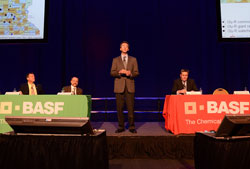
“I often tell our growers, think back to 2002-2003, you’re going to think of that as the good old days, because weed control is never going to be that easy again, or simple or cheap,” he said.

Dr. Steckel estimates that resistant weeds in Tennessee cost growers $45 an acre more in herbicides last year. “We got 1.6 million acres so that’s $72 million in herbicide costs,” he said, not counting other costs like having to actually weed by hand, as many farmers in the south have had to start doing the past couple of years.

What this means is that growers just have to use all the tools in the toolbox now to fight resistant weeds, including pre- and post-plant herbicides, cultural practices, cover crops, row width, crop rotation.

Listen to or download Dr. Steckel interview: Interview with Larry Steckel

Dr. Jeff Stachler, extension agronomist with North Dakota State University and the University of Minnesota, says the weed resistance problem is growing bigger. “The entire Midwest and even us in the northern plains are having a big issue,” he said. “The number one problem clearly is waterhemp, and not just glyphosate-resistant waterhemp, we have to deal with multiple resistant waterhemp.”

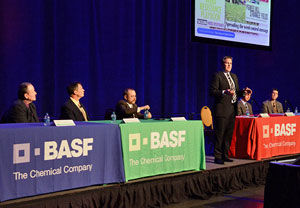
And then there’s the ragweeds and marestail, which he thinks is being managed to some degree “compared to the waterhemp, which I think is getting out of control,” he said. “Weeds are here on the planet Earth for a reason, to cover the soil, and they have a huge genetic diversity that we don’t truly appreciate.”

Not to mention a tremendous survival instinct, which is why they are finding ways to adapt and outsmart the weapons designed to kill them. “It is hard to prevent resistance, but there are certainly things we can and need to do to reduce the risk and that simply is being more diverse in our practices,” he said.

Listen to or download Dr. Stachler interview: Interview with Jeff Stachler

2012 BASF Science Behind Photo Album

Coverage of the 2012 Commodity Classic Show is sponsored by BASF and New Holland
Audio, BASF, Commodity Classic

Know Your Farmer Know Your Food Compass

Chuck Zimmerman

I couldn’t participate in today’s USDA webinar about their latest project but did get this information to share.

Today, Agriculture Secretary Tom Vilsack and Agriculture Deputy Secretary Kathleen Merrigan unveiled the Know Your Farmer, Know Your Food (KYF) Compass, an interactive web-based document and map highlighting USDA support for local and regional food projects and successful producer, business and community case studies. While hosting a live webinar to highlight USDA’s work over the past three years, the Secretaries emphasized how local and regional food systems across the country create additional economic opportunities for farmers, ranchers and food entrepreneurs, expand healthy food access and meet growing customer demand.

“USDA works every day to strengthen American agriculture, drive job growth and support farm-family income,” said Vilsack. “The KYF Compass highlights how USDA support for local and regional food systems has brought additional opportunities to our country’s farmers, ranchers, processors, distributors and food entrepreneurs. The stories and maps in the Compass underscore how diverse and innovative American agriculture can be.”

The KYF Compass is a digital guide to USDA resources related to local and regional food systems. The Compass consists of an interactive U.S. map showing local and regional food projects and an accompanying narrative documenting the results of this work through case studies, photos and video content.

Farming, Food, USDA

BASF Looks Toward Weed Control Future

Cindy Zimmerman

With glyphosate resistance continuing to grow nationwide as a threat to crop yields in fields throughout the country BASF Crop Protection kicked off the 2012 Commodity Classic with presentations on research, innovations and techniques to help prepare growers for the future of weed control at the sixth annual “Science Behind” media symposium.

BASF Vice President U.S. Crop Protection Paul Rea says resistant weeds are a significant challenge for growers. “And innovation is one of the keys to solving that challenge,” he said, noting that BASF is planning the release of three new herbicides this year – Armezon, OpTill PRO, and Zidua. “BASF invests close to $2 million every day in R&D which makes us a very good partner for growers who are looking for new technologies to increase their yield.”

Listen to or download Paul Rea interview: Interview with Paul Rea

BASF is also planning the release of Engenia™ herbicide, an advanced dicamba formulation, that will be ready when dicamba-tolerant crops make the market in a few years. “We have a long track history with dicamba,” said Steve Bowe, BASF Biology Group Leader. “With our latest formulation advancement Engenia it takes that another step forward.”


Listen to or download Steve Bowe interview: Interview with Steve Bowe

Dr. Dan Westberg, BASF Technical Market Manager, says using multiple sites of action is one way to fight the resistance issues. “In particular, we need to get back to using pre-emergence herbicides in soybeans, so that we provide a strong foundation of weed control and post emergence applications will be more effective,” he said. Scouting, proper planning, and cultural and mechanical strategies should also be considered.

Listen to or download Dan Westberg interview: Interview with Dan Westberg

2012 BASF Science Behind Photo Album

Coverage of the 2012 Commodity Classic Show is sponsored by BASF and New Holland
Audio, BASF, Commodity Classic

BASF Science Behind the Future of Weed Control

Chuck Zimmerman

For the 6th year BASF is holding a “Science Behind” event prior to Commodity Classic. This year the theme is The Science Behind the Future of Weed Control. A Grand Ole Opry studio is the perfect venue for this event where ag media are hearing from university researchers as well as product specialists from BASF.

The event is providing a “closer look at the new innovation in development, Engenia herbicide, an advanced dicamba formulation with low-volatility characteristics for improved on-target application. Engenia will help control more than 100 of the annual broadleaf weeds that farmers are battling in their crops today, including glyphosate-resistant Palmer amaranth, waterhemp and marestail.”

I’m collecting our photos from the event here: 2012 BASF Science Behind Photo Album

Coverage of the 2012 Commodity Classic Show is sponsored by BASF and New Holland
Agribusiness, BASF

Challenged To Think Beyond Yield Growth

Chuck Zimmerman

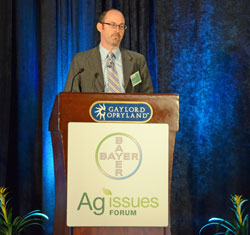
Challenging the ag journalists attending the Bayer CropScience Ag Issues Forum to think about global food security differently was Gawain Kripke, Director of Policy & Research, Oxfam America. He started his presentation by saying that he would bring up some provocative ideas and he did. For example, he says Oxfam wants an end to “excessive” speculation in commodity markets, for investors to move to small scale food producers and says our food system is “broken.” I didn’t hear how this would be accomplished. What’s the incentive for speculators and investors? Part of the theme of his talk was to think beyond yield growth. However, increasing yield has to be part of the solution to world hunger does it not? I do agree with comments made during yesterday’s session about the need to find a way to better distribute food, especially to the poor. Not sure that because we have that problem it means our food system is broken. What do you think? Take our current ZimmPoll on this very question too!

You can listen to Gawain’s here: Gawain Kripke Remarks

2012 Bayer CropScience Ag Issues Forum Photo Album

Agribusiness, Audio, Bayer

Zimfo Bytes

Melissa Sandfort

    Zimfo Bytes

  • Ohio Brownfield Ag News radio network is pleased to announce it has partnerships with 47 radio stations that are carrying Brownfield programming.
  • The Farm Journal Foundation announced its Farmers Feeding the World campaign’s largest single commitment to date, with a $1 million grant to Heifer International.
  • The economic nuts and bolts of paying farmers, ranchers and other landowners for providing environmental services will be examined at a conference April 17-18, 2012, at Resources for the Future, Washington, D.C.
  • Hay producers can now determine the moisture content of the hay they are baling on the go with the Advanced Baler-Mounted Hay Moisture Tester from John Deere.
    Zimfo Bytes