Monsanto’s Major Commitment to NAMA and ABEF

Melissa Sandfort

The National Agri-Marketing Association (NAMA) is pleased to announce that Monsanto has committed $10,000 a year, over the next three years, to both NAMA and ABEF. The company will become a Sustaining Partner with NAMA and will be the primary sponsor of the ABEF Student Competition.

“Monsanto is committed to sustainable agriculture,” said Gary Sakin, Monsanto Marketing Communications Lead. “That means providing solutions for farmers that help them meet consumer demand today, while developing innovative products to meet future demands of our growing planet. Continued agricultural innovation requires strong leadership in agriculture, which is exactly what Monsanto’s commitment to NAMA and ABEF is all about. NAMA events provide professional development opportunities for today’s agribusiness leaders and ABEF is committed to helping prepare the agribusiness leaders of tomorrow.”

Agribusiness, NAMA

John Deere Expands 6 Series Tractor Family

Cindy Zimmerman

John Deere’s expanded family of 6 Series tractors were in the spotlight at the 2012 Farm Progress Show, spanning the spectrum to cover just about any need you have in a tractor.

“We have 6D tractors which is our value spec tractor, we have a 6M which is our mid spec tractor – which replaces our 6030-7030 standard tractors, and then we have a full line of 6R tractors which is our premium spec model in the 6 family,” said Jeff Ostermann, senior marketing rep with John Deere Waterloo Works.

The whole family offers new features including a redesigned cab on the 6D, increased horsepower on the 6M, and new direct drive transmission on the 6R. The new 6D Series include 4 models – 6105D, 6115D, 6130D, and 6140D – ranging from 105 to 140 engine horsepower. The all-new John Deere 6M Series Tractors features six models, including the 6140M is pictured here, from 105 to 170 engine horsepower. And the expanded 6R tractors for the row-crop market includes two mid-horsepower model, 6140R and 6150R.

Listen to my interview with Jeff here: John Deere's Jeff Ostermann

Audio, Farm Progress Show, John Deere, Tractor

Latest Yield Results on Pioneer.com/yield

Melissa Sandfort

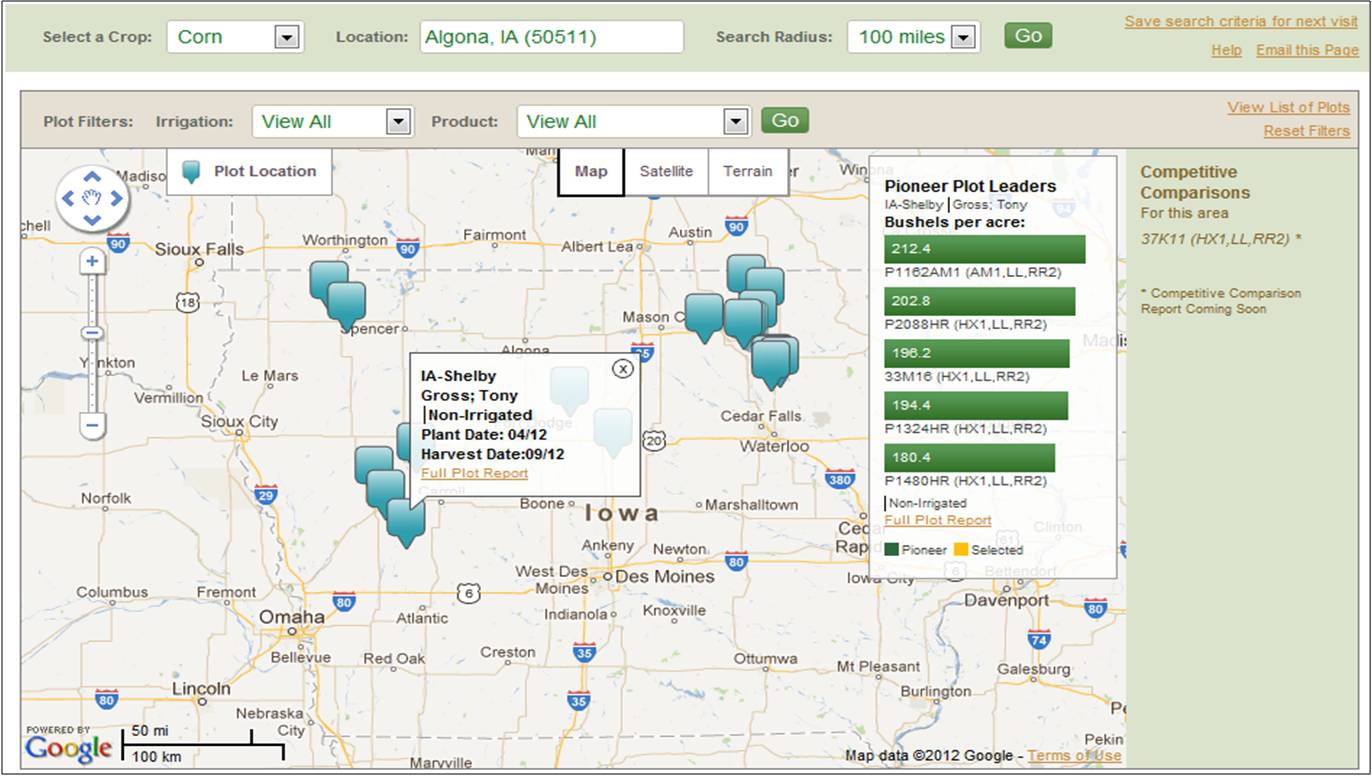
Harvest is progressing at a faster than average pace this year and yield data continues to stream into Pioneer.com/yield. The variability in weather experienced throughout the growing season will impact yields this fall. For a quick snapshot of harvest yields in your area and across the country, visit www.pioneer.com/yield.

The Pioneer yield site provides a brief summary of each plot as well as a detailed individual plot report with competitive comparisons, planting information and harvest data. The process to find local yield results and comparisons is easy. Simply select a crop, zip code and preferred radius to obtain a custom view of harvest yields in your area of interest.

As harvest continues to progress, visit www.pioneer.com/yield to see how Pioneer and other products are performing in your area and across the country.

Agribusiness, Pioneer

BASF to Acquire Becker Underwood

Melissa Sandfort

BASF plans to acquire Becker Underwood for a price of $1.02 billion. The company, headquartered in Ames, Iowa, is one of the leading global providers of technologies for biological seed treatment, seed treatment colors and polymers, as well as products in the areas of biological crop protection, turf and horticulture, animal nutrition and landscape colorants and coatings. Becker Underwood has 10 production sites worldwide and 479 employees. BASF came to an agreement with Norwest Equity Partners (NEP) to acquire Becker Underwood which has been a portfolio company of NEP since 2004. The purchase is subject to approval by the responsible authorities and legal closing of the transaction is expected by the end of 2012.

Becker Underwood is expected to achieve sales of $240 million for fiscal year 2012, ending on September 30. As part of the acquisition, BASF’s Crop Protection division will create a strategic global business unit called Functional Crop Care. The unit will merge BASF’s existing research, development and marketing activities in the areas of seed treatment, biological crop protection, plant health, as well as water and resource management with those of Becker Underwood. Becker Underwood’s animal nutrition business will be integrated into BASF’s Nutrition & Health division.

Agribusiness, BASF

USDA Expands Drought Assistance

Melissa Sandfort

Agriculture Secretary Tom Vilsack announced $11.8 million in additional financial and technical assistance to help crop and livestock producers in 22 states apply conservation practices that reduce the impacts of drought and improve soil health and productivity. The USDA’s Natural Resources Conservation Service (NRCS) provides this assistance through its Wildlife Habitat Incentive Program (WHIP) and Environmental Quality Incentives Program (EQIP).

Since early summer, USDA has announced a variety of assistance to producers impacted by the drought, including opening conservation acres to emergency haying and grazing, lowering the interest rate for emergency loans, and working with crop insurance companies to provide flexibility to farmers. Just a few weeks ago, USDA announced $16 million in financial and technical assistance to immediately help crop and livestock producers in 19 states cope with the adverse impacts of the historic drought. In July, the Secretary announced USDA would allow producers to modify current EQIP contracts to allow for grazing, livestock watering, and other conservation activities to address drought conditions, and also authorized haying and grazing of WRP easement areas in drought-affected areas where haying and grazing is consistent with conservation of wildlife habitat and wetlands. The announcement expands upon these efforts and brings the total assistance to nearly $28 million.

See the additional NRCS drought assistance received by each state here. Learn more about drought categories here.

Producers and landowners are encouraged to visit the NRCS website or stop by their local NRCS office to find out if they are eligible for this new funding.

Agribusiness, USDA

Needle & Haystack

Melissa Sandfort

When I was younger, my mom would send me out to the garage where our deep-freeze was to get meat to thaw for dinner that night. She’d tell me exactly what she wanted, exactly how it was packaged, and almost exactly where it was in the freezer but for some reason, I could never find it. And I think that’s a trait I inherited from my dad. She on the other hand, could locate it blindfolded and half asleep.

My husband is that way with his truck keys, except he always says, “Where did you move them?” or “Where did you put that paper? I had it laying right here.” (Mind you, I didn’t touch either!)

This sounds a little like a story my grandfather tells about an old tire inner-tube.

Listen to Grandpa explain

Maybe you can find a needle in a haystack, if you look a little harder.

Until we walk again …

Uncategorized

Opposition to California Proposition is Growing

Cindy Zimmerman

The National Corn Growers Association is the latest group to join a broad coalition opposing California’s Proposition 37, which would require labeling of some food products sold in that state that contain genetically engineered ingredients.

“All it’s going to do is add to food costs,” said NCGA president Garry Niemeyer of Illinois. “It is a flawed proposition and its exemptions don’t really make sense for those who support the idea of the ‘right to know.'”

An example of exemptions that make no sense – cow’s milk is exempt but soy milk requires a label. Dairy products, eggs, meat and poultry are all exempt. Fruit juice requires a label, but alcohol made with some of the same GE ingredients is exempt. Food sold in a grocery store requires a label, but the same food sold in a restaurant is exempt.

Listen to my interview with Garry here: NCGA president Garry Niemeyer

At least 60 agricultural organizations are part of the campaign urging Californians to vote No on Prop 37, titled the “California Right to Know Genetically Engineered Food Act.” San Joaquin valley diversified farmer Greg Palla says the initiative would effectively ban the sale of tens of thousands of common grocery products only in California, unless they are relabeled or made with more costly ingredients. “We feel that it’s a very deceptive initiative,” he said, noting that the idea of having to label perfectly safe products “just conflicts with good science.”

Palla says Proposition 37 would have a definite impact outside the state of California, since it would apply to so many retail products that made in other locations. “The impact would be swift and clear,” he said, noting that other states might follow California’s example.

Besides state and national agricultural groups, Prop 37 is being opposed by a broad coalition of ethnic and labor organizations, as well as groups representing scientists, doctors, business, and taxpayers in general. Find out more at NoProp37.com.

Listen to my interview with Greg here: California farmer Greg Palla

Audio, Biotech, politics

USDA Changing Report Release Times in 2013

Cindy Zimmerman

USDA is changing the release time of certain key statistical reports beginning in January 2013.

The U.S. Department of Agriculture today announced that the National Agricultural Statistics Service (NASS) and World Agricultural Outlook Board (WAOB) will begin issuing several major USDA statistical reports at 12:00 p.m. EDT beginning in January 2013. The current USDA release time of 8:30 a.m. EDT will remain in effect until January 1, 2013. USDA statistical reports affected are: World Agricultural Supply and Demand Estimates, Acreage, Crop Production, Grain Stocks, Prospective Plantings, and Small Grains Summary. The time for livestock reports currently released at 3:00 p.m. will not change.

Between June 8 and July 9, 2012, USDA sought public comment on the release times for several major statistical reports in response to changes in market hours by major commodity exchanges. Stakeholders submitted 147 comments through the NASS online response site and via letter and e-mail. You can read those comments here.

Markets, USDA

John Deere’s New Breed of Gator

Cindy Zimmerman

John Deere has a brand new species of Gator that is out to chomp the competition when it comes to speed, power and agility.

“It’s the Gator RSX850i, our first recreational utility vehicle,” said Product Line Marketing Manager Kevin Lund, who introduced the new Gator at the 2012 Farm Progress Show . “With 62 horsepower and 53 mile an hour top speed, four-wheel independent multi-link suspension, it delivers the performance that you need and still has the capability that you expect from a John Deere Gator.”

Lund says utility vehicles have been a part of John Deere’s 175 year history for the past 25 years. “John Deere really started the utility vehicle industry in 1987 with the AMT600,” he said. That evolved over the next few years into the Gator by 1993 and has continued to evolve with new models over the years.

Listen to my interview with Kevin from FPS here: John Deere's Kevin Lund

2012 Farm Progress Show Photo Album

Audio, Farm Progress Show, John Deere

It’s an iPhone World

Melissa Sandfort

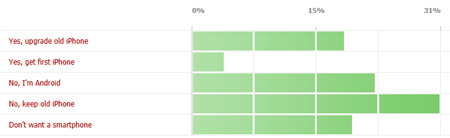
Our latest ZimmPoll asked the question, “Do you plan to buy an iPhone 5?”

Our poll results: 20% said yes, upgrade my old iPhone; 4% said yes, get first iPhone; 24% said no, I’m Android; 32% said no, keep old iPhone; and 21% said they don’t want a smartphone.

Our new ZimmPoll is now live and asks the question, “Have high fuel prices had an impact on your farm/business?” We’ve seen fuel prices go up quite a bit lately so we want to know – is it impacting your daily farm/business? What do you think?

ZimmPoll is sponsored by Rhea+Kaiser, a full-service advertising/public relations agency.

Technology, ZimmPoll