See the PRRS Big Picture, But Don’t Miss Details

John Davis

You’ve heard the expression, can’t see the forest for the trees. Well, when it comes to the PRRS eradication conversation at the Boehringer Ingelheim Vetmedica 4th PRRS ARC&E Seminar at the International PRRS Symposium, you have to make sure you’re seeing the big picture without missing important details.

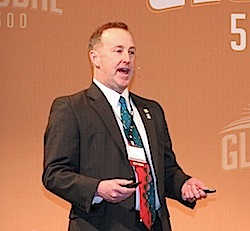
“Important stuff has some different levels – the micro level, the macro level and the meta level. The big picture most applies to the meta level, but the micro and macro levels has more to do with information people need to make decisions,” explained Dr. Dale Polson, who works in a technical resource capacity for BIVI in Des Moines during a break after his talk entitled, “Sufficient Surveillance for ARC&E: Getting the big-picture without missing the important stuff.” He said there are ways to gather information at all three levels without leaving one out. He added the limitations on some information gathering has been the high cost of getting that data, and that’s where they need to find surveillance approaches that are effective and economical.

Polson said there also needs to a common language to promote better collaboration. And he believes a meeting, such as this one sponsored by BIVI, is key. “Venues like this, opportunities like this are absolutely… required to facilitate that type of interaction.”

Listen to Chuck’s interview with Dr. Polson here: Interview with Dr. Dale Polson

2012 BIVI PRRS ARC&E Photo Album

Agribusiness, Audio, Boehringer Ingelheim, Pork

With PRRS, It’s the Last 1 Percent that’s the Problem

John Davis

One of the talks at the Boehringer Ingelheim Vetmedica 4th PRRS ARC&E Seminar at the International PRRS Symposium was dubbed “Unreasonable Expectations,” given by Dr. Eric Neuman, originally from Illinois, but now a veterinary epidemiologist with Massey University in New Zealand. Part of the “unreasonable expectation” in PRRS eradication could be thinking the disease can be solved easily. The problem is, the last lingering cases of the swine diseases seem to keep it going. Neuman calls it an anti-Pareto Effect, referencing the Pareto principle that says taking care of 20 percent of causes, solves 80 percent of the problems, the low-hanging fruit researchers look for. But in disease eradication, especially with PRRS, it’s flipped around.

“We can get rid of 99 percent of the cases, [but] it’s the last 1 percent [that can’t be solved] that make the difference,” Neuman says. In addition, he said there’s plenty of surveillance information about PRRS… maybe to the point of information overload. “We don’t need more information… I just need the right information.”

Neuman added that he likes where the industry is at this moment, but he’s worried there’s not enough diverse thinking contributing to a wider spectrum of answers. He said we know how to take PRRS out of a single farm, but we don’t know how to eliminate it on a larger scale. Neuman hopes that meetings like this one will foster more creative thinking.

Listen to Chuck’s interview with Dr. Neuman here: Interview with Dr. Eric Neuman

2012 BIVI PRRS ARC&E Photo Album

Agribusiness, Audio, Boehringer Ingelheim, Pork

BIVI Focus on Solutions, Not Sales, at Seminar

John Davis

While Boehringer Ingelheim Vetmedica might be one of the key players in swine vaccines, the company’s 4th PRRS ARC&E Seminar was not about selling inoculations.

“The reason [we created this symposium] was [there was] a lot of frustration about how to control PRRS. We didn’t really make the progress we thought we should be making, and we found out we had to take a different approach to things,” explained Dr. Stephen Lange, Head of Global Marketing Swine for BIVI, during the seminar held in conjunction with the International PRRS Symposium. He said meetings like this one helps promote a dialogue between all the key players on how to move forward together. In addition, BIVI offers veterinarians and representatives in the field, as well as a dedicated PRRS solutions team… all to promote communications. “What we want to do is partner with our customers to come up with a holistic approach to disease control.”

Listen to Chuck’s interview with Dr. Lange here: Interview with Dr. Stephen Lange

2012 BIVI PRRS ARC&E Photo Album

Agribusiness, Audio, Boehringer Ingelheim, Pork

Bioportal Could Help with PRRS Decisions

John Davis

Providing field practitioners with a bioportal to help them make better decisions was one topic of conversation at the 4th Boehringer Ingelheim Vetmedica PRRS ARC&E Seminar, an event held in conjunction with the International PRRS Symposium. Chuck caught up with Dr. Jean-Paul Cano, a veterinarian with BIVI and on the company’s PRRS team. His talk, “Application of Disease Bioportal for decision making in a production system,” focused on how to adopt bioportals (mentioned in our previous article) used in other animal agriculture to use for swine, in particular in fighting PRRS.

“We learned about this tool about two-and-a-half years ago, and we approached the guys at the University of California and [asked], ‘Can we use the tool and adapt it to the swine industry which has a very different dynamic than the cattle industry or poultry industry?’ and use that tool to tell practitioners which kind of virus they’ve got,” Cano explained, adding that he expects you could see this kind of bioportal become more widespread. “We think this could become the new standard for vet clinics and production systems for organizing all that information.”

Cano said this is still a work in progress, but it could be ready to go in possibly just a few months. He said this is just another example of BIVI investing in solutions for pork producers.

Listen to Chuck’s interview with Dr. Cano here: Interview with Dr. Jean-Paul Cano

2012 BIVI PRRS ARC&E Photo Album

Agribusiness, Audio, Boehringer Ingelheim, Pork

Bioportal Source of Info on Livestock Diseases

John Davis

Researchers at the University of California-Davis have created a bioportal, a place where information on a variety of diseases from all over the nation and the world can be combined into one place. The idea was of great interest at the Boehringer Ingelheim Vetmedica 4th PRRS ARC&E Seminar at the International PRRS Symposium (and we’ll talk more later how the folks at BIVI want to use it). Dr. Andres Perez, a veterinary epidemiologist at Cal-Davis, told Chuck during an interview that their bioportal helps control diseases by combining information into one place.

“One of the challenges that we have is to identify what is a new introduction of a virus. Then we can make a distinction between outbreaks from circulation of the disease within the farm versus a new introduction,” Perez said. He added this real-time tool is particularly helpful with something like PRRS, and they have been working with BIVI and the PRRS control group to see how the bioportal could be helpful in the eradication of PRRS. “We are developing prototypes right now with the idea to scale it up to include some progressive control programs and later on, statewide and nationwide.”

Perez said that the system is less than 1 percent of production costs… very cost effective when you consider how much an outbreak might cost.

Listen to Chuck’s interview with Dr. Perez here: Interview with Dr. Andres Perez

2012 BIVI PRRS ARC&E Photo Album

Agribusiness, Audio, Boehringer Ingelheim, Pork

Syngenta Shares New Product Lines at NAFB

Jamie Johansen

It was obvious Syngenta was excited to talk about all the new and innovative things they have going on in the soybean and corn labs at the recent National Association of Farm Broadcasting’s annual Trade Talk.

I spoke with Scott Erickson, Soybean Genetics Portfolio Manager for Syngenta. He shared how they are tackling all the things that can rob yields during the growing season and save farmers time and money.

“Well, we work on the seed part of the business which would be NK brand soybean varieties. Our focus is how do we put together the best genetic package that can deliver the most yield potential to todays soybean growers.”

“A lot of soybean farmers know CruiserMaxx Beans from Syngenta. That’s a registered insecticide and fungicide that we sold under the CruiserMaxx label, but now we have also launched a new fungicide focused on root strength called Vibrance. Soybeans from Syngenta this year, if purchased with treatment on them, will all come with CruiserMaxx Beans plus Vibrance. That is a great way to get the seedling off to a great start.”

Listen to my complete interview with Scott here: Scott Erickson - Syngenta

I also sat down with Chuck Lee, who is head of the corn division for Syngenta. He shared his enthusiasm for a great new product that will create drought tolerance in corn fields all season long.

“So, obviously we have lots invested in corn. We have lots of exciting things just this year that are coming out in the corn space. And probably one of the most exciting is our Agrisure Artesian technology. It’s a drought tolerant technology. It provides season long drought protection. It has really been an effective trait. We have more than 1,000 farmer strip trials out this year and in those strip trials they have increased yields up to 15% in moderate and severe drought environments.”

Listen to my complete interview with Chuck here: Chuck Lee - Syngenta

2012 NAFB Convention Photo Album

Agribusiness, Audio, BASF, Corn, Farming, NAFB, Seed, Soybean, Syngenta, Technology

BASF Scientist is a Role Model for Girls

Cindy Zimmerman

Dr. Jennifer Holland was hired by BASF Crop Protection right after graduating with a PhD in Plant Molecular Biology from the University of Missouri and she is a perfect role model for young women to consider a career in science.

“I had some fantastic opportunities when I was a youngster to develop my curiosity in science,” Jennifer said – including space camp and an all-girl science camp at Purdue University.

Jennifer grew up in the suburbs of Indianapolis, not on a farm, but she really became interested in agriculture after doing some research at the University of Wisconsin. “I wanted to get closer to the grower and that’s why I went to work for BASF,” she said, noting that she sees the company as a leader in helping to feed the world. “I’m a big believer in the more you know the better equipped you are to solve big problems and I think that’s really where science comes in to play in helping generate more food production for a growing population.”

We talked with Dr. Holland at NAFB Trade Talk about research she has been doing at BASF into how plant health fungicides can increase photosynthesis. Jennifer says they “see plant health and the ability to buffer against environmental stresses and to maximize photosynthesis as one piece of that puzzle” for growers to get better yields.

Learn more about Dr. Jennifer Holland in this interview: BASF Technical Market Specialist Jennifer Holland

Audio, BASF

New GROWMARK Dry Terminal in Iowa

Cindy Zimmerman

The first loads of fertilizer came in this week to test the new GROWMARK dry terminal in Stuart, Iowa but earlier this month I joined some of my fellow ag reporters in climbing to the top of the 15,500 ton facility. Notice it was all females – left to right, Rita Maloney of Illinois RFD Radio; Deanna Thomas of WMBD in Peoria; and Carrie Muehling of WJBC in Bloomington – with me. The guys on the trip declined to make the climb.

The facility will handle granular urea, monoammonium phosphate and white potash. It has capacity for 18 railcars with six 10 ton hoppers, five micro hoppers and a blending capacity of 300 tons per hour.

In the video below, GROWMARK Plant Food Operations Manager Brian Hundman provides a behind-the-scenes look at the new facility in its nearly complete stage. You can also check out photos from the media tour last week in the photo album and hear more about it in this month’s Precision Pays podcast, sponsored by Ag Leader Technology.

GROWMARK Iowa Media Tour Photos

Fertilizer, FS System, GROWMARK, Video

MediaPlanet USA Insert in USA Today

Chuck Zimmerman

There is a very nicely done insert in today’s issue of USA Today. I got mine in Kansas City, MO this morning on my way back to ZimmComm World Headquarters. It is put together by MediaPlanet USA. Here’s what they say about it on their Facebook page.

Rise and shine and enjoy our Agriculture in America publication over breakfast this morning! The publication lands on USA Today newsstands starting today in San Francisco, Washington D.C., Chicago, Denver, Dallas, Kansas City, and Minneapolis and we are thrilled to share this day with all of our partners. Many thanks to the U.S. Farmers & Ranchers Alliance, Case IH, Bayer CropScience, National FFA Organization, AgCareers.com, I Love Farmers They Feed My Soul, AgLocal, Meyer Hatchery, Stihl and many others for your partnership, support, and passionate contribution through this campaign!

If you don’t have the paper or can’t get it then download the insert here. You’ll find a number of articles, ads and lots of photos. What do you think about this effort?

Ag Groups, Agribusiness, Media

LPC Professional Development Stipend App Deadline

Chuck Zimmerman

lpc-logo-smallIf you’re a member of the Livestock Publications Council and could use some help with expenses for professional development then now is the time to apply (deadline is Dec. 15) for the LPC Professional Development Stipend Program (pdf). Here are the details:

LPC will offer up to 3 stipends of up to $1,000 each to LPC members to help cover expenses to a professional development class, seminar or workshop, which includes Ag Media Summit or IFAJ congress. The LPC board of directors believes that expanding knowledge and excitement in one’s profession will keep dedication and commitment to that job.

Stipend criteria:

– Open to any LPC member.
– Fill out application.
– Submit the information on the conference you wish to attend.
– Provide an estimated budget for your expenses to the event.
– In 250-350 words describe why you should receive this stipend, your professional goals and how you will use this award for
professional development.
– Write a short piece for the LPC Actiongram after you have attended the professional development event, telling how you
used the stipend and how it will help you become a better ag communications professional.
– The stipend funds should be used within a year of when it is awarded. If it is not used because of an emergency, please
contact the LPC executive director.
The application must be postmarked or received electronically by December 15, 2012. Stipend recipients will be contacted by January 10, 2013.

The stipend recipients will be selected by a group of three judges.

Send application to: Jennifer Carrico 24338 G Avenue Redfield, IA 50233 515-833-2120 jcarrico@hpj.com

LPC, Media