2014 Cooperative Communicators Winners Showcase

Chuck Zimmerman

Cooperative Communicators AssociationWant to see who the winners are in this year’s Cooperative Communicators Association Communications Contest? Here’s where you can see the best writing, publication, photography and more.

Welcome to the 2014 Winners Showcase

This showcase features all of the winning entries in this year’s CCA Communications Contest. Here you’ll find the best of the best of cooperative communications, from writing and photography to publications, programs, and projects. Below are links to PDFs of the lists of winners in each division. These lists are available to members and nonmembers alike.

Writing Winners
Publication Winners
Photography Winners
Programs and Projects

Ag Groups, Media

Farm Bill Toolbox

Chuck Zimmerman

farmdoc Farm Bill ToolboxHere’s a Toolbox farmers might want to add to their arsenal. It’s the University of Illinois farmdoc Farm Bill Toolbox. You’ll find articles, videos and FSA documentation.

This website provides educational outreach on 2014 Farm Bill related decisions and tools which are currently under development.

Previously, articles on farmdoc Daily have provided details regarding the efforts to inform readers about the 2014 Farm Bill, particularly with regard to farm program decisions that will have to be made (those articles are available here and here). As the next step in that project, today we introduce the Farm Bill Toolbox as the one-stop resource for farm program decisions, information and analysis, as well as providing further information regarding the ongoing efforts for the Farm Bill.

On July 1, 2014, the University of Illinois as the lead university for the National Coalition for Producer Education (NCPE) entered into a cooperative agreement with the Farm Service Agency for development of web-based decision tools to help producers and farm owners with the decisions and programs in the Farm Bill. This effort will involve the development of three different tools by the Illinois-led NCPE, as well as training, education, outreach and analysis on the tools and programs: (1) a tool for the ARC/PLC program decision, including base acre reallocation, payment yield updating and SCO/STAX; (2) a tool for the new dairy Margin Protection Program and Livestock Gross Margin-Dairy insurance policy; and (3) a tool for the new Noninsured Crop Disaster Assistance Program (NAP) provisions regarding buy-up coverage.

Education, Farm Bill, University

Well Cow – Bluetooth Connection to Your Cows

Chuck Zimmerman

Well CowWe’re hearing a lot about health applications of mobile and wearable technology lately. The anticipated iWatch from Apple is expected to open some new doors into that technology. But that’s for humans. What about cows? Well a Scottish company is introducing a bluetooth way to monitor cow and herd health – The Well CowTM Bolus.

Monitor the health of your herd remotely

The Well Cow bolus wirelessly monitors rumen pH and temperature, allowing optimisation of nutrition management for cows to improve their health and welfare. Farmers can use the data to optimise the diets for their cattle and consequently improve production efficiency and ultimately the profitability of their business.

Well CowTM has now also demonstrated the world’s first automated continuous long term measurement of rumen pH in dairy herds using its unique wireless telemetry bolus system. This enables the dietary health of herds to be monitored and early indications of problems which will adversely affect milk yields to be identified.

In the future Well CowTM technology will have the potential to also deliver the automated detection and measurement of other health and disease markers. This technology together with the latest developments in Wide Area Network communications will provide farmers with immediate alerts on the status of their herds on PC’s and mobile devices.


Thanks to CNET for the heads up.

Agribusiness, Dairy, Technology

McCarthy’s Comments on WOTUS in Missouri

Jamie Johansen

photo-1Environmental Protection Agency Administrator Gina McCarthy addressed the Agricultural Business Council of Kansas City yesterday. Her goal was to defend and explain the Administration’s proposed rules defining Waters of the United States (WOTUS) under the Clean Water Act (CWA).

In a media call on Wednesday before her trip concerns were expressed from those in attendance. During her speech yesterday, she addressed a few of them.

“Yesterday, we heard very clearly some of the concerns about our proposed rule. Let me clear up some of that: We heard fears that EPA is regulating groundwater. This is not true; groundwater regulations do and will fall under the purview of the states. EPA is not regulating all activities in floodplains, or every puddle, dry wash, and erosional feature. In fact, we’re doing just the opposite. If cattle cross a wet field – let them. That’s a normal farming practice, and all normal farming practices are still exempt. The bottom line is – if you didn’t need a permit before this proposed rule, you won’t need one when it’s finalized.”

McCarthy said their goal is for the practices to be reasonable and consistently applied. She added that everyone playing by the same rules allows farmers and ranchers to work with confidence and certainty.

“So let’s talk about the interpretive rule and the 56 conservation practices that are good for production and good for water quality. That rule seems to have generated lots of confusion. So, why did we want to list out those 56 practices? Those 56 are an attempt to clear the path for slam dunk conservation practices. We did not narrow exemptions; those 56 are a subset to the existing exemptions for normal farming, ranching, and silviculture. No one should have to think twice about taking advantage of these conservation practices.”

“Some mistakenly think that this means additional federal standards with which to comply, but that’s wrong. Conservation practice standards are not federal regulatory standards. They just provide a roadmap for producers to make sure they’re squeezing all they can out of their practice.”

“New exemptions are ‘self-implementing,’ which means no one needs to notify or get approval from EPA or the Corps. There’s no need to double check with anyone at any time. I’m sure farmers agree that the best discussion on jurisdictional determinations is one that never needs to happen. We added 56 exemptions because we want to boost conservation without boosting bureaucracy. Is the interpretive rule the best way to do that? Let’s figure that out together. I am about outcomes, not process.”

You can listen to her complete comments here: Administrator McCarthy’s Comments on WOTUS

Ag Groups, Conservation, Environment, Water

Zimfo Bytes

Talia Goes

Zimfo Bytes

Zimfo Bytes

AG UAVs in the Air

Chuck Zimmerman

Precision Aerial Ag ShowYou especially like to have good weather when you’re holding an air show! In this case it’s the Precision Aerial Ag Show taking place at the Farm Progress Show site in Illinois. Check out the flight schedule that’s going on.

I was really hoping to have a chance to attend this event. It has “AgNerd” written all over it. But the next best thing to being there is getting to chat with someone and being able to share a couple of photos.

Precision Aerial Ag ShowI talked with one of the coordinators for the event, Stu Ellis, AgEngage. The show is presented by Penton Farm Progress.

The show features a UAV technology showcase where manufacturers and suppliers of UAVs and related equipment for agricultural application will demonstrate their products throughout the show. There are also educational activities in addition to the demos.

I learned from Stu that there are more than 1,000 companies worldwide who are involved in UAVs for agriculture. he invited many of them to the show. He says that the U.S. is way behind Japan and countries in Europe in the use of this technology. Surprisingly there are attendees from several countries outside the U.S. As you might guess he says attendees are most interested in using UAVs for crop scouting since it can save so much time.

Listen to my interview with Stu Ellis here: Interview with Stu Ellis

Maybe I can go next year. BTW. Thank you to Hugh Whaley for the use of his phone for both photos and my interview with Stu!

Agribusiness, Audio, Media, Precision Agriculture

Do You Know How the EPA Water Rule Will Impact You?

Jamie Johansen

New Holland ZimmPollOur latest ZimmPoll asked the question, “What will be on your Independence Day grill?”

It looks like most people stuck with the traditional 4th of July grillers. Hamburgers and hot dogs topped the list and I can’t say I am surprised. Maybe everyone was saving their creative genius for the fireworks display.

Our poll results:

  • steak – 14%
  • hamburgers – 25%
  • hot dogs – 18%
  • pork chops – 14%
  • chicken – 4%
  • fish – 0%
  • shrimp – 4%
  • lamb chops – 0%
  • venison – 0%
  • multiple meats – 11%
  • other – 10%

Our new ZimmPoll is now live and asks the question, “How would the EPA water rule impact you?”

One of the hottest topics in the ag sector these days has to do with water rights. The EPA says that under the proposed rules defining Waters of the United States (WOTUS) under the Clean Water Act (CWA) “all normal farming practices are exempt – period” but those in the agriculture community are questioning if that will hold true. Have you looked in to how this water rule would impact your operation?

ZimmPoll

USFRA Seeking New Faces

Chuck Zimmerman

USFRAThe U.S. Farmers and Ranchers Alliance is seeking the newest crop of farmers and ranchers for its Faces of Farming & Ranching program.

“We’re very proud of the improvements our farmers and ranchers are bringing to America’s food supply and we think it’s imperative that they have a strong voice in addressing consumer questions,” said Randy Krotz, chief executive officer at USFRA. “The success we experienced with last year’s ambassadors shows us that people want to hear directly from those who are cultivating our food.”

Farmers and ranchers who grow and raise an assortment of foods through various methods, on differing scale and across all regions of the country are encouraged to apply, as it is important to show American agriculture and all of its diversity.

To apply for the Faces of Farming & Ranching program, farmers and ranchers must fill out an application form, available at www.FoodDialogues.com/Faces, and include a home video of less than three minutes describing themselves and their farm or ranch. Among other criteria, farmers and ranchers must have an existing social media presence, either through Facebook, Twitter and/or a blog. Information on the application process can be found at www.FoodDialogues.com/Faces. Entries will be accepted through August 10, 2014 at 11:59:59 PM CT.

A combination of public votes and USFRA judges’ scores will determine the winners, who will be announced on November 12 at the National Association of Farm Broadcasting Convention (NAFB) in Kansas City.

The public will get to know the USFRA Faces of Farming & Ranching winners through national media interviews, advertising and public appearances. For their time, they will receive a $15,000 stipend.

Ag Groups, USFRA

O Beautiful for spacious skies …

Melissa Sandfort

IMG95201407049514231395681For amber waves of grain …

This week Aunt Jeanette writes:
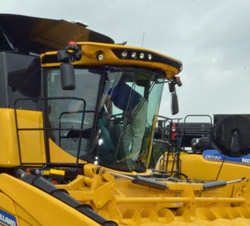
The Fourth of July has come and gone, but I couldn’t resist sharing this picture with you and thinking about this song. Dan is harvesting wheat and took this photo through the windshield of his combine. He shared it with me and now I am sharing it with you.

The wheat fields are gorgeous this summer! Wheat harvest is progressing at an enjoyable rate here in south central Nebraska. We haven’t had a wheat harvest like this for many years. Rains came at just the right time this spring. Life is good!

My job (one of many!) is to run our family-owned elevator during harvest. It gives me a break from my normal yard work, mowing, watering flowers, and all those other things I like to do outside. However, I still have to do those things – it just involves a little time rescheduling. Working at the elevator is a welcome change of pace – especially when the wheat is as good as it is this year. I also like becoming reacquainted with our customers at the elevator. They are wonderful people and willing to help me out whenever I need their assistance.

Despite the “RealFeel” temperature of 108 degrees yesterday, I thoroughly enjoyed my day of wheat harvest. Can you tell I am a true “farm girl?”

Until we walk again …

Uncategorized

Vetter Confirmed Speaker at USGC Annual Meeting

Jamie Johansen

US_GrainsCouncil_logoInternational trade policy, and current developments in agricultural trade with China, will be in the spotlight as recently appointed chief agricultural negotiator for the U.S. Trade Representative’s Office, Darci Vetter, addresses the U.S. Grains Council’s 54th Annual Board of Delegates Meeting in Omaha, Nebraska, July 28-30, 2014.

Helping implement the North American Free Trade Agreement, resolving agricultural trade issues with Canada and Mexico, and participating in the World Trade Organization Doha Round negotiations are among the highlights of Vetter’s distinguished career at senior levels of U.S. trade policy. With trade policy service in both the Clinton and Obama administrations and in the U.S. Senate as a senior staffer for the Senate Finance Committee, she has been a consistent advocate for expanding U.S. agricultural exports. Currently USDA deputy under secretary for farm and foreign agricultural services, Vetter was nominated last December for chief agricultural negotiator for the Office of the U.S. Trade Representative. Vetter’s nomination was approved by the Senate Finance Committee in May and is now awaiting approval from the full Senate.

In Omaha, Vetter’s insights will be followed by an expert discussion about the recent disruptions in U.S. distiller’s dried grains with solubles (DDGS) exports to China. She will underscore that these types of developments have happened before, and that continued engagement with China is necessary.

“Darci’s insights into this emerging powerhouse’s trade policy will leave attendees with an in-depth understanding of the issue at hand,” said USGC Chairman Julius Schaaf.

“After 30 years of at or near double digit economic growth, China’s capacity to continue increasing domestic corn and feed grain production is believed to be below projected consumption growth,” Schaaf said. “This means that trade disruptions, while costly to U.S. producers and exporters, are more costly to end-users in China and, ultimately, most costly to consumers in China.”

Register for the Council’s summer annual meeting to learn more about this fast-moving situation impacting trade.

Ag Groups, Grains, Trade, USGC