New Holland Refined DuraVee Hay Rakes

Joanna Schroeder

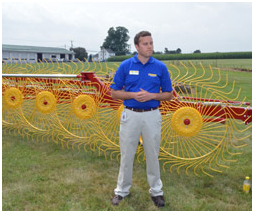
new-holland-hayrakeNew Holland has made some great refinements for its 2015 version of the DuraVee Trailing Wheel Rakes . The equipment offers easy adjustments, strengthened components and durability.  To learn more about DuraVee Trailing hay rakes, Chuck Zimmerman attended a media event just before the Farm Progress Show where he was given a preview of the improved features from Mike Sevick.

Some key features include:

  • Tailorability – A grower has various options to be best his needs.
  • Supportability – Numerous support options can be tailored to fit needs. For example, rear walking tandem axles can be equipped on 12 wheel and larger rakes to significantly improve floatation and trailing ability.
  • Selectability – All DuraVee raking wheels come with 55″ raking wheels but can be selected for use with 60 inch rake wheels. The rakes also come with optional center raking wheels.

Sevick said the DuraVee is for professional hay makers and features seven different models with raking widths from 17’5″ to 36’to fit any grower’s need. Learn more by watching this quick ProCart video featuring Sevick.


View the Farm Progress 2014 Flicker photo album.

Coverage of the 2014 Farm Progress Show is sponsored by

Coverage of the 2014 Farm Progress Show is sponsored by New HollandCoverage of the 2014 Farm Progress Show is sponsored by FMCCoverage of the 2014 Farm Progress Show is sponsored by GrowmarkCoverage of the 2014 Farm Progress Show is sponsored by AgLeader
Agribusiness, Equipment, Farm Progress Show, Hay, New Holland

On Track with Bayer CropScience Biologics

Cindy Zimmerman

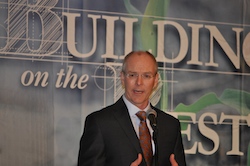
bayer-biologics-preopenThe California Railroad Museum was the venue for Bayer CropScience to gather with friends and dignitaries in the warm up show for the grand opening of the new Biologics and Vegetable Seeds Research & Development Center in West Sacramento, California.

Liam Condon, CEO of Bayer CropScience and Chairman of the Board of Management of Bayer CropScience AG, made a connection between the California railroad and the company. “The railroad here started in 1862…and in 1863 Bayer was founded,” he said. “We’re proud about our heritage and very excited about our future.”

The future in biologics for Bayer will head down the tracks today with the official opening of the new R&D center, which Condon says will be the global headquarters of this important segment of their business. “We’ve got a fantastic group of people who are just so excited about developing new innovations to tackle some of the huge challenges we’re facing in agriculture,” he said.

Also speaking at the opening reception Tuesday night were James Blome, President & CEO for Bayer CropScience LP (North America), and Sacramento site leader Mike Millie. Stay tuned for interviews from all the players here in Sacramento and find out more about what this new center means to them and to the future of agricultural production.

Bayer CropScience Biologics Center Opening reception remarks
Bayer CropScience Biologics Center Photo Album

Agribusiness, Audio, Bayer, Crop Protection, Seed, specialty crops, Vegetables

A Look at New Holland’s Discbine

Joanna Schroeder

Jordan Milewski New HollandNew Holland gave media a sneak peak of their new products during a media day prior to the Farm Progress Show held in Boone, Iowa. One of the technologies the attendees were able to see was the Discbine and they learned about the new features from Jordan Milewski, brand marketing managing, Crop Preparation.

In the video below, you’ll learn about some of the features including:

  • Ability to turn a standing crop into fast-drying windows of swatch with Discbine disc mower-conditioners.
  • Option for roll or flail conditioning featuring easy roll adjustments, tapered flails and adjustable conditioning hood.
  • The Discbine line ranges from seven-disc models that cut a nine-foot swatch up to 12-disc models that sweep through more than 15 feet at a time.

“One of the changes for 2015 is we now have the option of what’s called the quick max knife system,” explained Milewski. “Quick Max allows an operator to easily and quickly change his knifes. With the tool you take blade changes from minutes to seconds.”

Check out how it works….

View the Farm Progress 2014 Flicker photo album.

Coverage of the 2014 Farm Progress Show is sponsored by

Coverage of the 2014 Farm Progress Show is sponsored by New HollandCoverage of the 2014 Farm Progress Show is sponsored by FMCCoverage of the 2014 Farm Progress Show is sponsored by GrowmarkCoverage of the 2014 Farm Progress Show is sponsored by AgLeader



Agribusiness, Equipment, Farm Progress Show, New Holland, Video

Chris Novak Named NCGA CEO

Joanna Schroeder

The National Corn Growers Association (NCGA) has announced the appointment of Chris Novak as CEO of the association. He will be replacing Rick Tolman, who announced earlier this year he will be retiring after 14 years in the helm. Novak is currently the CEO of the National Pork Board (NPB) and will begin his tenure at NCGA on October 13, 2014.

novak_chris“We’re thrilled to have Chris join us at NCGA,” said NCGA President Martin Barbre, a corn grower from Illinois. “He has all the right qualifications to take the reins of this growing organization and keep it moving in the right direction, continuing the tradition of success we saw under Rick Tolman.”

Prior Novak’s time at NPB, from 2004 to 2008, he was executive director of the Indiana Corn Marketing Council, the Indiana Corn Growers Association and the Indiana Soybean Alliance. Novak also has served in positions at Syngenta and the American Soybean Association, and worked on Capitol Hill.

“We’re grateful to Chris for his leadership these past several years,” said Dale Norton, National Pork Board president. “With Chris’ guidance, our Pork Checkoff team built stronger relationships with pork producers across the country, with our state pork associations and with our partners in the food chain. Chris brought a spirit of collaboration that served our organization and our industry well.”

Novak added, “I am very excited about this opportunity to work with a terrific team of grower leaders, state affiliates and the NCGA staff. With a record corn crop predicted for this year, corn farmers must work together to build new markets that keep up with our increasing productivity. I’m looking forward to working with the team to meet this challenge.”

Agribusiness, Corn, NCGA

Mitas Launches “Farmers Can” To Celebrate Farmer Ingenuity

Jamie Johansen

Screen Shot 2014-09-02 at 10.47.14 AMWith a manufacturing facility in Charles City, Iowa, Mitas understands that today’s farmers are in a constant battle to get the most out of their farms. Farmers Can is a place where farmers share ideas with other farmers.

“Mitas believes in supporting the community that supports us. Our goal for Farmers Can is to enable farmers to share their ideas with one another and encourage innovation,” said Jeff Miller, Marketing Communications Manager at Mitas North America.

Farmers Can officially kickoffed at the Farm Progress Show in Boone, Iowa. If you missed them there check them out on Twitter, Facebook and Pinterest.

Agribusiness, Farm Progress Show, Social Media

Cultivating Is the Key to Connecting Food to the Fork

Jamie Johansen

Screen Shot 2014-09-02 at 9.22.40 AMThe AgChat Foundation’s 2014 Cultivate & Connect conference was held in Austin, TX, August 21 and 22. In attendance were over 140 farmers, ranchers, and ag communications professionals who hail from the U.S., Canada, and Australia. The resounding theme of the event was to learn more about how digital and social media can assist with cultivating open-minded conversation with consumers while connecting them to agriculture’s story.

Topics such as building digital communities, creating farmer engagement, and cultivating relationships beyond the choir were all part of the expansive offering which included 17 break out sessions. Key panels, which included “What Chefs & Moms Really Say About the Food You Are Growing” and “5 Questions Every Farmer and Rancher Needs to Learn to Answer”, provided unique insight about developing conversation with those who are disconnected from their food.

Keynote presentations were provided by conference catalyst, Thom Singer, who emphasized the need for human connection, as well as breakfast keynote Katie Uhlaender, Olympic skeleton racer and rancher who shared her story as a city girl turned Olympian turned rancher. The final keynote, Bruce Vincent, logger and motivational speaker, closed the conference by setting attendees off with dynamite enthusiasm.

The conference also included an evening banquet, beginning with the presentation of the 2014 Social Media Farmer of the Year Award, awarded to farmer and blogger Carrie Mess, followed by the annual Ag Swap and private concert from country music recording artist, Jason Eady.

When asked about her experience farmer, ag professional and blogger Taysha Reitzel replied, “My biggest takeaway from the conference was getting to hear so many different perspectives from the industry. Sometimes we get so used to justifying our own thoughts, it’s refreshing to hear other points of view that make us think and go into a conversation with open ears and an open mind. A definite highlight would be the networking opportunity. With so many industry people in one place, the opportunity to connect is huge. And, of course, the Jason Eady concert, because he is amazing!!”

Ag Groups, Social Media, Social Networking

Biologics R & D at Bayer Crop Science

Jamie Johansen

14862831029_fa8867ebf1_bBiologics are based on materials found in nature. At the Bayer Crop Science booth during the Farm Progress Show I spoke with Head of Biologic Research for Bayer CropScience, Dr. Jonathan Margolis, who is based out of their new facilities in Sacramento, CA. There he works with live microbes like bacteria, fungi and plant extracts.

“The difference between those and conventional chemical products is they typically have multiple modes of action and they don’t have regulated residue allowing them to be applied up until harvest.”

“The biologics are doing two things. They are acting as crop protectant agents. They are suppressing disease or killing pests. But in addition they act on the plant so they can stimulate yield or stress resistance. In the case of seed growth the microbe colonizes the roots and gives season long protection.”

Dr. Margolis said historically biologics were only used in horticulture because of concerns of residue and safety. Now the row crop industry recognizes all these other benefits which are complimentary to chemical products.

The development of biologics at Bayer stems from the acquisition of AgriQuest and put them in a new world-class facility where they are able to meet the safety standards and gives room for all the new hires they are making with this addition. In my interview with Dr. Margolis he goes on the share what products they have in the research and development stages and what we can see coming down the pipeline in 2015.

Here is my complete interview with Dr. Margolis:Interview with Dr. Jonathan Margolis, Bayer CropScience Biologics

Cindy is on her way to Sacramento to cover the grand opening and ribbon cutting of the new facility on Wednesday, so stay tuned to learn more about Bayer biologics!

2014 Farm Progress Show Photo Album

Coverage of the 2014 Farm Progress Show is sponsored by

Coverage of the 2014 Farm Progress Show is sponsored by New HollandCoverage of the 2014 Farm Progress Show is sponsored by FMCCoverage of the 2014 Farm Progress Show is sponsored by GrowmarkCoverage of the 2014 Farm Progress Show is sponsored by AgLeader


Agribusiness, Agronomy, Audio, Bayer, Biotech, Farm Progress Show

Meet the New CEO of GROWMARK

Leah Guffey

_DSC0248As of September 15, GROWMARK will have a new chief executive officer.

Jim Spradlin was named CEO of GROWMARK to replace Jeff Solberg who is retiring. Spradlin has a degree in business administration and economics from Illinois College and has held various positions within the GROWMARK System of cooperatives, including controller of Schuyler-Brown FS, regional administrative director, general manager of Piatt Service Company, general manager of Ag-Land FS, energy division manager, agronomy division manager, and vice president of agronomy for GROWMARK.

Last week, Spradlin addressed the GROWMARK annual meeting in Chicago and I had a chance to chat with him following his remarks to discuss his feelings about taking the helm of the cooperative where he has worked for the last 32 years. You can listen to my interview with Jim here: Interview with Jim Spradlin, CEO-elect GROWMARK

2014 GROWMARK Annual Shareholder’s Meeting Photo Album

Audio, Cooperatives, GROWMARK

FAPRI: Good News and Bad News for Livestock, Grain Producers

John Davis

FAPRI logoLivestock prices are up, but grain prices are down… that’s the good news, bad news for farmers this year. The latest report from the Food and Agricultural Policy Research Institute (FAPRI) at the University of Missouri says that while livestock producers are enjoying a complete reversal of fortune of not very long ago as prices for cattle, hogs and milk are at record highs this year, grain farmers (in many cases, one in the same as livestock producers) are seeing prices for their products drop.

FAPRI says strong demand and easing feed prices are helping livestock producers, while at the same time, grain farmers and biodiesel and ethanol producers are being hurt by the government’s lack of a final decision on the U.S. Environmental Protection Agency (EPA) proposal to cut the amount of ethanol and biodiesel to be blended into the nation’s fuel supply:

· The potential for record corn and soybean crops has weighed on prices for grains and oilseeds. Corn and soybean prices for the crops harvested this fall could be the lowest since 2009.

· Corn prices fall to $3.89 per bushel for the 2014 crop. Even with a projected decline in 2015 U.S. corn production, prices remain around $4 per bushel in 2015 and beyond.

· Large U.S. and global supplies cause soybean prices to decline to $10.30 per bushel for the 2014 crop and below $10 per bushel for the crop harvested in 2015.

· Cotton prices have also declined sharply, partly in response to large Chinese and global cotton stocks. Farm prices for cotton drop to 65 cents per pound this year, and remain near that level.

· Ethanol production prospects depend, in part, on EPA decisions about how to implement the Renewable Fuel Standard (RFS). With lower prices, ethanol exports continue to increase in 2015.

· Reduced cattle numbers, animal disease problems and strong international demand are among the factors causing record cattle, hog and milk prices in 2014. Supply response to these high output prices and lower feed costs contribute to lower meat and dairy prices in 2015.

At the retail level, consumers did pay more for their groceries, fueled a large part by higher meat prices. But FAPRI analysts expect that inflationary rate to drop below 2 percent again in 2015.

Agribusiness, Biodiesel, Dairy, Ethanol, Livestock

Learning More about BASF Limus

Cindy Zimmerman

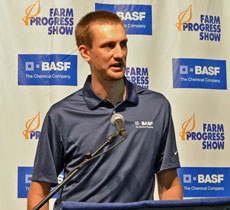
fps14-basf-nickDuring the Farm Progress Show last week, BASF Crop Protection Product Manager for Diversified Herbicides and Nutrient Management Nick Fassler was on hand to talk about the company’s new Limus urease inhibitor.

“BASF’s been talking about Functional Crop Care for the last several years and nutrient management was one core pillar in that group of new innovations we were going to bring to the marketplace and Limus is our first entry for the U.S. market,” said Fassler. “It helps growers really tailor and adjust their nutrient management system and utilize urea containing fertilizers and Limus will provide protection from volatilization.”

Find out more about Limus here: Interview with Nick Fassler, BASF

2014 Farm Progress Show photo album

Audio, BASF, Crop Protection, Farm Progress Show